
I experienced the chaos caused by EU's new border checks, here's the brutal truth of what awaits summer holidaygoers
Narrative Analysis: Appeal to Fear
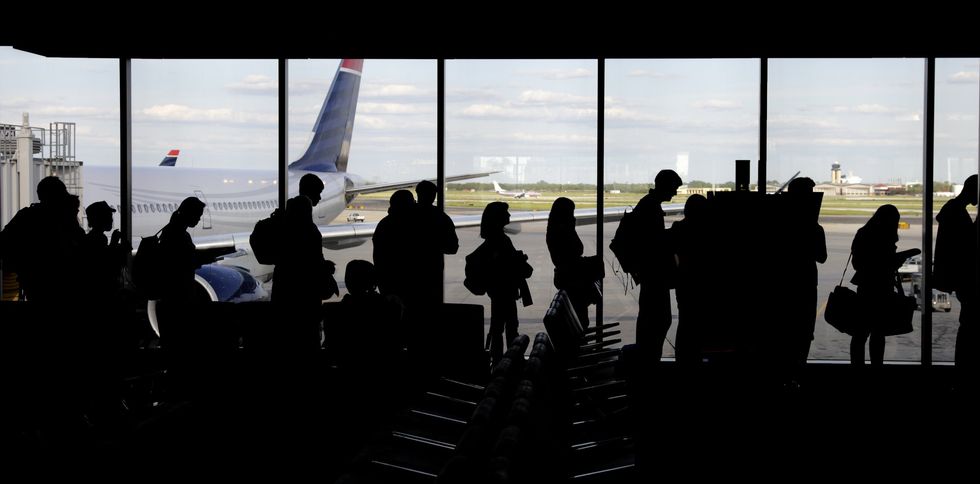
Landing in Paris, you'd expect striking staff to be the most likely culprit of airport chaos, but thanks to the roll-out of the European Union’s new Entry-Exit System (EES), there's a new headache for travellers navigating Paris-Charles de Gaulle airport.I was unfortunate enough to experience the flimsy facial scanners, glacial queues, and flustered staff first-hand during a trip to Paris this week. It's known as the City of Love, but I loathed every minute spent stranded in the sort of lines you'd expect to see for Space Mountain at Disneyland Paris inside the packed Charles de Gaulle terminal. Worst of all? You'll likely experience some version of the same tortured border process on your summer holiday.For those who missed the announcement, EES is a replacement for old-fashioned stamps from passport officials, with your entry and exit electronically recorded using biometric data, such as fingerprints and facial scans. The system, which was soft-launched in October of last year before rolling out more broadly on April 10, applies to visitors from countries outside the EU — including travellers from the United Kingdom, Commonwealth countries, and the United States — entering Europe for short stays. On paper, it sounds like a good idea — improving border security, reducing identity fraud, and helping authorities automatically keep tabs on how long visitors remain in the Schengen zone. When the system was announced, we were specifically promised a faster, more efficient, and more secure system for travellers. Standing in the queue at Paris-Charles de Gaulle airport for over an hour, trust me, it's anything but.I was lulled into a false sense of security by a textbook security check. Despite the airport bustling with activity from those travelling during half-term, I managed to sail through security in under 10 minutes.But then I was met with the queue for EES. And everything came to a standstill.At first, there was no announcement from Parisian officials to explain what was behind the hold-up. Passengers fidgeted with their boarding passes, using them as makeshift fans in the stifling heat because there was no air conditioning. Children sat on the floor as the queue remained unmoving.I was visiting Paris for work, and a colleague on the same trip, who had left for the airport more than an hour before me, sent a text to say that all the border patrol machines to process EES were experiencing a mass outage. She was still stuck somewhere in the middle of the queue ahead of me.If time flies when you're having fun, it crawls when you're standing in a queue at Paris-Charles de Gaulle airport. Eventually, intercom announcements confirmed that the EES machines were offline and that staff were working to move travellers through to their gates.Weary fliers stood around for so long, and temperatures in the terminal remained so high, staff were forced to start handing out bottles of water. When the queue eventually started to move, it did so at a glacial pace.Passengers ahead of me were becoming increasingly restless as departure times quickly approached. One man, due to board a flight to Bristol, realised his gate was about to close. After finally flagging down a staff member, he was pulled out of the line so he wouldn’t miss his flight.The staff appeared flustered as they tried to manage the growing chaos, but the process felt anything but organised. After about 30 minutes, they began ushering new arrivals to the interminable queue to the front of the line to use a handful of machines that had been brought back online.Meanwhile, those of us who had already been waiting much longer were told to stay put. About 20 minutes later, staff started randomly pulling people from the middle of the queue to form a separate line for the working machines, checking passports at random. I was one of the lucky ones. With a healthy dose of survivors' guilt, I left my fellow travellers behind in the queue and used one of the machines that French workers had managed to resurrect. In total, I waited an hour to get through what was supposed to be a short, seamless process. But that was nothing compared to some fliers, who had been waiting far longer.That became clear when I finally spotted that same colleague who had sent me the text 60-minutes before I'd even arrived at the airport, sprinting through the terminal in a last-ditch attempt to catch her flight.This outage follows EU border checks being suspended in Dover by French police. Waiting times of more than two hours were reported at the terminal in Kent for the cross-channel ferry to France.Thank you for your patience whilst at the Port of Dover. Our teams are working hard to get everyone through Border Control and Check-In as quickly as possible.Please treat all Port Staff with kindness and respect. Unacceptable behaviour towards staff will not be tolerated. pic.twitter.com/2qaE3DKXrt— Port of Dover Travel (@PoD_travelnews) May 24, 2026 EasyJet — the same airline that I was flying with — has demanded EU countries drop new rules over concerns of holidaymakers facing these lengthy delays.In my experience, EES is not the simple and speedy check that was promised. And to make matters worse, Britons will face an even bigger change with the European Travel Information and Authorisation System (ETIAS) later this year. Before traveling, you'll need to complete a short online application, answer security questions, pay a 20 Euro fee, and receive approval before departure. It is not a visa, but a mandatory pre-travel authorisation for visa-free visitors.The new ETIAS authorisation is meant to work alongside EES once it fully comes online. However, as there are already several kinks to be worked out, you should probably leave additional travel time on your next flight. Our Standards: The GB News Editorial Charter
Narrative Intelligence Brief
This article was published by GB News, a source frequently categorized with a lean right bias based in United States of America. Our narrative intelligence engine continuously monitors coverage from this outlet to track framing, bias, and rhetorical patterns. In this specific piece, our systems detected the potential use of the "Appeal to Fear" technique. This narrative approach is often used to shape reader perception by highlighting specific emotional or rhetorical angles. By understanding the editorial perspective of GB News, readers can better contextualize the information presented and compare it across our broader media matrix to find the real narrative.
Explore related topics: Stay informed with Real Narrative News as we track unfolding stories. Dive deeper into our coverage of pivotal topics including modern warfare, white house, roland garros, jean carroll, donald trump, jannik sinner, duty modern, iran war, social media, and جنوب لبنان. Our intelligence streams continuously monitor these keywords to bring you unbiased analysis and real-time updates on topics like "I experienced the chaos caused by EU's new border checks, here's the brutal truth of what awaits summer holidaygoers".
More from GB News
May 28, 2026
Idyllic beach with 12 hours of sunshine a day tops list of the warmest in Europe this summer
May 28, 2026
I fluked my way to the Oval Office. Today's working-class kids won't even get that chance
May 28, 2026
I experienced the chaos caused by EU's new border checks, here's the brutal truth of what awaits summer holidaygoers
May 28, 2026
State pension scandal as Labour MPs back Tony Blair's call to scrap triple lock
May 28, 2026
Microsoft shuts down major Android app downloaded over 10 million times
Reliability Insights
P
Technique: Appeal to Fear
System analysis detected use of specific narrative techniques in this piece.Analysis Methodology
This narrative analysis was generated using the CoDataLab Global Intelligence Engine. Our proprietary AI scans thousands of cross-border sources to identify sentiment patterns, framing techniques, and potential media bias. While AI provides the data-driven foundation, our objective is to empower readers with additional context beyond the standard headline.The content displayed above is a structured summary designed for rapid information processing. For the full original report, please visit the source outlet.More Coverage
Discussion