
Today in News History
On July 12, several notable moments in the history of News stand out. In 1914, Mohammad Moin, Iranian linguist and lexicographer (died 1971) was born. In 1948, Elias Khoury, Lebanese intellectual, playwright and novelist (died 2024) was born. In 1966, D. T. Suzuki, Japanese philosopher and author (born 1870) passed away. In 1997, Malala Yousafzai, Pakistani-English activist, Nobel Prize laureate was born. In 2006, The 2006 Lebanon War begins. In 2012, Syrian Civil War: Government forces target the homes of rebels and activists in Tremseh and kill anywhere between 68 and 150 people. In 2012, Hamid Samandarian, Iranian director and playwright (born 1931) passed away. In 2012, Else Holmelund Minarik, Danish-American author and illustrator (born 1920) passed away. In 2014, Jamil Ahmad, Pakistani author (born 1931) passed away. In 2015, Chenjerai Hove, Zimbabwean journalist, author, and poet (born 1956) passed away. Together, these milestones provide historical context for today's news news and ongoing narratives.
How the Muslim world is grappling with AI, faith and the struggle for human dignity
Narrative Analysis: Name Calling
How the Muslim world is grappling with AI, faith and the struggle for human dignity Submitted by Hesham Gaafar on Wed, 06/17/2026 - 19:56 As Pope Leo XIV warns in his recent encyclical, artificial intelligence is not simply another tool. It is reshaping every aspect of our lives This illustration photograph, taken in October 2023 in Mulhouse, France, shows figurines next to a screen displaying a logo of the US firm OpenAI (Sebastien Bozon/AFP) On When Pope Leo XIV signed his first encyclical, Magnifica Humanitas, on 15 May 2026, the date was not accidental. It marked 135 years since Rerum Novarum, the 1891 papal letter that confronted the moral crisis of the industrial age: factories, machines, labour exploitation and the violent imbalance between capital and workers. The new “social question” is no longer only the factory. It is the algorithm. The pope’s warning is clear: artificial intelligence is not simply another tool. Like the steam engine before it, it is reshaping work, war, knowledge, politics and even the way we define the human person. The question is no longer only what AI can do, but what kind of world it is building - and who is being sacrificed to build it. Across Muslim societies, similar questions are being asked, though not through one central voice. In Doha, scholars of Islamic ethics examine moral agency and accountability. In Malaysia, Islamic principles are being brought into the conversation around new technologies. In Indonesia, clerical institutions are beginning to address digital life, AI-generated religious answers, and the social impacts of automation. These traditions do not speak in the same language as Catholic social teaching, but they converge at a crucial point: the human being cannot be reduced to data, productivity or usefulness. In Catholicism, human dignity is rooted in the idea that people are created in the image of God. This dignity is not earned through efficiency, intellect or economic value. A machine may calculate, predict and imitate language, but it cannot possess conscience or moral responsibility. Islamic thought reaches a similar conclusion through different concepts. These include takrim, the Quranic honouring of the children of Adam; khilafah, human stewardship of the earth; and amanah, the moral trust carried by human beings. A person cannot surrender moral responsibility to a machine, because accountability belongs to the human being, not to the tool. Who owns the algorithm? This is where Islamic theology offers a powerful response to what might be called the deification of technology. Tawhid, the oneness of God, is not only a doctrine of worship; it is also a critique of false absolutes. If only God is absolute, then no technology, market or algorithm can be treated as destiny. AI is a tool made by human beings. It must not become an idol before which societies surrender judgement. Yet the deeper issue is not only philosophical. It is political. The most urgent questions are: who owns the machine? Who controls the data? Who profits from the systems? And who pays the hidden human costs? AI forces both Christian and Muslim traditions to confront the same truth: dignity is not an abstract word. It is tested where power becomes invisible Here, the tradition of Catholic social teaching offers a more developed structural critique. Pope Leo XIV places AI within the long history of labour, capital and inequality. He warns that power over AI is concentrated in the hands of private corporations, which have amassed resources greater than many states. Data, platforms, patents and infrastructure are becoming the new property of empire. The danger is not only misuse by individuals, but a global system in which a few actors control the conditions of knowledge, work and visibility. This matters profoundly for the Middle East, Africa and the wider Global South. AI systems are often trained on data extracted from the world, while the profits and decision-making power remain concentrated elsewhere. Languages such as Arabic, Malay and Indonesian are underrepresented when compared with English. Cultural assumptions embedded in western datasets can then return to Muslim societies disguised as neutral technology. But this is not neutrality. It is a new form of epistemic dependency. The field of Islamic ethics has the tools to respond. The maqasid tradition, an Islamic legal doctrine, asks whether a practice protects or harms religion, life, intellect, family, wealth, dignity and justice. Classical Islamic law also contains strong ideas about public goods, monopoly, harm and fair labour. Question of justice The prophetic principle that people share in essential resources could be extended to today’s digital commons: the data, algorithms and technological infrastructure that increasingly shape public life. But much contemporary Islamic discussion still treats AI mainly as a question of permissible use: is this application halal or haram? Can a chatbot issue religious advice? Can AI be used in finance, medicine or education? These are important questions, but they are not enough. The bigger question is not only whether Muslims may use AI, but whether the current AI economy itself is just. Behind the clean interface of an AI system are invisible workers labelling data, moderating violent content, training models and absorbing psychological harm. Many are young, underpaid and located in poorer economies. Behind the promise of automation are minerals, energy, surveillance, military contracts and widening inequalities. If Islamic ethics is serious about justice, it must ask not only what the machine says, but whose labour and whose suffering make it speak. The Indonesian experience offers one possible strength: collective religious reasoning. Institutions such as Nahdlatul Ulama, Muhammadiyah and the Indonesian Ulema Council have mechanisms for addressing new social questions collectively. The Malaysian tradition offers another strength: philosophical depth through maqasid, virtue ethics and critiques of secular knowledge. The Arab scholarly world, including facilities such as the Research Center for Islamic Legislation and Ethics in Doha, offers serious work on moral agency and accountability. Fragmented conversation The problem is not absence of thought. The problem is fragmentation. Catholicism has the pope and a unified tradition of social teaching. Sunni Islam, by contrast, has no single central authority. Its knowledge is dispersed across scholars, institutions, regions and languages. This can appear as a weakness when compared with a papal encyclical. But it can also be a strength, if Muslims learn to treat this diversity not as scattered noise, but as an open ethical system. Pope Leo XIV wants to disarm AI. Its developers want to win the race Read More » The challenge is not to create an Islamic “pope”. That would misunderstand the tradition. The challenge is to build a connected moral conversation: one that links Arab ethical scholarship, Malaysian maqasid thinking and Indonesian institutional reasoning with the lived realities of workers, migrants, women, minorities and communities already affected by algorithmic power. AI forces both Christian and Muslim traditions to confront the same truth: dignity is not an abstract word. It is tested where power becomes invisible. It is tested when a worker is managed by an algorithm they cannot question. It is tested when a refugee is reduced to a risk score. It is tested when a student’s future is shaped by automated systems trained on biased data. It is tested when lethal decisions in war are delegated to machines. The next chapter of human dignity will not be written only in churches, mosques, universities or the offices of tech companies. It will be written wherever theology has the courage to meet the algorithm - not to worship it, and not merely to fear it, but to insist that no machine, market or empire has the right to reduce the human person to a file. The views expressed in this article belong to the author and do not necessarily reflect the editorial policy of Middle East Eye. Technology Opinion Post Date Override 0 Update Date Mon, 05/04/2020 - 21:29 Update Date Override 0
Narrative Intelligence Brief
This article was published by Middle East Eye, a source frequently categorized with a lean left bias based in Qatar. Our narrative intelligence engine continuously monitors coverage from this outlet to track framing, bias, and rhetorical patterns. In this specific piece, our systems detected the potential use of the "Name Calling" technique. This narrative approach is often used to shape reader perception by highlighting specific emotional or rhetorical angles. By understanding the editorial perspective of Middle East Eye, readers can better contextualize the information presented and compare it across our broader media matrix to find the real narrative.
More from Middle East Eye
June 28, 2026
IRGC says it will respond to US attacks 'more strongly than before'
June 28, 2026
Rights groups criticise Turkey protest ban ahead of Nato summit
June 28, 2026
Iran urges US to force Israel to stop attacking Lebanon
June 28, 2026
Iran's foreign minister says Hormuz is under total Iranian control
June 28, 2026
Israel bombs southern Lebanon
Reliability Insights
P
Technique: Name Calling
System analysis detected use of specific narrative techniques in this piece.Analysis Methodology
This narrative analysis was generated using the CoDataLab Global Intelligence Engine. Our proprietary AI scans thousands of cross-border sources to identify sentiment patterns, framing techniques, and potential media bias. While AI provides the data-driven foundation, our objective is to empower readers with additional context beyond the standard headline.The content displayed above is a structured summary designed for rapid information processing. For the full original report, please visit the source outlet.More Coverage
Discussion
"wimbledon"
Back-To-Back! Jannik Sinner Keeps Hold of His Wimbledon Crown

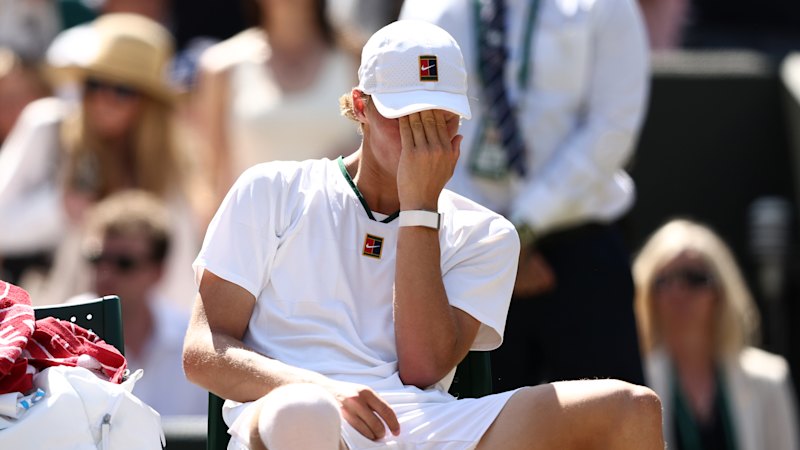
Heartbreak for Cruz Hewitt as teen loses Wimbledon boys’ final thriller
Jannik Sinner wins Wimbledon: Top seed beats Alexander Zverev in thrilling men's final to claim back-to-back titles

How other outlets are covering this story
Compare narratives across 6 related reports from 6 sources. Real Narrative News aggregates the coverage spectrum so you can see who emphasises what — bias tags reflect the outlet, not the story.
Coverage bias distribution
6 sources
Left 33%
Center 17%
Right 33%
Sada Elbalad
· Jun 28, 2026
Al-Azhar, U.N. Call for Ethical Framework to Govern Artificial Intelligence
Al-Azhar Grand Imam Ahmed Al-Tayeb and U.N. Deputy Secretary-General Amina Mohammed called for global cooperation to ensure artificial intelligence is governed by ethical principles
Borneo Bulletin
· Jul 6, 2026
World must not let AI ‘vibe-code’ humanity’s future: UN chief
World must not let AI ‘vibe-code’ humanity’s future: UN chief
Fortune
· Dec 9, 2025
The problem with ‘human in the loop’ AI? Often, it’s the humans
New studies show AI tools beating human professionals in law and advertising—challenging the assumption that human-AI collaboration always produces the best results.
Jacobin
· Jul 9, 2026
The Case for Nationalizing Artificial Intelligence
Artificial intelligence has been built by robbing the collective work of humanity. The public built AI — we should own it, not a handful of billionaires.
Syrian Arab News Agency
· Jun 29, 2026
Syrian team ranks among world’s top 11 in International Mathematical Modeling Challeng
Damascus, June 29 (SANA) A Syrian team has been named among the world’s top 11 teams in the 2026 International Mathematical Modeling Challenge (IMMC), an international competition that tests secondary school students’ ability to apply mathematics and data analysis to real-world problems. The 12th edition of the competition, organized online by the United States and []
UrduPoint
· Jul 7, 2026
UN Global Dialogue on AI Governance: New coalition puts children’s rights at centre of the AI age
UN Global Dialogue on AI Governance: New coalition puts children’s rights at centre of the AI age
Topics:
Related coverage for "How the Muslim world is grappling with AI, faith and the struggle for human dignity": Sada Elbalad — Al-Azhar, U.N. Call for Ethical Framework to Govern Artificial Intelligence. Borneo Bulletin — World must not let AI ‘vibe-code’ humanity’s future: UN chief. Fortune — The problem with ‘human in the loop’ AI? Often, it’s the humans. Jacobin — The Case for Nationalizing Artificial Intelligence. Syrian Arab News Agency — Syrian team ranks among world’s top 11 in International Mathematical Modeling Challeng. UrduPoint — UN Global Dialogue on AI Governance: New coalition puts children’s rights at centre of the AI age