Today in News History
On June 23, several notable moments in the history of News stand out. In 1812, War of 1812: Great Britain revokes the restrictions on American commerce, thus eliminating one of the chief reasons for going to war. In 1913, William P. Rogers, American commander, lawyer, and politician, 55th United States Secretary of State (died 2001) was born. In 1940, George Feigley, American sex cult leader and two-time prison escapee (died 2009) was born. In 1951, The ocean liner SS United States is christened and launched. In 1967, Cold War: U.S. President Lyndon B. Johnson meets with Soviet Premier Alexei Kosygin in Glassboro, New Jersey for the three-day Glassboro Summit Conference. In 1972, Watergate scandal: U.S. President Richard M. Nixon and White House Chief of Staff H. R. Haldeman are taped talking about illegally using the Central Intelligence Agency to obstruct the Federal Bureau of Investigation's investigation into the Watergate break-ins. In 1994, NASA's Space Station Processing Facility, a new state-of-the-art manufacturing building for the International Space Station, officially opens at Kennedy Space Center. In 2013, Frank Kelso, American admiral and politician, United States Secretary of the Navy (born 1933) passed away. In 2013, Militants storm a high-altitude mountaineering base camp near Nanga Parbat in Gilgit-Baltistan, Pakistan, killing ten climbers and a local guide. In 2014, The last of Syria's declared chemical weapons are shipped out for destruction. Together, these milestones provide historical context for today's news news and ongoing narratives.
House GOP blasts Trump's 'risky' military funding strategy as Pentagon crisis deepens
Narrative Analysis: Name Calling
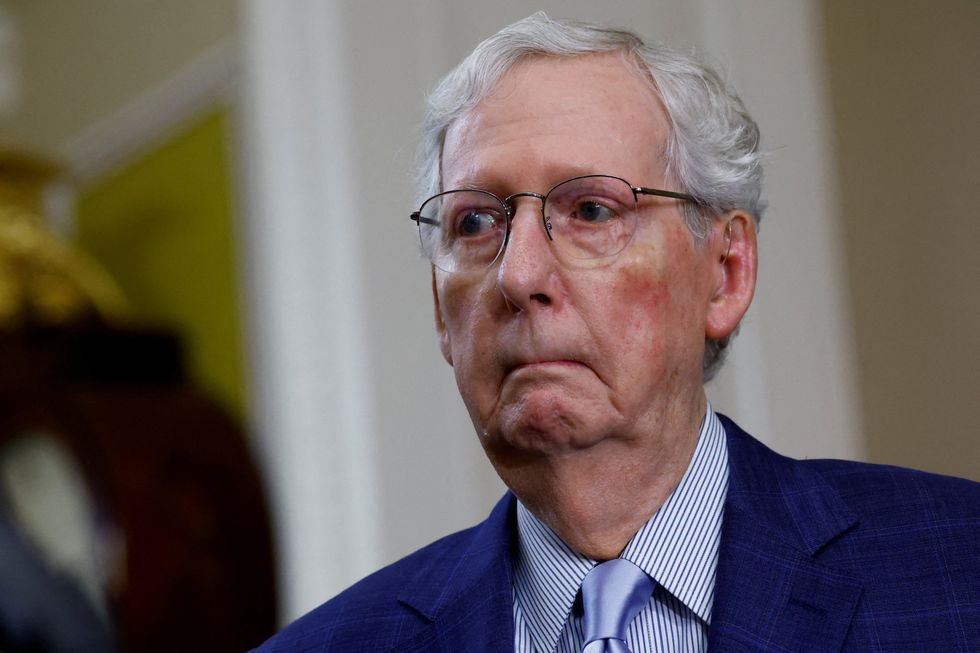
House Republican appropriators are publicly breaking with the Trump White House over what they call a risky and uncoordinated strategy to fund the U.S. military, warning that the administration is trying to push critical defense spending through a party-line reconciliation bill that may never reach the president's desk.In an official addendum to the chamber's defense funding bill obtained by Politico, House appropriators warned that the White House is attempting to fund critical efforts, including weapons and military equipment, through the reconciliation process rather than using it to supplement regular government funding bills. The two vehicles operate on entirely separate tracks, with different timelines, committees of jurisdiction, and approval processes, appropriators noted.The rebuke singles out Trump's decision to split funding for the F-35 fighter jet, the most expensive weapons program in Pentagon history, between the annual government funding bill and the reconciliation package.Analysts said last month the Pentagon's decision to split defense spending between the base budget and a reconciliation package has left members of Congress uncertain about what they're even voting to fund, with one expert calling the situation symbolic of the disorder and chaos.The outlook for another reconciliation vehicle remains uncertain. Senate Appropriations Chair Susan Collins and Defense subcommittee chair Mitch McConnell have both raised open concerns about Trump's demand for a 350 billion Recon 3.0 package. Punchbowl News has described the prospects as bleak.The friction comes as the Pentagon is reportedly running low on cash reserves due to the ongoing war with Iran, with lawmakers demanding cost transparency that the White House has yet to provide.Many House Republicans privately doubt GOP leaders can muscle another reconciliation package through the Senate before the fiscal year ends in October.
Narrative Intelligence Brief
This article was published by Raw Story, a source frequently categorized with a left bias based in United States of America. Our narrative intelligence engine continuously monitors coverage from this outlet to track framing, bias, and rhetorical patterns. In this specific piece, our systems detected the potential use of the "Name Calling" technique. This narrative approach is often used to shape reader perception by highlighting specific emotional or rhetorical angles. By understanding the editorial perspective of Raw Story, readers can better contextualize the information presented and compare it across our broader media matrix to find the real narrative.
More from Raw Story
June 23, 2026
Trump has taken his destruction to 'another scale' as he turns DC into 'swamp': expert
June 23, 2026
'Get your story straight!' Analyst gets into fiery exchange on CNN over Trump's deal
June 23, 2026
Red state to lose 51K jobs because of Trump's signature law: analysis
June 23, 2026
'Boy, was I wrong': Embarrassed conservative admits CNN was right about Trump's deal
June 23, 2026
'Clear admission' Trump DOJ broke rules to help Ghislaine Maxwell uncovered by expert
Reliability Insights
P
Technique: Name Calling
System analysis detected use of specific narrative techniques in this piece.Analysis Methodology
This narrative analysis was generated using the CoDataLab Global Intelligence Engine. Our proprietary AI scans thousands of cross-border sources to identify sentiment patterns, framing techniques, and potential media bias. While AI provides the data-driven foundation, our objective is to empower readers with additional context beyond the standard headline.The content displayed above is a structured summary designed for rapid information processing. For the full original report, please visit the source outlet.More Coverage
Discussion
"trump"
Trump’s Surrender Humiliation Deepens With Brutal Poll

Most Americans skeptical of Trump’s Iran deal: Poll

Chicago Mayor ignores another bloody weekend to focus on something called a, quote, “Transfemicide State of Emergency"