
Today in News History
On June 23, several notable moments in the history of News stand out. In 1901, Ahmet Hamdi Tanpınar, Turkish author, poet, and scholar (died 1962) was born. In 1927, John Habgood, Baron Habgood, English archbishop (died 2019) was born. In 1931, Ola Ullsten, Swedish politician and diplomat (died 2018) was born. In 1941, The Lithuanian Activist Front declares independence from the Soviet Union and forms the Provisional Government of Lithuania; it lasts only briefly as the Nazis will occupy Lithuania a few weeks later. In 1955, Pierre Corbeil, Canadian dentist and politician was born. In 1965, Sylvia Mathews Burwell, American government and non-profit executive was born. In 1967, Cold War: U.S. President Lyndon B. Johnson meets with Soviet Premier Alexei Kosygin in Glassboro, New Jersey for the three-day Glassboro Summit Conference. In 1972, Watergate scandal: U.S. President Richard M. Nixon and White House Chief of Staff H. R. Haldeman are taped talking about illegally using the Central Intelligence Agency to obstruct the Federal Bureau of Investigation's investigation into the Watergate break-ins. In 2012, James Durbin, English economist and statistician (born 1923) passed away. In 2015, Nirmala Joshi, Indian nun, lawyer, and social worker (born 1934) passed away. Together, these milestones provide historical context for today's news news and ongoing narratives.
Haberman and Swan's "Regime Change": How Trump became "untethered" in second term
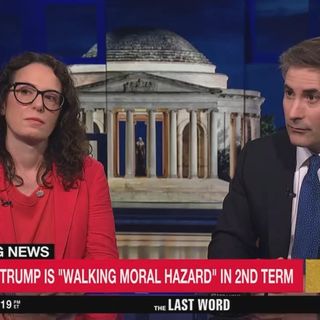
Maggie Haberman and Jonathan Swan tell me these are the top two themes of their book on President Trump's second term, Regime Change, out Tuesday:His greater willingness to use power in his second term — like no other president, period.How four years out of office built up his determination to project that power globally.The latest: In the duo's first live interview about Regime Change, Haberman said Monday night on Lawrence O'Donnell's The Last Word on MS NOW that people got used to Term 1: Trump didn't really know his government, and he was surrounded by aides who saw his behavior as dangerous.There's none of that now, Haberman said. They believe there is something almost mystical about him, that he can hear frequencies that maybe they can't. And they hate the mainstream media more than they hate things they see him doing, that they have concerns about.Swan added during the MS NOW appearance, which ran an astonishing 46 minutes, that Trump wants to be the capital G, Great Man of history.He wants to reshape the world, Swan said. I don't think he would have gone to war in Iran in the same circumstances in Term 1. I don't think he would have rolled the dice on what he did in Venezuela. He wouldn't have started a trade war with the whole world. But he's in a different mindset, and he's untethered from all of those domestic political considerations [of] the first term.Behind the scenes: Haberman and Swan write that some Trump aides told them they wished their boss was more anxious about the dangers he was courting, and about his plunging poll numbers.To the extent he still cared about polling at all, he was seeing far fewer polls than during his first term. His advisors knew he was not receptive to being briefed on harsh realities. In his second term, unlike his first, he was willing to take breathtaking risks, risks that could throw not only his presidency but the Republican Party and the entire world into chaos and carnage. More than ever before as President, he was operating on pure gut instinct. (p. 409) Watch the interview Book takeaways (NYT gift link).
Narrative Intelligence Brief
This article was published by Axios, a source frequently categorized with a center bias based in United States of America. Our narrative intelligence engine continuously monitors coverage from this outlet to track framing, bias, and rhetorical patterns. Our initial algorithmic scan of this specific piece did not flag high-confidence rhetorical techniques, suggesting a generally straightforward reporting style or neutral framing. By understanding the editorial perspective of Axios, readers can better contextualize the information presented and compare it across our broader media matrix to find the real narrative.
More from Axios
June 23, 2026
People Inc. CEO accuses Google of abusing its market power with web crawling
June 23, 2026
Ten years after Brexit, the U.K. marks a lost decade
June 23, 2026
Google takes the hit in AI's talent war
June 23, 2026
The most costly primaries you've never heard of are raging on D.C.'s doorstep
June 22, 2026
Democrats' Jeffries and Mamdani wings face off in New York
Analysis Methodology
This narrative analysis was generated using the CoDataLab Global Intelligence Engine. Our proprietary AI scans thousands of cross-border sources to identify sentiment patterns, framing techniques, and potential media bias. While AI provides the data-driven foundation, our objective is to empower readers with additional context beyond the standard headline.The content displayed above is a structured summary designed for rapid information processing. For the full original report, please visit the source outlet.More Coverage
Discussion


