GCC youth population exceeds 23.5 million, representing 38.2% of total population
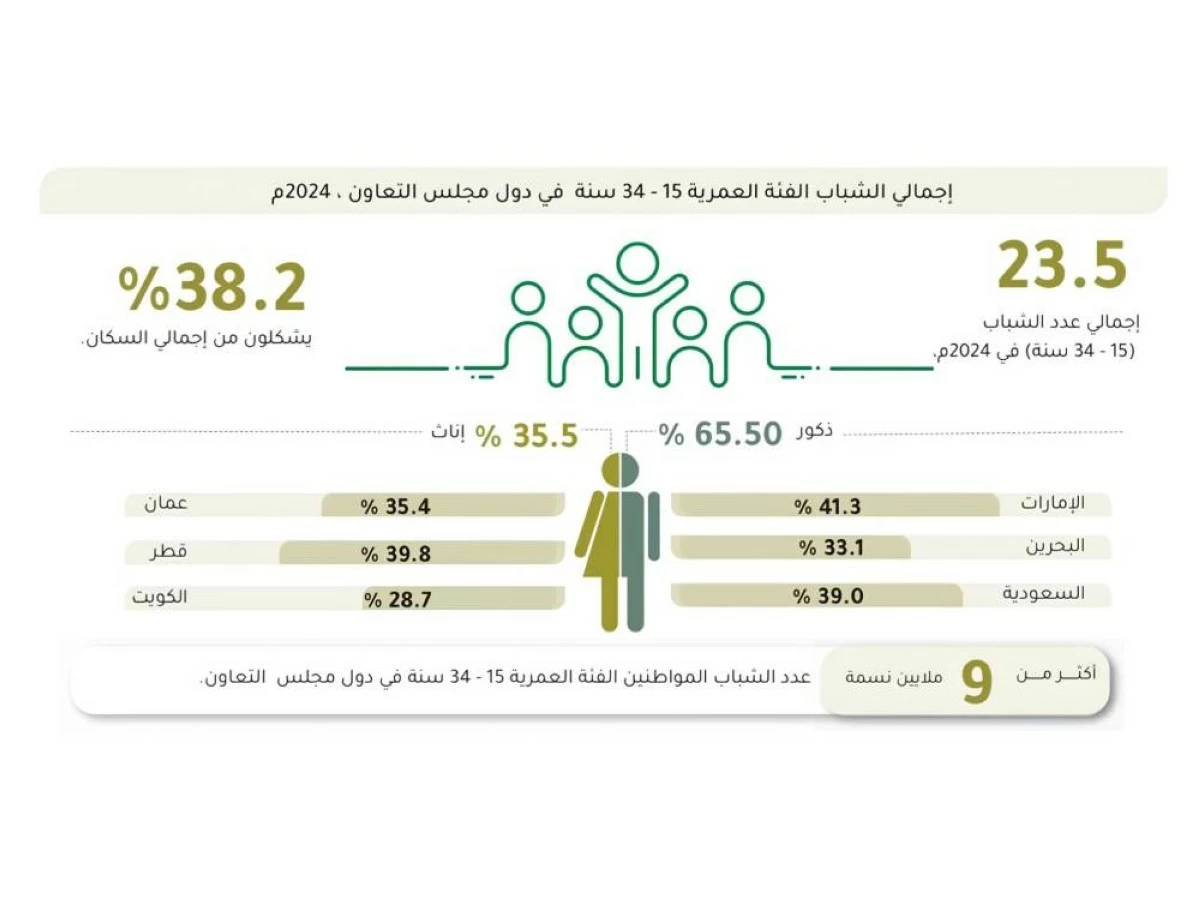
Muscat: The GCC Statistical Centre (GCC-Stat) has revealed that the total number of young people aged 15 to 34 in GCC countries reached approximately 23.5 million in 2024, accounting for 38.2 percent of the region’s total population.The data, released to mark GCC Youth Day observed annually on 6 June, showed that 15.1 million of this group are males, representing 64.5 percent, while 8.4 million are females, accounting for 35.5 percent.Demographic trendsThe Centre noted that GCC countries are undergoing demographic changes similar to global trends. The share of youth in the overall population declined slightly from 38.9 percent in 2010 to 38.2 percent in 2024. Globally, youth representation decreased from 32.8 percent to 30.3 percent over the same period.At the same time, the proportion of people aged 35 and above has increased, alongside a decline in the share of children under 15, reflecting rising life expectancy and lower fertility rates.Workforce participationIn the labour market, around 14.2 million young people were employed across GCC countries in 2025, representing 38.1 percent of the region’s total workforce. This marked a growth of 5.1 percent compared to 2024.The number of employed GCC national youth reached approximately 2.5 million, accounting for 43.5 percent of all employed GCC nationals, with a year-on-year increase of 3.1 percent.Improved participation in education and employmentData also showed progress in reducing the proportion of young people not in education, employment or training (NEET). The rate declined from 20.1 percent in 2010 to 15.7 percent in 2024, indicating improved integration of youth into education systems and the labour market.Future outlookAccording to United Nations estimates, the youth population in GCC countries is expected to reach 28.6 million by 2050, an increase of approximately 5.9 million compared to 2024, representing overall growth of 26 percent.The figures underline the importance of youth as key contributors to economic and social development, innovation and entrepreneurship, as GCC countries continue to focus on building sustainable and prosperous futures.
Narrative Intelligence Brief
This article was published by Emirates 24/7, a source frequently categorized with a lean right bias based in United Arab Emirates. Our narrative intelligence engine continuously monitors coverage from this outlet to track framing, bias, and rhetorical patterns. Our initial algorithmic scan of this specific piece did not flag high-confidence rhetorical techniques, suggesting a generally straightforward reporting style or neutral framing. By understanding the editorial perspective of Emirates 24/7, readers can better contextualize the information presented and compare it across our broader media matrix to find the real narrative.
More from Emirates 24/7
June 14, 2026
EU assesses impact of US AI restrictions on Anthropic models
June 14, 2026
New York Knicks win NBA title after 53-year wait
June 14, 2026
Dubai Health campaign attracts over 43,000 blood donors
June 14, 2026
Swiss voters decide on proposal to cap population at 10 million
June 14, 2026
Swiss voters decide on proposal to cap population at 10 million
Analysis Methodology
This narrative analysis was generated using the CoDataLab Global Intelligence Engine. Our proprietary AI scans thousands of cross-border sources to identify sentiment patterns, framing techniques, and potential media bias. While AI provides the data-driven foundation, our objective is to empower readers with additional context beyond the standard headline.The content displayed above is a structured summary designed for rapid information processing. For the full original report, please visit the source outlet.More Coverage
Discussion
"white house"
Duffy's personal ‘quest’ leaves critic ‘utterly disgusted’ – and GOP livid: report

The Memo: Trump’s UFC fight night risks landing with a thud

Trump voters ‘at a loss for words’ trying to defend him amid ‘watershed moment’: pollster