Today in News History
On July 3, several notable moments in the history of News stand out. In 1767, Norway's oldest newspaper still in print, Adresseavisen, is founded and the first edition is published. In 1849, France invades the Roman Republic and restores the Papal States. In 1866, Austro-Prussian War is decided at the Battle of Königgrätz, enabling Prussia to exclude Austria from German affairs. In 1940, Jerzy Buzek, Polish engineer and politician, 9th Prime Minister of Poland was born. In 1940, World War II: The Royal Navy attacks the French naval squadron in Algeria, to ensure that it will not fall under German control. Of the four French battleships present, one is sunk, two are damaged, and one escapes back to France. In 1944, World War II: The Minsk Offensive clears German troops from the city. In 1970, The Troubles: The "Falls Curfew" begins in Belfast, Northern Ireland. In 1979, U.S. President Jimmy Carter signs the first directive for secret aid to the opponents of the pro-Soviet regime in Kabul. In 1988, United States Navy warship USS Vincennes shoots down Iran Air Flight 655 over the Persian Gulf, killing all 290 people aboard. In 1988, The Fatih Sultan Mehmet Bridge in Istanbul, Turkey is completed, providing the second connection between the continents of Europe and Asia over the Bosphorus. Together, these milestones provide historical context for today's news news and ongoing narratives.
EU nation moves to lift nuclear weapons ban
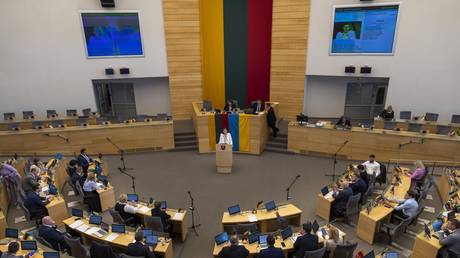
Lithuanian lawmakers have introduced a constitutional amendment to remove the country’s ban on hosting nuclear weapons Read Full Article at RT.com
Narrative Intelligence Brief
This article was published by Russia Today, a source frequently categorized with a right bias based in Russia. Our narrative intelligence engine continuously monitors coverage from this outlet to track framing, bias, and rhetorical patterns. Our initial algorithmic scan of this specific piece did not flag high-confidence rhetorical techniques, suggesting a generally straightforward reporting style or neutral framing. By understanding the editorial perspective of Russia Today, readers can better contextualize the information presented and compare it across our broader media matrix to find the real narrative.
More from Russia Today
July 3, 2026
AI industry is ‘effing insane’ – Palantir CEO
July 3, 2026
Why Europe still needs Russia to keep the lights on
July 3, 2026
UNESCO warns Pakistan over ancient city’s status
July 3, 2026
Russian arms giant showcases pioneering anti-drone rounds (VIDEO)
July 3, 2026
US feared plot to kill Iranian negotiators – NYT
Analysis Methodology
This narrative analysis was generated using the CoDataLab Global Intelligence Engine. Our proprietary AI scans thousands of cross-border sources to identify sentiment patterns, framing techniques, and potential media bias. While AI provides the data-driven foundation, our objective is to empower readers with additional context beyond the standard headline.The content displayed above is a structured summary designed for rapid information processing. For the full original report, please visit the source outlet.More Coverage
Discussion