
Emirati and Polish authors discuss future of the novel at Warsaw International Book Fair 2026
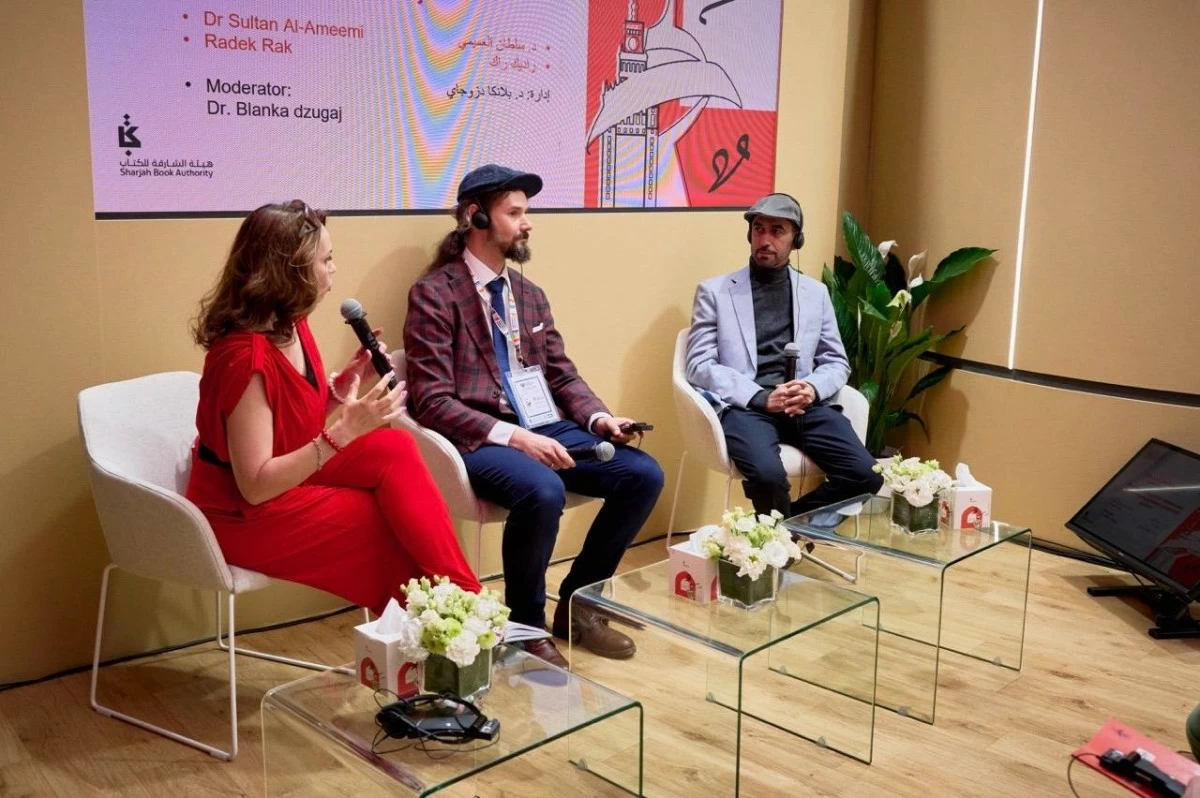
Warsaw: Emirati writer and researcher Dr Sultan Al Ameemi and Polish novelist Radek Rak explored how literature crosses linguistic and cultural boundaries during a discussion held at Sharjah’s pavilion at the Warsaw International Book Fair 2026.The session, part of Sharjah’s Guest of Honour programme, focused on the evolving nature of contemporary fiction, the role of translation, and the relationship between writers, readers and literary traditions.Speaking during the session titled “Artistic and intellectual developments in contemporary Emirati and Polish literature”, Al Ameemi said the growing translation of Arabic literature into other languages has strengthened literary exchange and expanded opportunities for dialogue between cultures. He noted that contemporary fiction increasingly addresses concerns shared across societies, regardless of geography or language.He added that many themes in world literature reflect similarities long present in folk traditions across East and West, where stories often converge despite arising from different cultural contexts.Reflecting on the development of the Emirati novel, Al Ameemi said contemporary Emirati fiction has become more open to experimentation in language, structure and ideas. However, he stressed that literary progress is driven by the writer’s individual creative vision rather than institutions or cultural environments alone.He also said that while literary prizes and competitions can support writers and recognise achievement, they do not create novelists, adding that lasting literary value comes from sustained commitment to craft and the development of a distinct creative voice.On the relationship between writers and readers, Al Ameemi said authors do not write solely for themselves, but warned that excessive concern with audience expectations can weaken a work. He noted that readers bring different perspectives to the same text over time, and a novel may be interpreted differently by the same person at various stages of life.He added that concerns about translation or international readership should not shape the writing process, emphasising that a writer’s primary responsibility is to the text, its language and its artistic construction.Addressing language, Al Ameemi said Standard Arabic remains the shared literary language of the Arab world despite regional diversity, allowing readers across countries to engage with a common literary tradition. He added that while the use of dialects in prose remains limited, Emirati poetry continues to flourish in both classical Arabic and Nabati forms.For his part, Rak said literature draws strength from balancing cultural specificity with universal human experience. He cited Umberto Eco’s The Name of the Rose as an example of a work deeply rooted in a specific historical context that continues to resonate across cultures and generations.He added that cultural specificity gives literature its distinct identity, while universal themes allow readers to connect with stories beyond their own experiences, creating both familiarity and discovery.Discussing examples from Polish and Finnish literature, Rak said the role of the translator goes beyond transferring words, extending to conveying the cultural and linguistic essence of a text.On the craft of fiction, Rak said novels are shaped not only by plot but by the writer’s perspective and interpretation of the world. He added that while story remains important, the most meaningful books are those that leave a lasting impression and offer insight into lives and experiences different from the reader’s own.
Narrative Intelligence Brief
This article was published by Emirates 24/7, a source frequently categorized with a lean right bias based in United Arab Emirates. Our narrative intelligence engine continuously monitors coverage from this outlet to track framing, bias, and rhetorical patterns. Our initial algorithmic scan of this specific piece did not flag high-confidence rhetorical techniques, suggesting a generally straightforward reporting style or neutral framing. By understanding the editorial perspective of Emirates 24/7, readers can better contextualize the information presented and compare it across our broader media matrix to find the real narrative.
Explore related topics: Stay informed with Real Narrative News as we track unfolding stories. Dive deeper into our coverage of pivotal topics including champions league, قلعة الشقيف, ligue champions, جنوب لبنان, législatives communales, league final, victoire psg, beaufort castle, southern lebanon, and iran war. Our intelligence streams continuously monitor these keywords to bring you unbiased analysis and real-time updates on topics like "Emirati and Polish authors discuss future of the novel at Warsaw International Book Fair 2026".
More from Emirates 24/7
May 31, 2026
PSG target Champions League threepeat after historic back-to-back wins
May 31, 2026
Experimental pill shows promise for deadly pancreatic cancer
May 31, 2026
PublisHer highlights women’s leadership at Warsaw International Book Fair 2026
May 31, 2026
Emirati and Polish authors discuss future of the novel at Warsaw International Book Fair 2026
May 31, 2026
Dubai Police marks 70 years of security, innovation and global leadership
Analysis Methodology
This narrative analysis was generated using the CoDataLab Global Intelligence Engine. Our proprietary AI scans thousands of cross-border sources to identify sentiment patterns, framing techniques, and potential media bias. While AI provides the data-driven foundation, our objective is to empower readers with additional context beyond the standard headline.The content displayed above is a structured summary designed for rapid information processing. For the full original report, please visit the source outlet.More Coverage
Discussion