
Today in News History
On June 23, several notable moments in the history of News stand out. In -47 BC, Caesarion, Egyptian king (died 30 BC) was born. In 1266, War of Saint Sabas: In the Battle of Trapani, the Venetians defeat a larger Genoese fleet, capturing all its ships. In 1305, A peace treaty between the Flemish and the French is signed at Athis-sur-Orge. In 1594, The Action of Faial, Azores. The Portuguese carrack Cinco Chagas, loaded with slaves and treasure, is attacked and sunk by English ships with only 13 survivors out of over 700 on board. In 1919, Mohamed Boudiaf, Algerian politician, President of Algeria (died 1992) was born. In 1956, The French National Assembly takes the first step in creating the French Community by passing the Loi Cadre, transferring a number of powers from Paris to elected territorial governments in French West Africa. In 1959, Hidir Lutfi, Iraqi poet. (born 1880) passed away. In 2013, Militants storm a high-altitude mountaineering base camp near Nanga Parbat in Gilgit-Baltistan, Pakistan, killing ten climbers and a local guide. In 2014, The last of Syria's declared chemical weapons are shipped out for destruction. In 2017, A series of terrorist attacks take place in Pakistan, resulting in 96 deaths and wounding 200 others. Together, these milestones provide historical context for today's news news and ongoing narratives.
Dubai: When a city becomes a verb
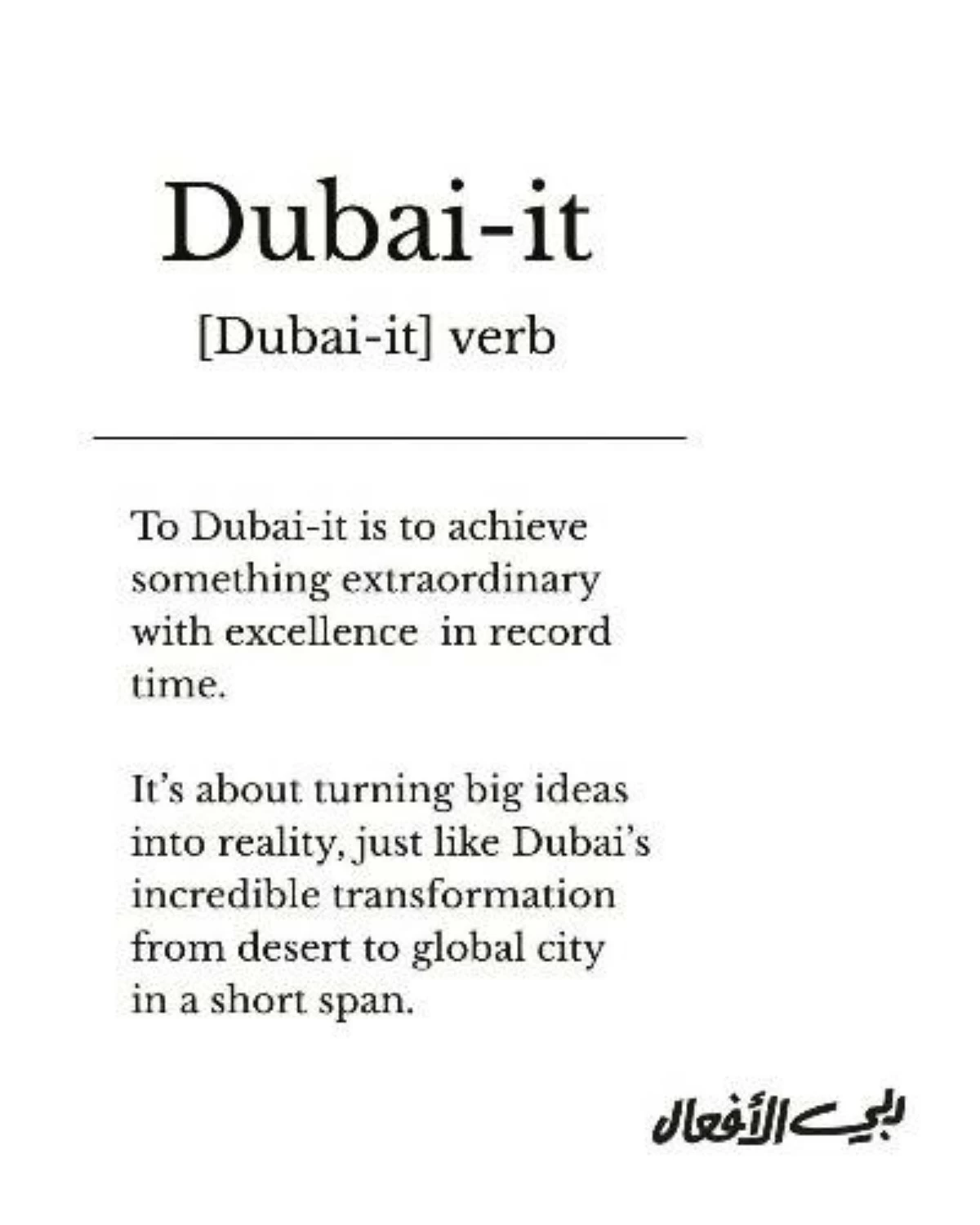
Only a handful of brands have entered the language as verbs. Google it. Uber it. Cities do not usually get that privilege.Until June 17, 2026, when His Highness Sheikh Mohammed bin Rashid Al Maktoum, Vice President and Prime Minister of the UAE and Ruler of Dubai, launched 'Dubai-it' and gave the world a new definition: to achieve something extraordinary with excellence in record time.This is a city that has spent decades being described, analysed, doubted, praised, and misread by everyone else. Now it is defining itself, on its own terms, in its own language, and handing the world a new concept to use.The world still tends to treat Dubai’s transformation as spectacle. A skyline, a headline, a record-breaking structure. What it misses is the system behind it. The skyline is often mistaken for the story. It is actually the evidence.Emirates Airline launched in 1985 with two aircraft and ten million dollars. Four decades later, it is the world’s most profitable airline. Dubai International Airport processed 95.2 million passengers in 2025. The Dubai Metro, which opened at 9 minutes and 9 seconds past 9pm on 09/09/09, carried 294.7 million riders last year. More than 95 per cent of Dubai’s GDP is non-oil, an economy more diversified than countries that have had centuries to figure it out.When the 2008 financial crisis hit, Dubai was building the tallest structure in human history. Analysts expected it to be abandoned. Instead, the Burj Khalifa was inaugurated on January 4, 2010. When Covid-19 shut the world down, Dubai reopened to tourism within three months and went on to host Expo 2020, welcoming more than 24 million visits from 192 countries. In Dubai, uncertainty rarely pauses execution.This is what “Dubai-it” codifies. Speed with precision. Ambition backed by execution. “Speed does not mean haste. Quality does not mean slowness. Ambition has no value without execution.”There is a reason this matters beyond branding. Cities across Asia, Africa and Latin America have studied elements of Dubai’s model, from free zones and aviation strategy to city branding and investment attraction. What many can replicate is the structure. What remains harder to replicate is the culture behind it.What those cities borrow is the output. What “Dubai-it” names is the input, the methodology, the operating system behind every result the world can see.The timing is deliberate. Dubai’s GDP reached AED 937 billion in 2025. The D33 agenda aims to double the economy by 2033 through 100 transformational projects. The UAE’s non-oil foreign trade exceeded one trillion dollars for the first time last year. These targets are being hit while a regional conflict tests every system the country has built.“Dubai-it,” or “Dubai Al Af’al” in Arabic, is designed to codify a culture and transfer it to future generations, embedded across institutions and companies as a framework for how Dubai operates and intends to operate for decades to come.“Our motto has always been: we say what we do, and we do what we say.” That line, from the leader who turned a creek town into a global powerhouse, is perhaps the shortest summary of a model the rest of the world is still trying to reverse-engineer. Most cities compete on infrastructure, tax policy, or location. Dubai competes on philosophy, and packages that philosophy for export.Most cities leave landmarks. A few leave ideas. Dubai may become one of the rare places that leaves a verb.(Naoufer Ramoul is a senior TV presenter and producer at Dubai Media Incorporated, and the host of the award-winning political show Qabel lil Niqash on Dubai TV. She has worked as a presenter at Al Jazeera, Al Arabiya and Alhurra.)
Narrative Intelligence Brief
This article was published by Emirates 24/7, a source frequently categorized with a lean right bias based in United Arab Emirates. Our narrative intelligence engine continuously monitors coverage from this outlet to track framing, bias, and rhetorical patterns. Our initial algorithmic scan of this specific piece did not flag high-confidence rhetorical techniques, suggesting a generally straightforward reporting style or neutral framing. By understanding the editorial perspective of Emirates 24/7, readers can better contextualize the information presented and compare it across our broader media matrix to find the real narrative.
More from Emirates 24/7
June 23, 2026
Explained: UAE's social media ban for children under the age of 15
June 23, 2026
Think big, move fast: How Dubai residents are living the ‘Dubai-it’ philosophy
June 23, 2026
'Dubai-it': The mindset that turns ambition into action
June 23, 2026
US opens probe of fatal Tesla Model 3 crash into Texas home
June 23, 2026
Dubai retains No.1 global ranking for Greenfield FDI in 2025
Analysis Methodology
This narrative analysis was generated using the CoDataLab Global Intelligence Engine. Our proprietary AI scans thousands of cross-border sources to identify sentiment patterns, framing techniques, and potential media bias. While AI provides the data-driven foundation, our objective is to empower readers with additional context beyond the standard headline.The content displayed above is a structured summary designed for rapid information processing. For the full original report, please visit the source outlet.More Coverage
Discussion
"amazon prime"
I Buy Differin Every Amazon Prime Day—This Is the Lowest Price I’ve Ever Seen

Samsung SSD Prime Day Deals: Save On Portable And Internal Storage

TV Fire Sticks are at their lowest price ever! Stream TNT Sports for less with £25 Amazon Prime Day deal before it sells out - after free to air coverage is banned
