Today in News History
On July 3, several notable moments in the history of News stand out. In 1775, American Revolutionary War: George Washington takes command of the Continental Army at Cambridge, Massachusetts. In 1863, American Civil War: The final day of the Battle of Gettysburg culminates with Pickett's Charge. In 1886, The New-York Tribune becomes the first newspaper to use a linotype machine, eliminating typesetting by hand. In 1898, Stefanos Stefanopoulos, Greek politician, Prime Minister of Greece (died 1982) was born. In 1940, Lamar Alexander, American lawyer and politician, 5th United States Secretary of Education was born. In 1950, James Hahn, American judge and politician, 40th Mayor of Los Angeles was born. In 1970, The Troubles: The "Falls Curfew" begins in Belfast, Northern Ireland. In 1979, U.S. President Jimmy Carter signs the first directive for secret aid to the opponents of the pro-Soviet regime in Kabul. In 1988, United States Navy warship USS Vincennes shoots down Iran Air Flight 655 over the Persian Gulf, killing all 290 people aboard. In 2013, President of Egypt Mohamed Morsi is removed from office by the military after four days of protests all over the country calling for his resignation, to which he did not respond. The president of the Supreme Constitutional Court of Egypt, Adly Mansour, is declared acting president until further elections are held. Together, these milestones provide historical context for today's news news and ongoing narratives.
Democratic governors press US Postal Service to drop plan tied to Trump's election order
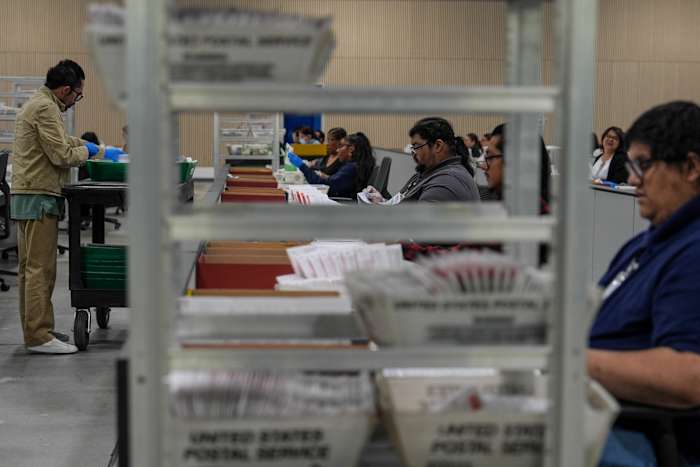
A group of Democratic governors is asking the U.S. Postal Service to withdraw its proposed rule to comply with an executive order that seeks to create a federal list of eligible voters, including those eligible to receive a ballot by mail.
Narrative Intelligence Brief
This article was published by KSAT San Antonio, a source frequently categorized with a center bias based in United States of America. Our narrative intelligence engine continuously monitors coverage from this outlet to track framing, bias, and rhetorical patterns. Our initial algorithmic scan of this specific piece did not flag high-confidence rhetorical techniques, suggesting a generally straightforward reporting style or neutral framing. By understanding the editorial perspective of KSAT San Antonio, readers can better contextualize the information presented and compare it across our broader media matrix to find the real narrative.
More from KSAT San Antonio
July 3, 2026
Illegal parties take over North Side homes under development, local builder urges for police action
July 3, 2026
Traffic improvement plan for Alamo Ranch Parkway estimated to cost $80 million, official says
July 3, 2026
Another man pleads guilty in Quintana Road human smuggling tragedy
July 3, 2026
Powerful general in Iran emerges from hiding as Tehran prepares for Khamenei's dayslong funeral
July 3, 2026
With 3 boat ramps, mid-lake fireworks show, Canyon Lake prepares for busy Fourth of July
Analysis Methodology
This narrative analysis was generated using the CoDataLab Global Intelligence Engine. Our proprietary AI scans thousands of cross-border sources to identify sentiment patterns, framing techniques, and potential media bias. While AI provides the data-driven foundation, our objective is to empower readers with additional context beyond the standard headline.The content displayed above is a structured summary designed for rapid information processing. For the full original report, please visit the source outlet.More Coverage
Discussion
"cristiano ronaldo"
¡Así festejó Roberto Martínez el penal de Cristiano Ronaldo para el empate de Portugal!

Portugal snatch controversial late World Cup victory over Croatia

Is Cristiano Ronaldo Retiring? Portugal Star Gives Update On Future