
Today in News History
On June 28, several notable moments in the history of News stand out. In 1836, Emmanuel Rhoides, Greek journalist and author (died 1904) was born. In 1927, Correlli Barnett, English historian and author (died 2022) was born. In 1928, Harold Evans, English-American historian and journalist (died 2020) was born. In 1934, Georges Wolinski, Tunisian-French journalist and cartoonist (died 2015) was born. In 1952, Enis Batur, Turkish poet and author was born. In 1971, Elon Musk, South African-born American entrepreneur was born. In 1972, Geeta Tripathee, Nepali poet, lyricist and literary critic was born. In 1975, Rod Serling, American screenwriter and producer (born 1924) passed away. In 1989, Joris Ivens, Dutch journalist, director, and producer (born 1898) passed away. In 2014, Seymour Barab, American cellist and composer (born 1921) passed away. Together, these milestones provide historical context for today's news news and ongoing narratives.
David Sedaris on his Duolingo obsession: ‘“Today is the last day,” I told myself – but I was powerless to stop’
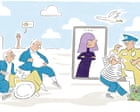
I decided to combine my need to top the leader table with my daily step count – which is how I found myself walking 10 miles a day while reading out sentences in Japanese, German, Spanish and FrenchHugh and I were driving from Washington, DC, to the Sea Section, our house on the coast of North Carolina, when I noticed a dot with legs traversing the hem of my untucked shirt. “There’s a tick on me!” I said.He looked down at my lap. “Well, throw it outside. It’s nothing to get hysterical about.” Continue reading...
Narrative Intelligence Brief
This article was published by Education | The Guardian, a source frequently categorized with a left bias based in United Kingdom. Our narrative intelligence engine continuously monitors coverage from this outlet to track framing, bias, and rhetorical patterns. Our initial algorithmic scan of this specific piece did not flag high-confidence rhetorical techniques, suggesting a generally straightforward reporting style or neutral framing. By understanding the editorial perspective of Education | The Guardian, readers can better contextualize the information presented and compare it across our broader media matrix to find the real narrative.
More from Education | The Guardian
June 28, 2026
Late drama sends Austria and Algeria into World Cup knockouts to break Iran hearts
June 28, 2026
Lionel Messi steps off bench and scores to cap Argentina’s World Cup win over Jordan
June 28, 2026
Alphonso Davies returns as Canada approach World Cup moment of destiny
June 28, 2026
Algeria v Austria: World Cup 2026 – live
June 28, 2026
Jordan v Argentina: World Cup 2026 – live
Analysis Methodology
This narrative analysis was generated using the CoDataLab Global Intelligence Engine. Our proprietary AI scans thousands of cross-border sources to identify sentiment patterns, framing techniques, and potential media bias. While AI provides the data-driven foundation, our objective is to empower readers with additional context beyond the standard headline.The content displayed above is a structured summary designed for rapid information processing. For the full original report, please visit the source outlet.More Coverage
Discussion
"iran"
All HELL BREAKS LOOSE as Trump BOMBS IRAN…AGAIN!!!

Petitions against Kennedy Agyapong unwarranted; NPP should probe corruption claims – Dr Kennedy
[Video] "Iran’s regime will no longer exist if violations continue.
