Today in News History
On July 2, several notable moments in the history of News stand out. In 1566, Nostradamus, French astrologer and author (born 1503) passed away. In 1840, A Ms 7.4 earthquake strikes present-day Turkey and Armenia; combined with the effects of an eruption on Mount Ararat, kills 10,000 people. In 1954, Chris Huhne, English journalist and politician, Secretary of State for Energy and Climate Change was born. In 1966, France conducts its first nuclear weapon test in the Pacific, on Moruroa Atoll. In 1986, Aeroflot Flight 2306 crashes while attempting an emergency landing at Syktyvkar Airport in Syktyvkar, in present-day Komi Republic, Russia, killing 54 people. In 1986, Rodrigo Rojas and Carmen Gloria Quintana are burnt alive during a street demonstration against the dictatorship of General Augusto Pinochet in Chile. In 1994, USAir Flight 1016 crashes near Charlotte Douglas International Airport, killing 37 of the 57 people on board. In 2010, The South Kivu tank truck explosion in the Democratic Republic of the Congo kills at least 230 people. In 2013, A magnitude 6.1 earthquake strikes Aceh, Indonesia, killing at least 42 people and injuring 420 others. In 2024, A stampede during a religious event in Uttar Pradesh, India, leaves at least 121 people dead and 150 others injured. Together, these milestones provide historical context for today's news news and ongoing narratives.
Dangerous heatwave scorches US ahead of Fourth of July holiday
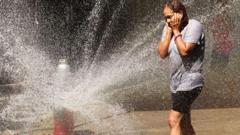
Millions are enduring dangerous heat and humidity, with temperatures expected to stay at 38C (100F) for several days.
Narrative Intelligence Brief
This article was published by BBC News, a source frequently categorized with a center bias based in United Kingdom. Our narrative intelligence engine continuously monitors coverage from this outlet to track framing, bias, and rhetorical patterns. Our initial algorithmic scan of this specific piece did not flag high-confidence rhetorical techniques, suggesting a generally straightforward reporting style or neutral framing. By understanding the editorial perspective of BBC News, readers can better contextualize the information presented and compare it across our broader media matrix to find the real narrative.
More from BBC News
July 2, 2026
Sabrina Carpenter and Graham Norton spotted in NYC before rumoured Swift wedding celebrations
July 2, 2026
Sciver-Brunt leads superb England into World Cup final
July 2, 2026
I take responsibility to fund defence plan extremely seriously, says Burnham
July 2, 2026
Goat and skin in millions of 'lamb' kebabs compared to horsemeat lasagne scandal
July 2, 2026
Mini-mart at centre of BBC drug dealing investigation closed down
Analysis Methodology
This narrative analysis was generated using the CoDataLab Global Intelligence Engine. Our proprietary AI scans thousands of cross-border sources to identify sentiment patterns, framing techniques, and potential media bias. While AI provides the data-driven foundation, our objective is to empower readers with additional context beyond the standard headline.The content displayed above is a structured summary designed for rapid information processing. For the full original report, please visit the source outlet.More Coverage
Discussion
"supreme court"
Trump has a bomb ticking in the White House — and he plans for it to blow up the midterms
The Hen Report: “It Doesn’t Seem Fair” | Animal Cruelty Laws, SCOTUS & Constitutional Rights for Animals

'Abbotsford man' convicted of second-degree murder in wife’s fatal stabbing days after arriving in Canada