Today in News History
On June 23, several notable moments in the history of News stand out. In 1930, Francis Newall, 2nd Baron Newall, English businessman and politician was born. In 1934, Bill Torrey, Canadian businessman (died 2018) was born. In 1955, Pierre Corbeil, Canadian dentist and politician was born. In 1964, Nicolas Marceau, Canadian economist and politician was born. In 1967, Cold War: U.S. President Lyndon B. Johnson meets with Soviet Premier Alexei Kosygin in Glassboro, New Jersey for the three-day Glassboro Summit Conference. In 1972, Watergate scandal: U.S. President Richard M. Nixon and White House Chief of Staff H. R. Haldeman are taped talking about illegally using the Central Intelligence Agency to obstruct the Federal Bureau of Investigation's investigation into the Watergate break-ins. In 1978, Matt Light, American football player and sportscaster was born. In 2008, Arthur Chung, Guyanese surveyor and politician, 1st President of Guyana (born 1918) passed away. In 2013, Nik Wallenda becomes the first man to successfully walk across the Grand Canyon on a tight rope. In 2021, John McAfee, British-American computer programmer and businessman, founded McAfee (born 1945) passed away. Together, these milestones provide historical context for today's news news and ongoing narratives.
Confused Trump raises eyebrows as he stumbles through order-signing on 'crypto-graffey'
Narrative Analysis: Name Calling
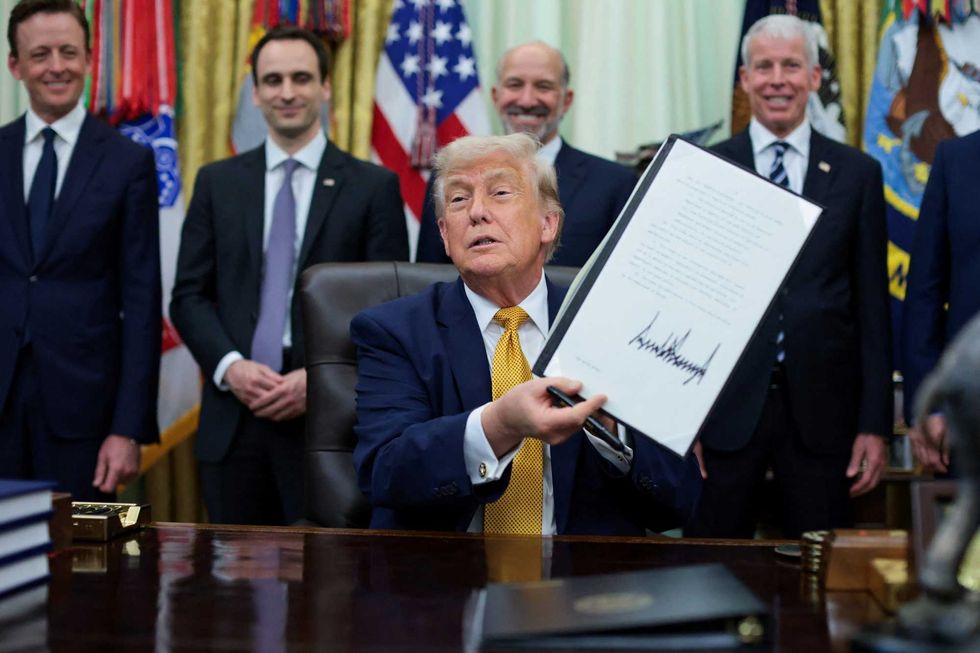
President Donald Trump's executive order signing ceremony on Monday left some observers wide-eyed. Trump signed a pair of executive orders to boost America's quantum computing industry during a ceremony in the Oval Office. However, Trump stumbled over a section of one of the orders while reading it to the press, leaving some onlookers genuinely baffled. The second order I am signing directs federal agencies to make the transition to what is called 'quantum crypto-graphy,' Trump said, seeming confused. Does anybody know what that is? You're going to hear very soon.The Oval Office may have fallen quiet after Trump made his comments, but political observers were active online reacting to clips of the ceremony. Journalist Aaron Rupar posted on Bluesky that [Trump] clearly has no clue about the executive orders he was signing. President Good Brains calls it 'crypto-graffey' twice, Brandon Friedman, a former Obama administration staffer, posted on Bluesky. Perhaps another reason we should think of elections as selecting teams and political networks (albeit with notional leaders) into office, Sarang Shah, a fellow at Columbia University's Center for Law and the Economy, posted on Bluesky. Hang this up in the Unitary Executive Theory Hall of Fame, James Goodwin, policy director at the Center for Progressive Reform, posted on Bluesky. Trump on an executive order he's about to sign that he clearly has no clue about: Quantum ... cryptography. Does anybody know what that is?[image or embed]— Aaron Rupar (@atrupar.com) June 22, 2026 at 1:58 PM
Narrative Intelligence Brief
This article was published by Raw Story, a source frequently categorized with a left bias based in United States of America. Our narrative intelligence engine continuously monitors coverage from this outlet to track framing, bias, and rhetorical patterns. In this specific piece, our systems detected the potential use of the "Name Calling" technique. This narrative approach is often used to shape reader perception by highlighting specific emotional or rhetorical angles. By understanding the editorial perspective of Raw Story, readers can better contextualize the information presented and compare it across our broader media matrix to find the real narrative.
More from Raw Story
June 23, 2026
Trump has taken his destruction to 'another scale' as he turns DC into 'swamp': expert
June 23, 2026
'Get your story straight!' Analyst gets into fiery exchange on CNN over Trump's deal
June 23, 2026
Red state to lose 51K jobs because of Trump's signature law: analysis
June 23, 2026
'Boy, was I wrong': Embarrassed conservative admits CNN was right about Trump's deal
June 23, 2026
'Clear admission' Trump DOJ broke rules to help Ghislaine Maxwell uncovered by expert
Reliability Insights
P
Technique: Name Calling
System analysis detected use of specific narrative techniques in this piece.Analysis Methodology
This narrative analysis was generated using the CoDataLab Global Intelligence Engine. Our proprietary AI scans thousands of cross-border sources to identify sentiment patterns, framing techniques, and potential media bias. While AI provides the data-driven foundation, our objective is to empower readers with additional context beyond the standard headline.The content displayed above is a structured summary designed for rapid information processing. For the full original report, please visit the source outlet.More Coverage
Discussion
"trump"
Trump’s Surrender Humiliation Deepens With Brutal Poll

Most Americans skeptical of Trump’s Iran deal: Poll

Chicago Mayor ignores another bloody weekend to focus on something called a, quote, “Transfemicide State of Emergency"