
0
Chicago just built the largest magic venue in the world—take a peek inside
April 21, 2026
Posted 4 hours ago by
The last time I set foot in this historic Chicago mansion built in the heart of Michigan Avenue, I’d been served one less-than-generous slice of lukewarm prime rib. This is back when it was a Lawry’s steakhouse. I remember white tablecloths, silver serving trays, one decent staircase, and just the stodgiest of old rooms that felt less like I was in the Gilded Age than at a funeral parlor.
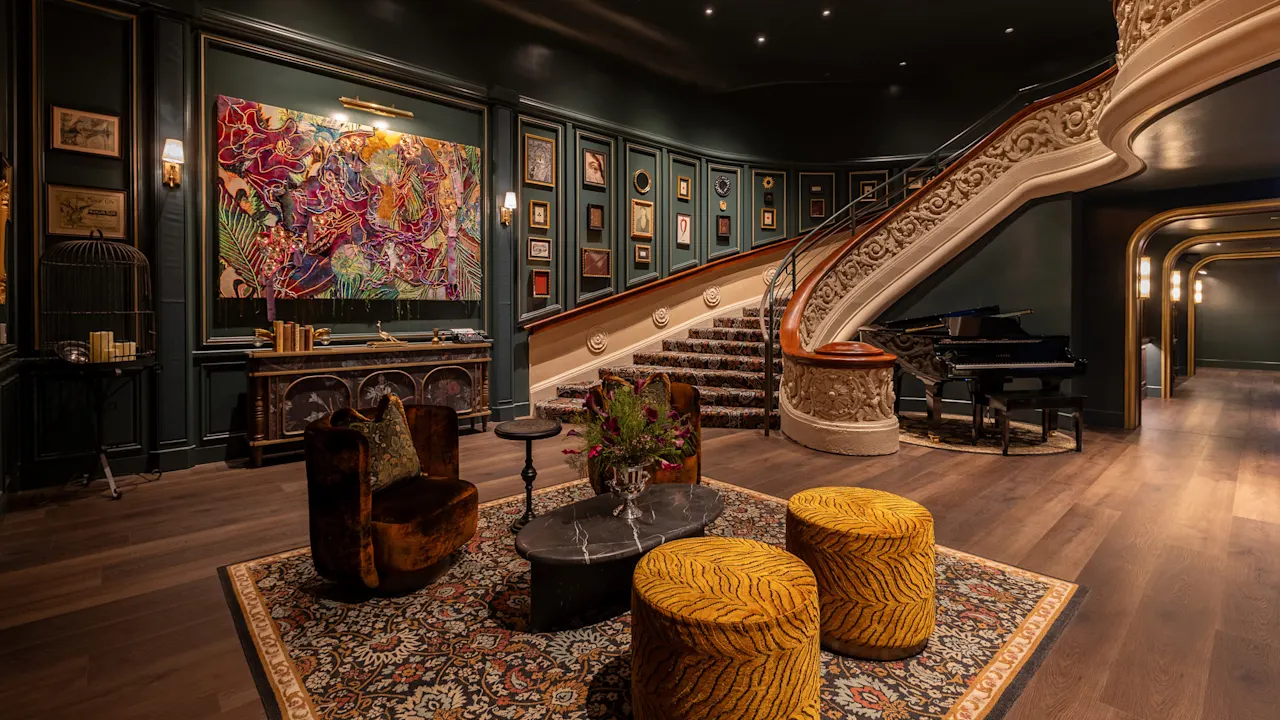
Now, when I step inside the lobby, a large wooden door slides open in front of me. I enter a room with a ringing telephone. And when I pick it up, my journey begins . . . With the help of the architecture firm Rockwell Group and the design firm Pentagram, the McCormick mansion has been transformed into The Hand The Eye, the largest magic venue in the world at 35,000 square feet. [Photo: Matthew Reeves/courtesy The Hand The Eye] The overall vision—and 50 million investment behind it—comes from Glen Tullman, who is both a Chicago-based venture capitalist and a lifelong magic enthusiast. His bet is that locals and tourists will spend 225 for a three-hour, no-cameras-allowed experience (with 75 in credits for food and drink) as they bounce from intimate rooms to larger theaters—seeing more magic at every turn in a setting that’s as much of a spectacle as the illusions themselves. “We built this to be a 100-year venture from every little aspect of what we’ve done,” says Tullman, as he excitedly gives me a tour through the space. “We built it to be for the performers and for the guests. We didn’t build it to say, ‘Let’s maximize profits.’ [Though] sometimes when you do that, you actually maximize profits, because people say, ‘This is so special.’” What is The Hand The Eye? The Hand The Eye is a theater, club, school, and networking spot for the magic-inclined. But ultimately, it’s an ode to mid-century Chicago-style magic: point-blank, reality-shattering card tricks that filled the city’s taverns as magicians walked from table to table, casually blowing people’s minds with nothing more than 52 small pieces of waxed paper. The mansion is designed to transport you out of any particular place and time, with a mishmash of motifs pulled from the 1870s to 1930s, the golden age of magic. Rich wallpapers, marble bars, careful carpentry, custom brass plaques, and copious amounts of fringe and velvet serve as a baseline across a space where no two rooms are alike. And since the mansion has few windows, it feels like a permanent 10:30 p.m. inside. I can see how the environment could make time disappear. The careful ode to magic never feels like kitsch, largely due to the fact that, ironically, most of what you’re looking at is real. This isn’t an escape room or some Disneyland ride. A mix of antique and custom-built furniture fills the space, and a museum’s worth of art and ephemera are staged everywhere you look—ranging from one of Harry Houdini’s milk cans (he’d lock himself inside and escape from the roughly 36-by-26-inch steel churn) to Alexander Herrmann’s “Chinese rings” and decapitation cloth. Many are sourced right from Tullman’s own collection. [Photo: Matthew Reeves/courtesy The Hand The Eye] Both the space and service are architected to create an unpredictable night. When you arrive, you’re given a schedule for a three-hour experience (and one you don’t need to follow to the minute—color-coded pins ensure that staff know to signal you when it’s time to move on, should you lose track of time). You may be ushered from communal bars and two large dining rooms into cozy spaces that squeeze in maybe a dozen people for close-up work, and then into one of four auditoriums for larger stage shows. I was particularly taken by a safe room lined with shining safety deposit boxes that belong to VIP members, who can bring their keys to unlock the occasional surprise. A séance room features one large table . . . but I’m told that when the lights go low, you never know what spirits might show up. The mansion contains too many rooms to fully enjoy in one night. So the club saves your journey, and it will never schedule you the same path through the space twice. I hear there are secret passages and rooms—none of which are revealed to me during my visit. In fact, even as a member of the media, I’m not allowed to photograph my tour. My phone’s camera, like everyone else’s who visits, is covered with a sticker upon arrival. “Today you go to a concert, and if you’re not in the front row, you mostly see it through the back of someone’s phone,” Tullman says. “Here, you’re in the moment and people walk out, and they’re, like, ‘That’s just the best evening I’ve had.’ Some of them don’t even think about why it was so good. And it’s because you were totally focused on enjoying it with people next to you.” Building the brand So much of the vibe—from the name and the logo to the signage and the merch—was developed alongside a 12-person team from Pentagram with support from Paper Tiger. The club was originally named “Metamorphosis,” after one of Houdini’s most famous tricks. Finding that a little too on-the-nose, the team went through a vast branding process to rename it. What they landed on—The Hand The Eye—is stately, mysterious, and descriptive. “We wanted a name that wasn’t just a pun or had the word ‘magic’ in it,” Pentagram partner Emily Oberman says. “The hand is about how all the magicians perform their magic, and then the eye is how the audience experiences it.” Visually, the team wanted to avoid magical tropes—no rabbits or top hats, no wands, no lightning scars. For the logo, Pentagram went literal, drawing a slightly curled hand with a floating eyeball between the thumb and index finger. When the team first showed Tullman the idea for the logo over a Zoom call, he surprised the team by making a ball float between his fingers. Oberman calls the project “a love letter to Chicago.” It incorporates the city’s stars and brass signage found around town. The color system—a rich, rotating mix of seasonal colors—pulls in a soft blue that locals might not even realize is straight from the Chicago flag. Meanwhile, the filigree and patterns used across Pentagram’s brand design—and gosh, there is so much intricate work—were pulled from the facade of the mansion itself. I can’t help but feel that the brand is so rich and retro because it’s not overly scripted or matchy-matchy. “It’s kind of like a mix of styles; all the filigree is a little bit different, too, and unique to the piece that it’s on,” notes Mira Khandpur, associate partner at Pentagram and lead designer on the project. You’ll find all of that branding across the typical touchpoints you’d expect, but also across magic tricks and card decks the team designed to be sold at the venue’s store (which, yes, is staffed by a magician who will gladly teach you a thing or two). I imagine it will be impossible to visit without at least buying a deck of cards to bring home. For Chicago, the investment is a boon to revitalizing its Mag Mile, which has faced challenges with vacancy since COVID—and Tullman claims that since he bought the building, it’s attracted other business owners to the block. But for the wider world of magic, it’s something more: It’s a space where mind-bending tricks—honed over endless hours in solitary confinement—can be put on a pedestal and shared with the world.
Fast Company
Coverage and analysis from United States of America. All insights are generated by our AI narrative analysis engine.