Cancer patient among 100,000 red state voters who lost food aid under Trump's new law
Narrative Analysis: Appeal to Fear
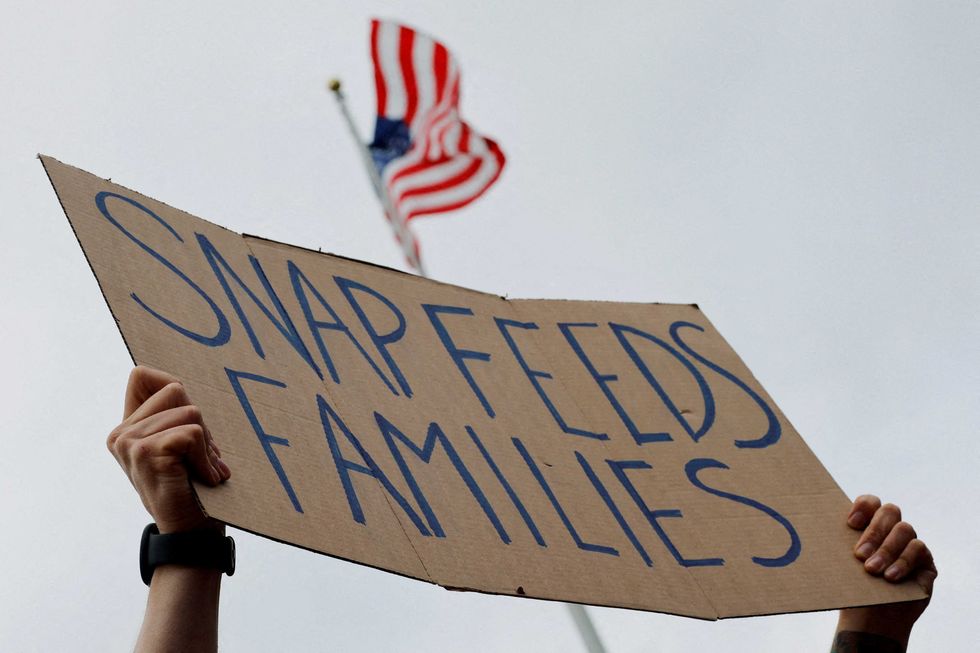
As she neared her 60th birthday, the stable pieces of Cassandra Boyle’s life began to fall away: first, she was laid off from her job. Then, a newly-purchased used car died in the middle of the freeway.She depleted her savings and retirement to pay rent, as she unsuccessfully tried to find a job with limited transportation. Ultimately, Boyle said, she decided to make a fresh start in Nashville, arriving in December from her hometown of Minneapolis-St. Paul.Weeks after she moved to Tennessee, Boyle was diagnosed with ovarian cancer.Living in a woman’s shelter while undergoing treatment at Vanderbilt University Medical Center, Boyle in January qualified for a 300 Supplemental Nutritional Assistance Program, or SNAP, to supplement the food provided at the shelter with the healthy and fresh foods her healthcare providers urged her to consume. She lost that benefit in April.“The notice said I was denied because I am able-bodied,” Boyle said. Notice came from the Department of Human Services, which administers the federal program in Tennessee.Boyle joins nearly 100,000 people in Tennessee who have lost the federal food aid since July 2025, according to state enrollment data. In May of this year, 597,890 Tennesseans received some level of SNAP benefits, down from 696,000 people in July 2025, the data shows. One out of every seven individuals who relied on the benefit last year no longer have it.The drop in enrollment coincides with a new law from the Trump Administration that rewrote many of the rules in the program. Beginning last July, the One Big Beautiful Bill Act cut 186 billion from the SNAP program, an 80-year-old federal program that provides low income individuals and families a monthly cash benefit, loaded onto debit cards, to spend at the grocery store.The law also added and expanded the requirement to hold down a job or attend school as a condition of receiving the benefit: previously, the rules made exceptions for individuals over the age of 55, veterans, children aging out of foster care and individuals experiencing homelessness. Now, these individuals must work or attend training or school to get the food assistance.Boyle falls into two of the new categories: she is unhoused and over 55. She has applied for federal disability benefits, but these can take months, or even years, to obtain. In the meantime, she said that even if she felt physically well enough to work, her frequent cancer treatments and doctors appointments make it nearly impossible to find a job.“It’s frustrating, because I’m trying to do the right thing all the way through. That’s what it feels like, ‘you are doing what you are supposed to do and you get penalized for it,” said Cassandra Doyle of qualifying for federal food benefits. (Photo: John Partipilo/Tennessee Lookout)“I’m just so close to saying, ‘forget it,’ and figuring out a way to get any job,” she said. A job would allow her to rent an apartment and move on with her life. “But the reason I haven’t done it is simply, with my medical stuff going on, who’s to say I wouldn’t end up homeless again in a few months?”“It’s frustrating, because I’m trying to do the right thing all the way through. That’s what it feels like, ‘you are doing what you are supposed to do and you get penalized for it,” she said.A spokesperson for the Tennessee Department of Human Services said last week the agency does not track how many individuals lost benefits due to new work or other federal requirements imposed by the One Big Beautiful Bill Act. Individuals may roll on and off for a variety of reasons, including changes in their economic circumstances, job loss and job gains.“We do not have data available at this time specifically tracking the information you have requested,” the spokesperson said. “As previously mentioned, there are many factors that affect an individual’s SNAP eligibility.”Advocates with the Tennessee Justice Center, a Nashville-based nonprofit legal advocacy organization, said the steep drop in enrollment since the legislation’s adoption makes the correlation clear.“Tennesseans did not suddenly stop needing help putting food on the table,” said Signe Anderson, senior director of nutrition advocacy at the Tennessee Justice Center.“What changed was the law. New barriers and paperwork requirements have made it harder for working families, older adults, veterans, and children to access the nutrition assistance that they are qualified to receive.” QuotationTennesseans did not suddenly stop needing help putting food on the table.– Signe Anderson, Tennessee Justice CenterEven as enrollment drops, the Department of Humans Services has taken alternative steps to expand eligibility for certain individuals, the department spokesperson said.The state last month adopted a new category, referred to as “broad-based categorical eligibility” that raises the income and asset limits for individuals and families to qualify for SNAP benefits.Previously, families’ gross income limit was 130 of federal poverty guidelines. Under the newly adopted rules, the gross income limit was raised to 200 of the federal poverty guidelines. Under the former guidelines, families could not qualify if they had more than 3,000 in savings. The new Tennessee guidelines eliminate this asset test.The federal government has long permitted states to adopt the broad-based categorical eligibility rules. Tennessee was the 47th state to adopt them, according to the Tennessee Justice Center.
Narrative Intelligence Brief
This article was published by Raw Story, a source frequently categorized with a left bias based in United States of America. Our narrative intelligence engine continuously monitors coverage from this outlet to track framing, bias, and rhetorical patterns. In this specific piece, our systems detected the potential use of the "Appeal to Fear" technique. This narrative approach is often used to shape reader perception by highlighting specific emotional or rhetorical angles. By understanding the editorial perspective of Raw Story, readers can better contextualize the information presented and compare it across our broader media matrix to find the real narrative.
More from Raw Story
June 16, 2026
Republicans get bad news in Iowa as they fail to boot spoiler candidate
June 16, 2026
Mockery erupts over Trump DOJ's 'embarrassing' evidence in Antifa indictments
June 16, 2026
Oscar legend plans Jan. 6 film that could be 'nightmare' for Trump: report
June 16, 2026
Supercut catches Trump repeatedly nodding off after he says ‘I’m not a big sleeper’
June 16, 2026
ICE rushing out new rules allowing detention center contractor to avoid lawsuits: report
Reliability Insights
P
Technique: Appeal to Fear
System analysis detected use of specific narrative techniques in this piece.Analysis Methodology
This narrative analysis was generated using the CoDataLab Global Intelligence Engine. Our proprietary AI scans thousands of cross-border sources to identify sentiment patterns, framing techniques, and potential media bias. While AI provides the data-driven foundation, our objective is to empower readers with additional context beyond the standard headline.The content displayed above is a structured summary designed for rapid information processing. For the full original report, please visit the source outlet.More Coverage
Discussion
"trump"
Trump’s OWN JUDGE Clobbers HIM FOR FRAUD ON COURT!!!!

UFC’s White House Fight Night May Have Been An Unforgivable Folly, But At Least It Was Violent And Offensive
The backlash against AI reveals it’s a terrible scapegoat