Today in News History
On June 20, several notable moments in the history of News stand out. In 1176, Mikhail of Vladimir, Russian prince passed away. In 1605, Feodor II of Russia (born 1589) passed away. In 1932, Robert Rozhdestvensky, Russian poet and author (died 1994) was born. In 1944, World War II: During the Continuation War, the Soviet Union demands unconditional surrender from Finland during the beginning of partially successful Vyborg-Petrozavodsk Offensive. The Finnish government refuses. In 1946, Xanana Gusmão, Timorese soldier and politician, 1st President of East Timor was born. In 1949, Gotabaya Rajapaksa, 8th president of Sri Lanka was born. In 1963, Following the Cuban Missile Crisis, the Soviet Union and the United States sign an agreement to establish the so-called "red telephone" link between Washington, D.C., and Moscow. In 1969, Misha Verbitsky, Russian mathematician and academic was born. In 1990, The 7.4 Mw Manjil-Rudbar earthquake affects northern Iran with a maximum Mercalli intensity of X (Extreme), killing 35,000-50,000, and injuring 60,000-105,000. In 2003, The Wikimedia Foundation is founded in St. Petersburg, Florida. Together, these milestones provide historical context for today's news news and ongoing narratives.
Can Russia secure ‘third power’ status in Southeast Asia with energy push?
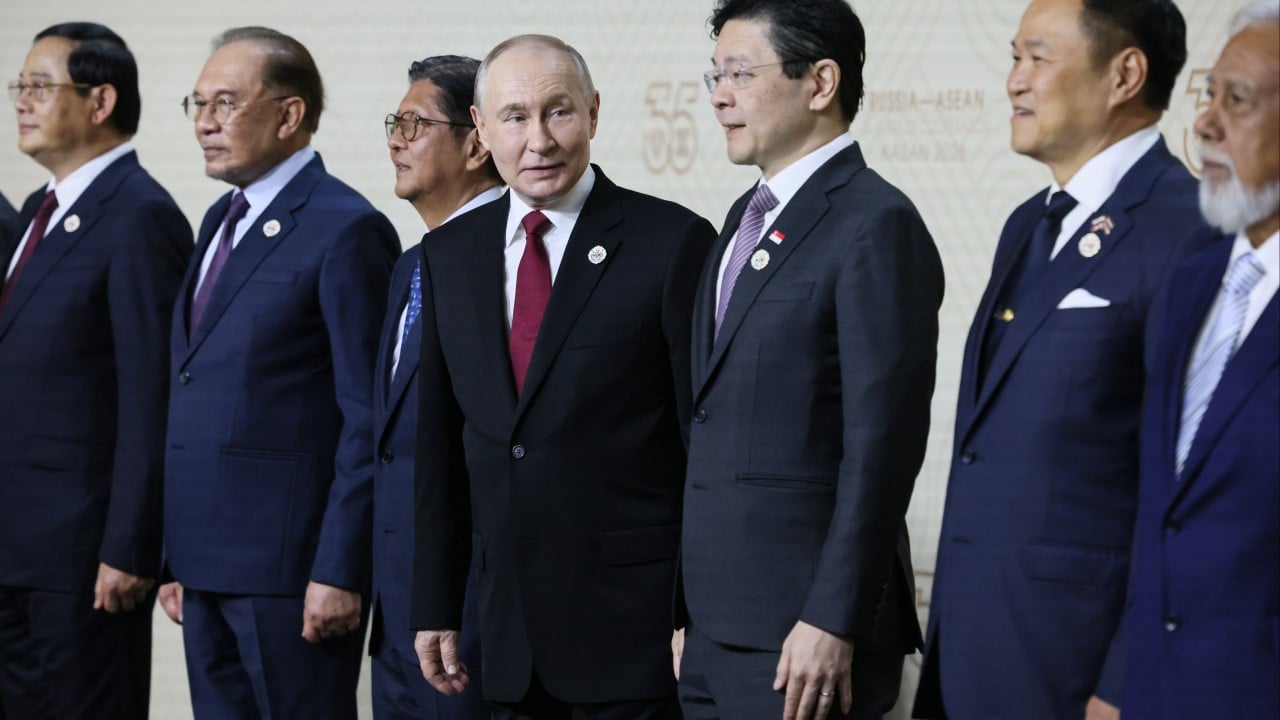
As Southeast Asia grapples with energy supply uncertainty, fallout from the Iran conflict and intensifying rivalry between the United States and China, Russia appears to be presenting itself as a viable “third power” option for the region, analysts say. Moscow’s pitch was on display at the Asean-Russia Commemorative Summit in Kazan on Thursday, where Russian leader Vladimir Putin met regional counterparts, and the two sides agreed to bolster political and economic ties, alongside several...
Narrative Intelligence Brief
This article was published by South China Morning Post, a source frequently categorized with a lean left bias based in Hong Kong. Our narrative intelligence engine continuously monitors coverage from this outlet to track framing, bias, and rhetorical patterns. Our initial algorithmic scan of this specific piece did not flag high-confidence rhetorical techniques, suggesting a generally straightforward reporting style or neutral framing. By understanding the editorial perspective of South China Morning Post, readers can better contextualize the information presented and compare it across our broader media matrix to find the real narrative.
More from South China Morning Post
June 20, 2026
Last professional letter writer in Chinese city pens 100,000 missives over 59 years
June 20, 2026
After another suicide, Hong Kong to review age threshold to cover more elderly in need
June 20, 2026
Bolivia’s president declares state of emergency, paving way for troop deployment
June 20, 2026
When the US comes for Cuba, what can Vietnam do?
June 20, 2026
What is Hong Kong’s role under China’s new vision for better global governance?
Analysis Methodology
This narrative analysis was generated using the CoDataLab Global Intelligence Engine. Our proprietary AI scans thousands of cross-border sources to identify sentiment patterns, framing techniques, and potential media bias. While AI provides the data-driven foundation, our objective is to empower readers with additional context beyond the standard headline.The content displayed above is a structured summary designed for rapid information processing. For the full original report, please visit the source outlet.More Coverage
Discussion
"die"
Anthony Albanese says Australia’s first mainland case of deadly H5N1 bird flu ‘concerning’
Obama: US may be 'worse off' than before Iran war started

Pete Hegseth’s ‘exceptionally bad idea’ creating needless suffering in military: analysis