
Today in News History
On June 22, several notable moments in the history of News stand out. In 1839, Cherokee leaders Major Ridge, John Ridge, and Elias Boudinot are assassinated for signing the Treaty of New Echota, which had resulted in the Trail of Tears. In 1905, Francis Lubbock, American colonel and politician, 9th Governor of Texas (born 1815) passed away. In 1941, World War II: Nazi Germany invades the Soviet Union in Operation Barbarossa. In 1944, World War II: Opening day of the Soviet Union's Operation Bagration against the Army Group Centre. In 1945, World War II: The Battle of Okinawa comes to an end with an American flag-raising ceremony. In 1950, Zenonas Petrauskas, Lithuanian lawyer and politician (died 2009) was born. In 1960, Erin Brockovich, American lawyer and environmentalist was born. In 1975, Urmas Reinsalu, Estonian academic and politician, 28th Estonian Minister of Defence was born. In 1990, Cold War: Checkpoint Charlie is dismantled in Berlin. In 2002, An earthquake measuring 6.5 Mw strikes a region of northwestern Iran killing at least 261 people and injuring 1,300 others and eventually causing widespread public anger due to the slow official response. Together, these milestones provide historical context for today's news news and ongoing narratives.
'Big trouble': Analyst flags 'severe cracks' in key bloc over Trump's broken promises
Narrative Analysis: Name Calling
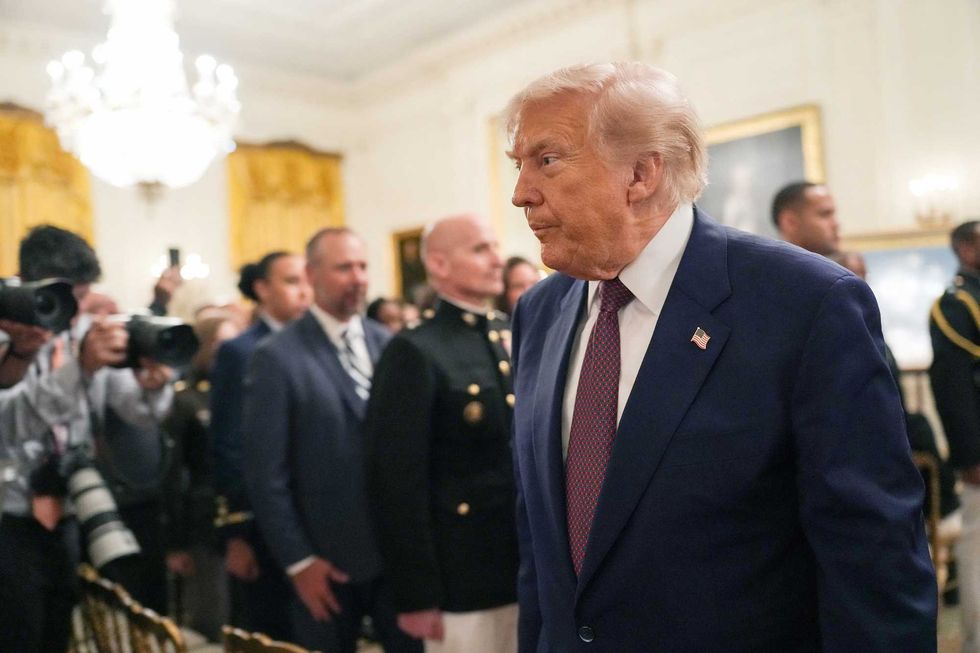
Republicans have signs of trouble ahead of the midterm elections after President Donald Trump has failed to deliver on his economic promises, an analyst argued on Monday. In a column for The Guardian, journalist and author Steven Greenhouse pointed out how the GOP will have to face this growing problem among white, blue-collar voters in the fall.If any demographic group was key to Donald Trump’s election victories in 2016 and 2024, it was white, blue-collar voters, Greenhouse wrote. But in perhaps perilous news for Republicans, Trump’s support from that group has plummeted – as many white, working-class voters have grown upset about everything from increased inflation and gas prices to Trump’s war against Iran. These glaring cracks in Trump’s blue-collar base point to big trouble for Republicans in this November’s midterm elections.The disappointment among GOP voters is bad news for Republicans, Greenhouse argued. And polls point to that mounting dissatisfaction — a new CBS poll revealed that 54 percent of white voters without a college degree disapprove of Trump's performance as president. Trump won 66 percent of white voters without a four-year degree in the 2024 presidential election.This shows severe cracks in Trump’s white, blue-collar base, a group that candidate Trump wooed by promising to crack down on immigration, to reduce prices on day one, to bring back manufacturing jobs and to not start new foreign wars, Greenhouse wrote. Many blue-collar voters see that Trump has failed to deliver on any of these promises except for his massive crackdown on immigrants – that crackdown has grown unpopular, however, after Trump’s masked agents killed Renee Good and Alex Pretti in Minneapolis.Democratic candidates in states with a large population of blue-collar, white workers could benefit in midterms from voters turning on Trump, especially in states such as Iowa, North Carolina, Ohio and Texas.To increase their chances of taking back the House and Senate, Democrats need to tap into the growing blue-collar disenchantment with Trump and Republicans, Greenhouse wrote. And let’s not forget that it’s not just white, blue-collar voters who have turned against Trump – many working-class African Americans, Hispanics and Asian Americans are also upset that Trump plunged the US into war and that gas prices have soared and that tomato prices are up 32 over the past year, coffee prices up 17 and beef up 13.
Narrative Intelligence Brief
This article was published by Raw Story, a source frequently categorized with a left bias based in United States of America. Our narrative intelligence engine continuously monitors coverage from this outlet to track framing, bias, and rhetorical patterns. In this specific piece, our systems detected the potential use of the "Name Calling" technique. This narrative approach is often used to shape reader perception by highlighting specific emotional or rhetorical angles. By understanding the editorial perspective of Raw Story, readers can better contextualize the information presented and compare it across our broader media matrix to find the real narrative.
More from Raw Story
June 22, 2026
Judge's scathing rebuke of Trump admin startles CNN: 'Quite a shock to see it on paper'
June 22, 2026
Woman swarmed by National Guard and US Marshals for dipping hand into reflecting pool: TMZ
June 22, 2026
Former White House communications director reveals what Trump told him about MAGA voters
June 22, 2026
Man busted in Chris Hansen sting operation wearing Trump shirt
June 22, 2026
Blistering new ruling finds Trump's agencies 'knowingly trampled' on a sacred right
Reliability Insights
P
Technique: Name Calling
System analysis detected use of specific narrative techniques in this piece.Analysis Methodology
This narrative analysis was generated using the CoDataLab Global Intelligence Engine. Our proprietary AI scans thousands of cross-border sources to identify sentiment patterns, framing techniques, and potential media bias. While AI provides the data-driven foundation, our objective is to empower readers with additional context beyond the standard headline.The content displayed above is a structured summary designed for rapid information processing. For the full original report, please visit the source outlet.More Coverage
Discussion
"lionel messi"
Kylian Mbappé hungry for Golden Boot battle with Messi as he sings Les Bleus

Lionel Messi Makes World Cup History With Record-Breaking Goal Against Austria

Lionel Messi breaks all-time World Cup scoring record with strike against Austria
