
0
Anduril isn’t just building the future of warfare; it’s redesigning it
April 28, 2026
Posted 2 hours ago by
What’s the closest you’ve ever stood to a drone? I’m not talking about a cute quadcopter, but a military-grade death machine that can carry enough warheads to obliterate a bridge, a tank, or a building? Sure, I’d heard of them. I’d seen them on the news. I’ve closely followed the paper, scissors, rock war in Ukraine where every six weeks the Ukrainians or Russians break the rules with new drone hacks.
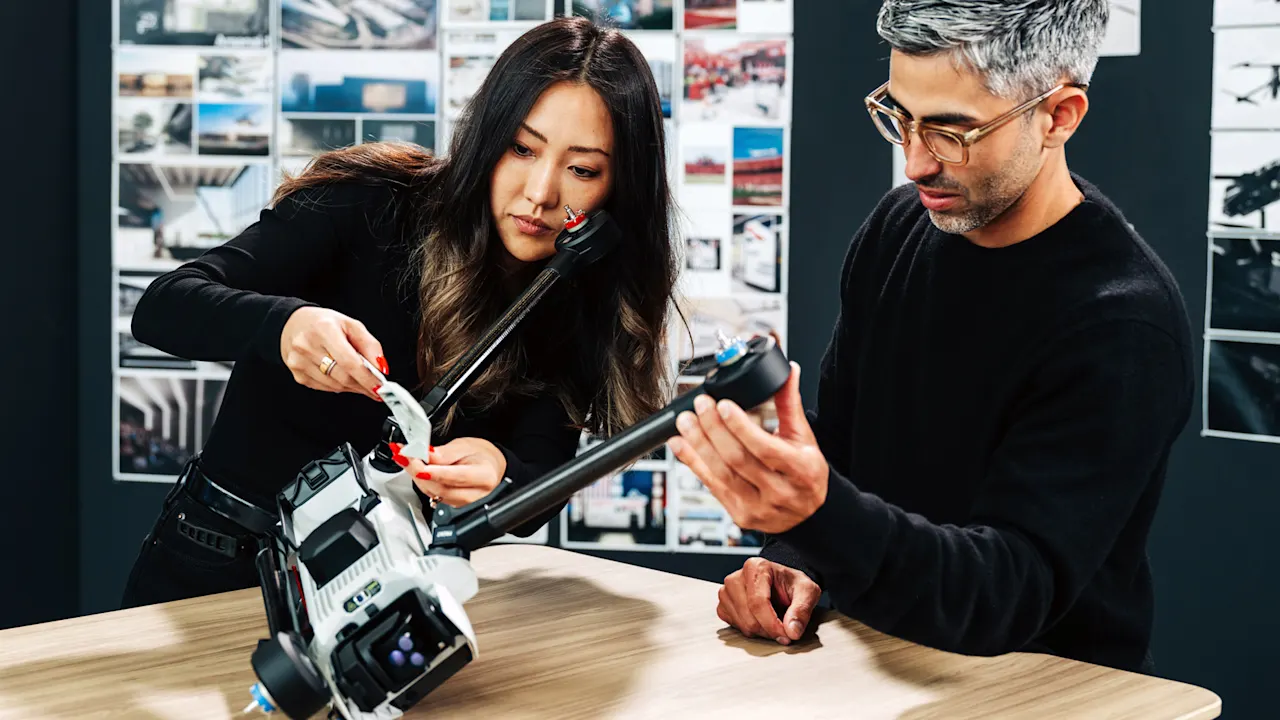
But it wasn’t until I was standing in front of the Fury, an autonomous plane meant to fly alongside F-16s and other military jets, that our Terminator era of warfare really hit me. This thing looks mean in an unknowable way, like a deep-sea predator that’s shed its gills and taken to the skies. It’s hard to look at the Fury without feeling a little afraid, and even a little disgusted. And yet for all my qualms around military spending and my dreams about a peace-filled world without war, ultimately I respond exactly like I’m supposed to: I’m relieved that the Fury is on our side. Or I should say, it can be, for a price. I’m standing next to Jen Bucci, the leather-jacket-clad head of design at Anduril, America’s hottest defense startup. She’s giving me a tour of the showroom, which looks a little like a Costco, with its unadorned concrete floors and stockpile of products—in this case, underwater missiles, an autonomous submarine mothership, and a variety of vertical-launching drones—that are sold in bulk. We’re heading toward the design lab, where Bucci’s team of 50 designers help craft the look and feel of Anduril’s offerings, from the shape of the weapons to the way they’re marketed. I’m the first journalist to be invited inside, and from the moment I step into the space, it’s clear Anduril isn’t interested in being a traditional defense contractor. Anduril is a defense manufacturer founded in 2017 by technologists Palmer Luckey, Brian Schimpf, Trae Stephens, Matt Grimm, and Joseph Chen—a group of technologists and venture capitalists with strong ties to the secretive surveillant software company Palantir, which powers the ImmigrationOS software used by the U.S. Immigration and Customs Enforcement agency. While the traditional “Primes” like Northrop Grumman, Boeing, and Lockheed Martin court mega government contracts to develop new weapons, Anduril acts more like a traditional product company. It forecasts the wars of tomorrow, spending hundreds of millions of its own funds to develop and acquire a range of interoperable (oft autonomous) products that it bets are too irresistible for the government to pass up. [Photo: José Mandojana for Fast Company] It’s easy to see how this vision plays out in the showroom. Each weapon is painted in matching gunmetal tones and accented in Chrysler “national safety yellow” (a hue that sits in the spectrum of “world’s most visible color” while giving the weaponry an enticing, Nike-like glow). A simple, machined curve is mirrored across products. As I eye a 13-foot underwater Copperhead missile in one corner, I realize how it could slot right into the expandable Dive-XL submarine in the other. [Image: courtesy Anduril] I mention to Bucci that the model feels like Apple; the more you buy, the more you want to buy. She agrees, but points out that it also fits the Android model when analyzing the actual technological stack, because other products can plug into Anduril’s Lattice software, which maps conflicts in real time by treating every connected device as another data source. So far, Anduril is a fraction of the size of its traditional competitors. In 2025 the company pulled in an estimated 2.1 billion in revenue to Lockheed Martin’s 75 billion. But with multiple government contracts that could add up to nearly 50 billion over the coming decade, Anduril’s private stock is trading at 40 over its value as analysts anticipate an initial public offering in 2027. Meanwhile, Bucci—who sits at an unusual perch as the head of design at a major defense contractor—leads her homebuilt team of cross-functional designers to ensure the Anduril brand articulates a new way of doing things across its products, marketing, and user experience. From industrial design to merch to the creation of what she jokingly calls the Anduril Cinematic Universe, Bucci is shaping the identity of the future of warfare as something more inspiring, or even aspirational. “I think that defense is an industry that needs design the most,” she says. “It’s the dirtiest, dullest, most dangerous job—you’d want to design for an audience [facing] that.” Trae Stephens, cofounder and executive chairman at Anduril, minces no words that he’s invested in design in order for the company to be viewed with the same sheen as a SpaceX. [Photo: José Mandojana for Fast Company] “[SpaceX] is essentially a rocket and satellite company that 99.9 of people in the world have no touchpoint to. They’re not gonna buy anything . . . and yet everyone’s excited about it,” he says. “There’s like a retail component to SpaceX that people understand. It’s cool and it’s new and it’s fresh, and it’s growing really fast. . . . So what does that do for them as a business? It de-risks them. It de-risks them on capital. It makes it much easier for them to raise money.” But Anduril’s strategy is actually more nuanced and ambitious than that. Anduril is using design to redefine patriotism for a generation that grew up on Gunpla, anime, and video games. It’s inventing a future of warfare that’s only been the stuff of war gazey sci-fi fantasy. That’s the ad, that’s the brand, and that’s the product—to stunt to taxpayers, soldiers, politicians, and military buyers, showing them where the money’s going to work. [Photo: José Mandojana for Fast Company] Inside the Anduril design lab The scene opens with an idyllic cloudy blue sky reminiscent of a Studio Ghibli film. Even as the drones fly past, it’s almost pastoral. That is until the synths come in and the camera is submerged underwater. We see hands typing at a red-hued military workstation, a shot straight out of 1990s war anime. Then the cartoon segues into a diametric explainer, as Anduril’s submerged ship comes into view, deploying its Seabed Sentry mesh network and Copperhead missiles that swirl like sharks feeding. While perhaps a strange scene for a defense contractor, this anime ad on YouTube has successfully educated me on the intricacies of Anduril’s complex weapons systems, and the commenters on the internet love it. “We kind of view fiction as being a window into the future. Science fiction, anime, manga,” Bucci says, noting that references to Gundam are commonplace with founder Palmer Luckey when ideating future products. “A lot of the things that will become critical to the future of war have already been described and explored in great detail in fiction. And so capturing that aesthetic, I think, is part of inspiring humanity.” [Photo: José Mandojana for Fast Company] As a self-described ’90s kid, Bucci grew up on Sailor Moon and Power Rangers. She became obsessed with the 007 films. Pierce Brosnan, whom she declares to be “the most underrated Bond,” was her first crush. Bond was always “so stylish doing all the badass things,” she says, and the movies introduced both a passion for vehicles like his Aston Martin and the desire to be something like a CIA agent herself. Bucci dropped out of an ROTC program in the eighth grade, but she did attend ArtCenter College of Design and pursue automobile design. After landing a job at Ford, she faced the same realization that a lot of eager young designers do: Maybe one person gets to design the silhouette of the vehicle. Everyone else toils away at small details. “I don’t know how many wheels I’ve done. I must have done, like, hundreds of them,” she says. “I’m like, ‘I don’t know how else to slice up the circle! I’m tapped out.’” [Photo: José Mandojana for Fast Company] But auto design lured her to auto marketing, and she ventured into photography and branding, stretching her skill set. Eventually, Bucci’s desire to be part of something bigger had her shoot for the moon with NASA but ultimately land at Boeing, where she designed liveries and “everything was blue.” She got her first taste of how conservative the Primes are when it comes to the role of design across the company. “At Boeing, I don’t think I met a single industrial designer, if I’m being honest,” she says. “There were a lot of design engineers, you know, but there wasn’t, like, an industrial design department.” So when she saw Anduril’s job listing for an industrial designer, she concluded it must be “very modern, thinking about this stuff.” Little did she know, Anduril was trying to be modern—to build an enticing, Apple-like model in defense—but failing. Stephens had spent nearly four years searching for the company’s head of design. He interviewed more than 50 people for the position, but was left inspired by all of them. But during their interview in 2021, Stephens and Bucci discovered they were kindred spirits. Stephens, too, had something of a 007 complex, having started his career in the intelligence industry, only to be heartbroken when he was issued an old Windows 98 laptop instead of a laser watch. (Cue his inspiration for Anduril.) When he asked Bucci about her favorite car—a question she always hated—she offered, “Aston Martin.” Not realizing Stephens was a car buff himself, he wanted her to name a model. So she mentioned being fond of the design of the Vantage in the early 2000s. “He turns around, and he picks up a car model. He’s like, ‘This one?’” Bucci recounts. “And it was exactly the model. It was exactly in that moment that we clicked.” Instead of an industrial design role, Bucci was offered the entire design department. Roughly five years later, she tours me through the design lab she’s built. “I really wanted design to be a central function and a core function, so it’s a pillar of every decision that we’re making as a business, but also that it’s one team that is centralized,” she says. “You have to infiltrate the whole thing for this to work. It’s setting that standard and having everybody kind of go through that machine.” [Photo: José Mandojana for Fast Company] The first thing I note, walking into Anduril’s design lab, is how much natural light comes in through the windows. Visit design labs at tech companies like Microsoft and Google, and you’ll find yourself in secure rooms built without windows. Bucci admits that Anduril has a similar space she’ll use a few hours a month on high-clearance secret projects. But otherwise, the team works here together. In the very front of the lab is the design dojo, an open space with a large shared table where teams hold weekly or biweekly meetings. I spot Anduril posters along the walls—all of which use Helvetica with a respect for the Swiss grid. [Photo: José Mandojana for Fast Company] The bulk of the design team can be found in the loft above the dojo. Here, industrial designers, brand designers, motion designers, interaction designers, environmental designers, concept designers, sound designers, and animators all work elbow-to-elbow. A photography and media production studio brings in the tail of the setup, where the team keeps every U.S. military uniform and several sizes of boots on hand so they can customize imagery for each branch of the armed forces. I can’t help but notice a black-and-white Hawaiian shirt at the end of the rack, which I can only assume is the more serious uniform of the luau-ready Luckey. Peeking at monitors as Bucci introduces me to the team, I begin to understand how her Anduril strategy comes together. I see NASCAR liveries for its stock car sponsorship. Plans for Anduril’s brutalist Arsenal-1 factory that opened in Ohio in March but whose entire buildout will extend to 2035. Schematics for its augmented reality Eagle Eye helmet and glasses (3D-printed mockups sit nearby and serve as form studies to explore various sizes of temple tips). Each disparate project is a unique articulation of the brand. [Photo: José Mandojana for Fast Company] As we walk, I meet the designers of Anduril’s OV-1s. That’s a technical term, but think of them as detailed tactical mission maps, oft-used to sell the government on hardware. OV-1s from competitors look like a cheesy board game weekend gone wrong, with flat maps covered in seemingly senseless arrows. But Anduril’s are presented with 3D terrain and hyperrealistic graphics—like little terrariums of war. It’s a demonstration of how Bucci’s team challenges the design tropes of war. And how it’s even more responsible for marketing, branding, and selling Anduril as it is designing products; you’ll find just three industrial designers on Anduril’s 50-person design team. [Photo: José Mandojana for Fast Company] “The hyperreal look works here because we’re trying to communicate things accurately,” Bucci explains, noting how visualizations offer creative leeway that Anduril wouldn’t dare use elsewhere. “But for the products that we’re putting out into the public, it’s very important that none of them are renderings, none of them are 3D models. It’s only practical photography and video, because we’re trying to show that these are real and in action and storytelling of the operator.” Anduril is playing with different ways to design these maps. On one screen, I see a moodboard with video game HUDs and worlds rendered in Miami-style neon colors. They don’t represent the Anduril style of today, but the company is always looking to evolve. “We are world-building,” Bucci says. “I want each product line to have its own suit.” The designers joke internally that they’re building the Anduril Cinematic Universe, which I tease is the ACU to Marvel’s MCU. But don’t expect that universe to stick around in anime, or any other single rinse-and-repeat aesthetic. “Anime fits us because anime is always about conflict, like these machines fighting each other. It’s always good and bad, and we as people who are basically building that future, it’s a medium that really fits us,” Bucci says. “But I don’t want to use it as a trick constantly. We’re going to do one more installation of it and we’re done.” [Photo: José Mandojana for Fast Company] Defining the Anduril product Building the Anduril brand is about a lot more than marketing. Ultimately, Bucci’s role is to ensure design impacts every part of the business, especially the presentation and experience of products. That’s difficult, she admits. Engineering is king in the defense world, as it dictates specifics around aerodynamics and other mission-critical details. “Early conversations with engineering weren’t always that smooth,” Bucci says. “It was a lot of questions around, like, ‘Why would we do this? Why should we do this?’ We’re adding more steps to the process. Contrasting that with now . . . it is a complete collaboration, where they understand the value of what industrial design is—that it’s not just decorating.” Key to this collaboration has been getting design involved earlier in the development process of new products. A good example is Anduril’s Dive-XL submarine. It basically looks like a big whale. [Photo: José Mandojana for Fast Company] You can appreciate the utilitarian decisions at play: The four panels making up the front and rear are actually just one piece repeated four times. Its side walls are flat panels for easy manufacturing. All are the sort of engineering efficiencies that Anduril prioritizes to ensure its products can be produced easily, on typical assembly lines. But designers always look for opportunities to add speed. And in this case, Bucci’s team gave the design more of a spine (like a car), and adjusted the mast angle from vertical, like The Titanic, to swept, like an oceanic carnivore. [Image: courtesy Anduril] The overall form is but another “squircle”—and Anduril’s penchant for chamfering details across its product portfolio always makes me think of the space war Xbox franchise Halo—which we see repeated whenever aerodynamics doesn’t get in the way. Bucci works squircles into everything. Anduril’s sensor tower, for instance, is built largely from off-the-shelf parts, with circular cutouts on many pieces. But a single brace the Anduril team added has squircle cutouts. We see squircles incorporated into Eagle Eye, into drones, into equipment bags, into the very silhouette of the Dive-XL. [Photo: José Mandojana for Fast Company] One of my biggest surprises is that, even on submarines and missiles, screws are exposed for simple serviceability. Across the board at Anduril, weapons are made to be modular, fixable, and often quickly assembled and deployed in the field. Designers point to such features with plain-language liveries and the aforementioned safety-yellow highlights. It all adds up to better UX for soldiers on the battlefield and also, Bucci hopes, a certain confidence that comes with knowing they’re using an Anduril product. [Photo: José Mandojana for Fast Company] “I’m constantly looking for ways we can infuse a little bit of our design language that’s lightweight and easy into a system that is predominantly not designed,” she says. In the case of fold-out Bolt drones, that’s as simple as adding a two-tone, black-and-white “water line” to articulate the shapes. Meanwhile, the team leaves elements like heat sinks and fans exposed. Sometimes, it’ll even coat those elements with a bit of Anduril yellow, dunking an otherwise drab chicken wing into some hot sauce. [Image: courtesy Anduril] Much of Bucci’s focus is on developing repeatable systems that can service every product in Anduril’s arsenal, to get every product on the same page so that it looks its best. Color is a big part of that effort, and Anduril has its own versions of military colors it uses solely for marketing—like an “artichoke” green that I see listed alongside a line of dusty colors that look straight out of a Skims ad. That insight was born from an early misstep with engineering, in which they were wrapping a large truck in military tan. The engineer assured Bucci he had “the perfect tan,” and he’d seen a swatch. But when Bucci went to see the finished vehicle in a warehouse? “It was Ken doll tan. Fleshy—a little pink,” she says with a laugh. “Ever since then, I was like, ‘This is the variance. Here are exactly the three tans you’re allowed to use. That’s it.’ Nobody gets to pick tans anymore. Actually, nobody gets to pick any colors anymore.” Anduril’s more thoughtful approach to branding has caught on. While armed forces still use their own spec, Anduril has begun to branch out and design the livery that will appear on the tail wing of a product it sold to the U.S. Air Force. Bucci believes it’s the first time an external contractor has ever done so. With this move, Anduril is no longer just branding its own products. It’s actually branding the U.S. armed forces—which seems to be the greater, tacit goal of Anduril’s design language across the board. [Photo: José Mandojana for Fast Company] The business of war Ask anyone at Anduril how they feel about building weapons for a living, and you won’t get an apology. Bucci says she sleeps well at night by framing her work around the end user—that young soldier on the battlefield. “It’s what makes the work very deeply human for me,” she says. “Anytime I talk to candidates, I’m very clear: You’re joining a company that is going to be manufacturing weapon systems. That shouldn’t be something that we’re straying away from or trying to hide in some way. . . . If the motivation isn’t there . . . it’s very hard to succeed here.” Beyond its role manufacturing autonomous weapons and some field reports that have questioned the performance of Anduril products, the company has been criticized for its involvement in surveillance through its Autonomous Surveillance Towers and its Ghost drones, which monitor border crossings from Mexico. When I ask Bucci how she would feel if products she helped design were used in ways she disagreed with, she says she’s not hired for her opinions on politics, but so far that hasn’t happened. “We’ve supported the Ukraine deterrence efforts,” she notes, “and I’m really proud of that.” Outside the company, she knows this viewpoint is less common. “The first project I actually got was redesigning our website, and that was interesting, because I think I got a glimpse of the perception of our company at the time—because none of the agencies wanted to work with us,” she recalls. “They’re like, ‘We don’t want anything to do with you.’ When that happened, I thought, Oh, this is going to be hard. But I believed strongly that we could change that.” [Image: courtesy Anduril] Today, the perception around Anduril has evolved from punch line to uncomfortable investment to darling IPO waiting to happen. Part of that credit belongs to the political climate during the second Trump administration, where defense spending is up and the Department of Defense was literally renamed the Department of War. And part of the credit belongs to Bucci and her team, whose rebrand of war seems crucial to this mind shift. There may be no greater evidence of Anduril’s increasing palatability than the fact that while Bucci used to face an environment where “nobody was applying,” so she was barely able to fill design positions, now she has countless applications for every open designer role. In the meantime, Anduril doesn’t mind framing itself as an unlikely source of innovation to move humanity into its sci-fi era—embracing a return to the paradoxical optimism of midcentury defense initiatives like RAND and DARPA that brought us technologies ranging from the internet to GPS. Before I end my call with Stephens, he brings up the 2013 Matt Damon movie, Elysium. Despite the fact that it’s a dark popcorn flick in which Damon’s character is a poor, radiated worker who dons a super suit to escape a rotting Earth, break into a wealthy galactic suburb, and use a special med bay to cure himself, Stephens argues it’s more inspiring than people give it credit for. “That’s remembered as being a dystopian movie about wealth inequality, which I get. I’m not saying that wealth inequality is a good thing,” he says. “But they had a machine that could cure all human disease. Why are we not talking about that?”
Fast Company
Coverage and analysis from United States of America. All insights are generated by our AI narrative analysis engine.