
Today in News History
On July 5, several notable moments in the history of News stand out. In 1915, The Liberty Bell leaves Philadelphia by special train on its way to the Panama-Pacific International Exposition. This is the last trip outside Philadelphia that the custodians of the bell intend to permit. In 1934, "Bloody Thursday": The police open fire on striking longshoremen in San Francisco. In 1954, The BBC broadcasts its first daily television news bulletin. In 1965, Porfirio Rubirosa, Dominican race car driver, polo player, and diplomat (born 1909) passed away. In 1970, Air Canada Flight 621 crashes in Brampton, Ontario, Canada, killing all 109 people on board. In 1975, Hernán Crespo, Argentinian footballer and coach was born. In 1976, Walter Giesler, American soccer player and referee (born 1910) passed away. In 1993, Jorge Polanco, Dominican baseball player was born. In 2009, A series of violent riots break out in Ürümqi, the capital city of the Xinjiang Uyghur Autonomous Region in China. In 2015, Yoichiro Nambu, Japanese-American physicist and academic, Nobel Prize laureate (born 1921) passed away. Together, these milestones provide historical context for today's news news and ongoing narratives.
A Shockingly Positive Review Of World Cup Public Transit In Los Angeles
Narrative Analysis: Bandwagon
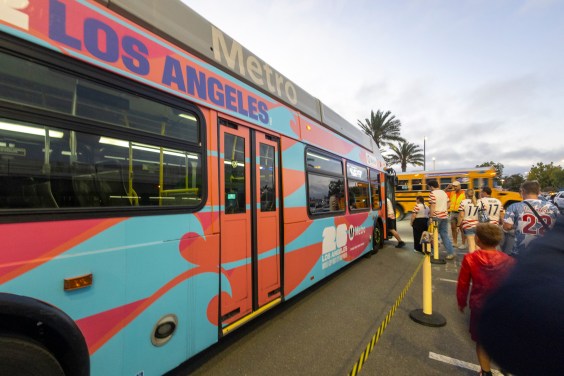
Expectation is everything. Considering the public transit price-gouging SNAFUs in New York New Jersey and Foxboro that dogged World Cup transit public relations prior to the event, some heat was taken off cities historically hostile to the concept of public and transit, such as Los Angeles. Together, all three cities compose the Doable But Miserable tier of Aaron Gordon's breakdown of World Cup stadium transit access, which also elaborates on how the new Los Angeles stadium and its surrounding area, despite proximity to a great deal of transit options, fails to directly connect to many of the most convenient ones. Unlike New York New Jersey and Foxboro, however, Los Angeles was only charging 1.75 for direct service to and from the stadium. This posed some interesting questions. How easy and efficient would it actually be to take public transit—specifically the special shuttle service—in Los Angeles to a World Cup game? Would it be better or worse than Secaucus Junction? And so amidst threats made by my beloved colleagues to force me try walking to the Meadowlands for journalism's sake, I fled to the West Coast to instead answer a question that was less likely to result in immediate death and/or severe bodily harm. Here was the situation. I was planning on going to, though not directly attending, the round of 32 game between Spain and Austria in Inglewood. I was staying with a friend in her hotel room in downtown Los Angeles, right next to the Los Angeles Sparks' arena. This is one of the more transit-accessible locations in Los Angeles, with access to four separate Metro stops within a 15-minute walk. Without the direct shuttle, the commute from the hotel to the stadium would, in an ideal world sans traffic, take approximately 25 minutes by car, an hour by transit, and three hours and 40 minutes by foot. (This last point would not be relevant, if not for the fact that as my friend and I were breaking this down, we discovered that one could walk across the entirety of Munich in that same three hour and 40 minute timeframe.)
Narrative Intelligence Brief
This article was published by Defector, a source frequently categorized with a center bias based in United States of America. Our narrative intelligence engine continuously monitors coverage from this outlet to track framing, bias, and rhetorical patterns. In this specific piece, our systems detected the potential use of the "Bandwagon" technique. This narrative approach is often used to shape reader perception by highlighting specific emotional or rhetorical angles. By understanding the editorial perspective of Defector, readers can better contextualize the information presented and compare it across our broader media matrix to find the real narrative.
More from Defector
July 5, 2026
Banger British Grand Prix Ends With A Whimper
July 5, 2026
FIFA Makes Good And Right And Not At All Corrupt Decision To Rescind Folarin Balogun’s Red Card Suspension
July 3, 2026
Darren Aronofsky’s AI Videos Are A Fitting Tribute To America, I Guess
July 5, 2026
Jonas Vingegaard Made It Out Alive, Then Made Barcelona Smile
July 3, 2026
25 Rap Songs For America’s 250th
Reliability Insights
P
Technique: Bandwagon
System analysis detected use of specific narrative techniques in this piece.Analysis Methodology
This narrative analysis was generated using the CoDataLab Global Intelligence Engine. Our proprietary AI scans thousands of cross-border sources to identify sentiment patterns, framing techniques, and potential media bias. While AI provides the data-driven foundation, our objective is to empower readers with additional context beyond the standard headline.The content displayed above is a structured summary designed for rapid information processing. For the full original report, please visit the source outlet.More Coverage
Discussion
"folarin balogun"
Trump Thanks His World Cup Suck-Up Pal for Doing His Bidding

FIFA Makes Good And Right And Not At All Corrupt Decision To Rescind Folarin Balogun’s Red Card Suspension
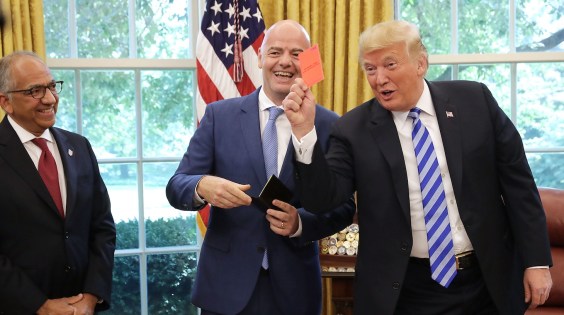
Trump called FIFA president to reverse Folarin Balogun’s one-game ban
