
'A Dramatic Abdication': Trump Admin to Send US Citizens With Ebola Exposure to Kenya
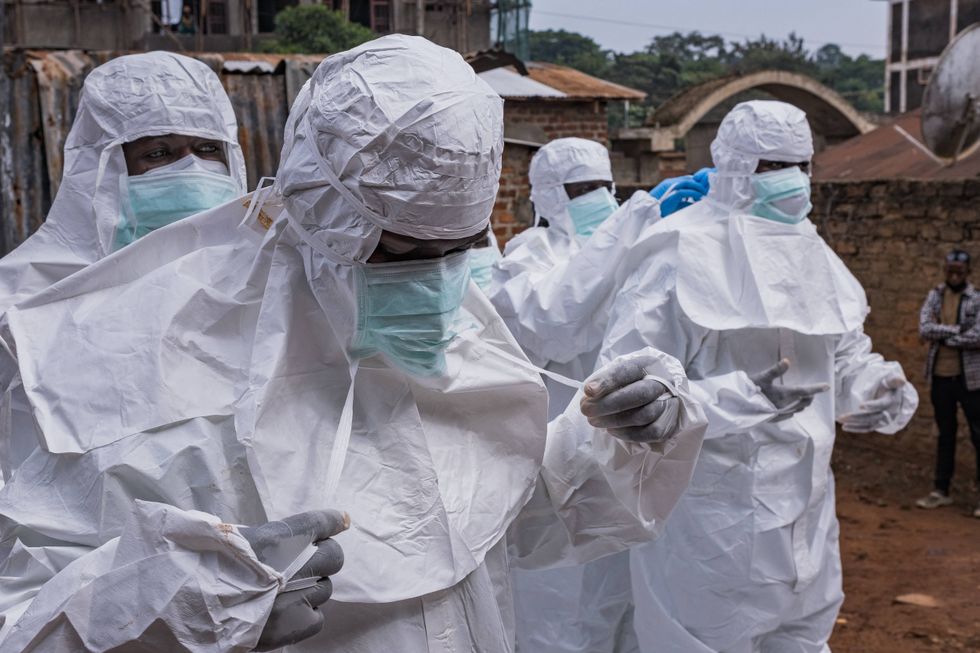
In what one emergency physician and public health expert called “a dramatic abdication of what we owe our own,” the Trump administration is reportedly preparing to send Americans with suspected and confirmed cases of Ebola to a facility in Kenya, instead of repatriating them and treating them in the state-of-the-art quarantine and treatment facilities the US has for dangerous diseases that pose a threat to public health. The facility is currently being set up, The New York Times reported, and several dozen Public Health Service officers—whose agency operates under the Department of Defense—are training to deploy to Kenya. The PHS also deployed to Liberia during the 2014 Ebola outbreak in West Africa. This is unbelievable and infuriating, said Dr. Craig Spencer, a professor of public health at Brown University. According to the Times, the PHS officers in Kenya were initially going to monitor any Americans, such as healthcare workers who have gone to the Democratic Republic of Congo (DRC) to help contain the outbreak that was declared a public health emergency of international concern earlier this month. Those who showed symptoms would be transferred to European hospitals; at least seven Americans have been sent to facilities in Germany and the Czech Republic in recent weeks.But two people familiar with the plans told the Times that the administration now plans to see to the patients' treatment in the Kanya facility as well. When Americans will need us most—especially those who go abroad to help end this outbreak at its source—the US government plans to send them to a hospital it is standing up from scratch in Kenya, wrote Spencer on Substack on Tuesday. I find it incredibly difficult to believe that we can stand up a facility in the next few weeks—or even months—with the staff, the supplies, and the experience we’ve built over the past decade in more than a dozen hospitals across the US.Dr. Krutika Kuppalli, who helped treat Ebola patients in Sierra Leone in 2014, said the plan does not make sense from a preparedness, operational, or ethical standpoint.How are public health officers going to take care of persons who get sick? said Kuppalli. These are not persons who have experience in providing high levels of care for persons with this infection. Also, why would a PHS officer deploy knowing if they had an exposure that they wouldn’t be repatriated? Spencer raised concerns that the plan could push people to hide potential exposures, or incentivize individuals or organizations to downplay those exposures. If you know that any 'high-risk' exposure will get you shipped to Kenya instead of sent home, it’s not hard to imagine people not being fully forthcoming about what may have happened to them. That is exactly backwards from how you contain a disease.This will also discourage Americans from joining as part of the response, he wrote. I know of multiple healthcare providers who are considering deploying with humanitarian organizations, and we need a cavalry to help support the on-the-ground response if we have any hope of ending this outbreak. But programs and policies like this are exactly the reasons people will hesitate to sign up.Spencer, who contracted Ebola after deploying to West Africa in 2014 and was quarantined and treated at Bellevue Hospital in New York City, emphasized that the strain of Ebola that began spreading in Ituri Province, DRC and is confirmed to have spread to Uganda does not have an approved treatment or vaccine. Survival depends heavily on the quality of the system and the people around you, wrote Spencer. We have that system—I survived Ebola and am here today partly because of it—but we are choosing not to use it.The news of the plan to send infected Americans to Kenya comes as suspected cases have ballooned to at least 906, according to the World Health Organization's (WHO) latest Weekly External Situation Report, released on Sunday. The report said there have been 223 suspected deaths from the current Ebola strain, which is caused by the Bundibugyo virus, as opposed to the Zaire strain, for which a vaccine and treatments have been approved. More than 100 cases and 10 deaths have been confirmed in DRC, while seven cases and one death have been confirmed in Uganda. The report emphasized that following up with contacts of people who have developed Ebola symptoms is a major challenge, with just 19.3 of contacts seen by health professionals within the previous 24 hours as of May 23. Constraints include insecurity, movement restrictions, highly mobile populations linked to mining communities, anddifficulties tracing contacts across dispersed and cross-border populations, as well as limited trained contact tracers todate, reads the report. Low levels of trust in the affected communities—a major impediment to an effective response—also appear to be raising the risk of transmission. As Reuters reported on Monday, at least three attacks on Ebola treatment facilities in the northeastern DRC have caused dozens of patients to flee the hospitals.The attackers are reportedly motivated by a desire for the hospitals to release the bodies of deceased Ebola patients for burial—unsafe given that the virus remains transmissible after death—or by suspicion or doubt about the virus, reported Reuters. Dr. Richard Lokudu, medical director of the Mongbwalu General Referral Hospital in Ituri, told Reuters that there is denial of the disease within the population.While US Secretary of State Marco Rubio blamed WHO for being a little late to identify that outbreak, public health experts have pointed to the Trump administration's massive cuts to foreign assistance and global public health initiatives, including the dismantling of the US Agency for International Development (USAID), as a major factor that likely allowed cases to spread for an extended period of time before international officials realized the outbreak was occurring. As Common Dreams reported last week, USAID's Ebola prevention work was largely halted by the Department of Government Efficiency, run last year by tech billionaire Elon Musk—despite Musk's insistence that funding for Ebola efforts was maintained. USAID had more than 50 staffers dedicated to responding to and preparing for disease outbreaks like Ebola and Marburg virus, but DOGE's cuts reduced the workforce to about six people. With Rubio insisting that we can’t have Ebola cases in the US and that keeping the disease out of US borders is the top priority for the country, the administration has invoked Title 42 to keep travelers from the DRC, Uganda, and neighboring South Sudan from entering the US if they were in any of the three countries in the previous 21 days. WHO has warned that travel bans and restrictions are not based in science. Cuts at the CDC have also led the agency to put out a call to its workforce, seeking volunteers to conduct public health screenings at airports. The State Department said last week it had mobilized about 23 million to help the DRC and Uganda respond to the outbreak and is mobilizing CDC staff and resources.But Spencer said Sunday that the administration's travel bans and focus on keeping those affected by Ebola out of US borders are a policy you put in place when you have nothing else meaningful to add. It gives the appearance of doing ‘something’ while effectively doing nothing of value at all. And it takes away attention from where the real problem is.
Narrative Intelligence Brief
This article was published by Common Dreams, a source frequently categorized with a left bias based in United States of America. Our narrative intelligence engine continuously monitors coverage from this outlet to track framing, bias, and rhetorical patterns. Our initial algorithmic scan of this specific piece did not flag high-confidence rhetorical techniques, suggesting a generally straightforward reporting style or neutral framing. By understanding the editorial perspective of Common Dreams, readers can better contextualize the information presented and compare it across our broader media matrix to find the real narrative.
Explore related topics: Stay informed with Real Narrative News as we track unfolding stories. Dive deeper into our coverage of pivotal topics including white house, عيد الأضحى, iran war, donald trump, جنوب لبنان, supreme court, eid aladha, ebola outbreak, ken paxton, and james talarico. Our intelligence streams continuously monitor these keywords to bring you unbiased analysis and real-time updates on topics like "'A Dramatic Abdication': Trump Admin to Send US Citizens With Ebola Exposure to Kenya".
More from Common Dreams
May 27, 2026
Food Prices Set for Summer Surge as Trump and GOP Stare Down Inflation ‘Abyss’
May 27, 2026
'A Dramatic Abdication': Trump Admin to Send US Citizens With Ebola Exposure to Kenya
May 27, 2026
Ben-Gvir Says Israel ‘Will Not Allow’ Trump to Make a Peace Deal With Iran as IDF Kills Dozens in Lebanon
May 27, 2026
'How the Corruption Works': Trump Boosts Prediction Markets as His Family Profits
May 27, 2026
2,315 Meters Under the Sea, Greenpeace Stages Deepest Protest in World History
Analysis Methodology
This narrative analysis was generated using the CoDataLab Global Intelligence Engine. Our proprietary AI scans thousands of cross-border sources to identify sentiment patterns, framing techniques, and potential media bias. While AI provides the data-driven foundation, our objective is to empower readers with additional context beyond the standard headline.The content displayed above is a structured summary designed for rapid information processing. For the full original report, please visit the source outlet.More Coverage
Discussion