
Today in News History
On June 22, several notable moments in the history of News stand out. In 1897, British colonial officers Charles Walter Rand and Lt. Charles Egerton Ayerst are assassinated in Pune, Maharashtra, India by the Chapekar brothers and Mahadeo Vinayak Ranade, who are later caught and hanged. In 1909, Infanta Beatriz of Spain, Spanish princess and aristocrat (died 2002) was born. In 1920, Jovito Salonga, Filipino lawyer and politician, 14th President of the Senate of the Philippines (died 2016) was born. In 1981, Sione Lauaki, New Zealand rugby player (died 2017) was born. In 2000, Wuhan Airlines Flight 343 is struck by lightning and crashes into Wuhan's Hanyang District, killing 49 people. In 2002, An earthquake measuring 6.5 Mw strikes a region of northwestern Iran killing at least 261 people and injuring 1,300 others and eventually causing widespread public anger due to the slow official response. In 2009, A Washington D.C Metro train traveling southbound near Fort Totten station collides into another train waiting to enter the station. Nine people are killed in the collision (eight passengers and the train operator) and at least 80 others are injured. In 2012, A Turkish Air Force McDonnell Douglas F-4 Phantom II fighter plane is shot down by the Syrian Armed Forces, killing both of the plane's pilots and worsening already-strained relations between Turkey and Syria. In 2015, The Afghan National Assembly building is attacked by gunmen after a suicide bombing. All six of the gunmen are killed and 18 people are injured. In 2022, An earthquake occurs in eastern Afghanistan resulting in over 1,000 deaths. Together, these milestones provide historical context for today's news news and ongoing narratives.
3 killed, 5 injured in school shooting in Philippines
Narrative Intelligence Brief
This article was published by The Economic Times, a source frequently categorized with a lean right bias based in India. Our narrative intelligence engine continuously monitors coverage from this outlet to track framing, bias, and rhetorical patterns. Our initial algorithmic scan of this specific piece did not flag high-confidence rhetorical techniques, suggesting a generally straightforward reporting style or neutral framing. By understanding the editorial perspective of The Economic Times, readers can better contextualize the information presented and compare it across our broader media matrix to find the real narrative.
More from The Economic Times
June 22, 2026
'India eyes preferential access via US trade deal'
June 22, 2026
AI's hidden thirst: The path India must follow
June 22, 2026
8th CPC: Can it submit its report in March 2027?
June 22, 2026
Lack of trust prompted exit, says Sena rebel MP
June 22, 2026
Kolkata woman earned Rs 26 cr, paid 0 tax legally
Analysis Methodology
This narrative analysis was generated using the CoDataLab Global Intelligence Engine. Our proprietary AI scans thousands of cross-border sources to identify sentiment patterns, framing techniques, and potential media bias. While AI provides the data-driven foundation, our objective is to empower readers with additional context beyond the standard headline.The content displayed above is a structured summary designed for rapid information processing. For the full original report, please visit the source outlet.More Coverage
Discussion
"trump"
Trump Marks Father’s Day With Angry Rant

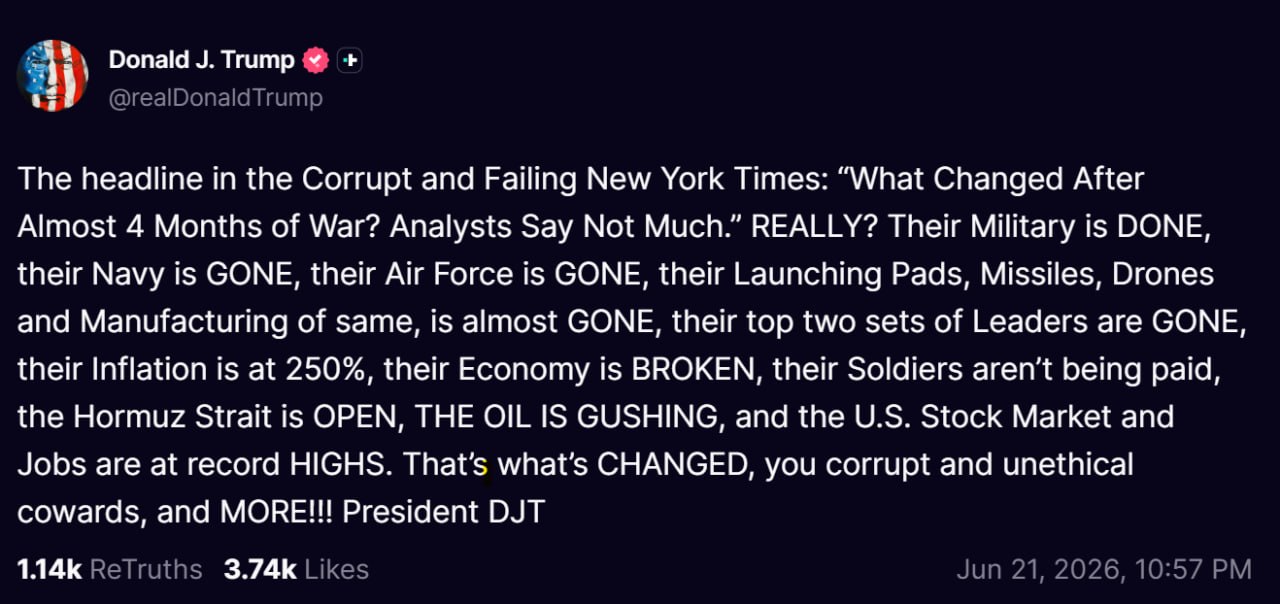
[Photo] 🇺🇸🇮🇷⚡️ — Trump via Truth Social:The headline in the Corrupt and Failing New York Time [...]
Iran’s ‘back and forth’ tactics leave Donald Trump furious during negotiations
