
2,315 Meters Under the Sea, Greenpeace Stages Deepest Protest in World History
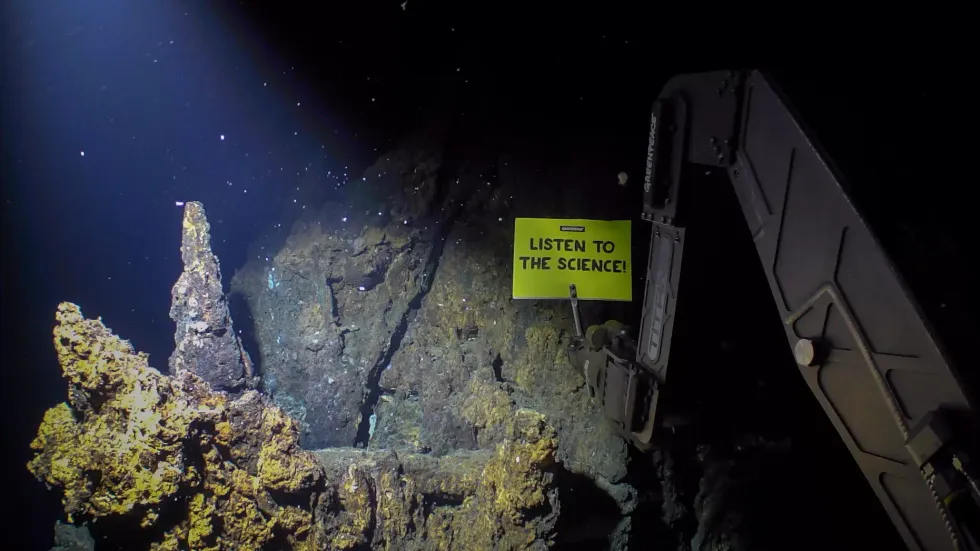
Aided by a sophisticated underwater submersible, activists with Greenpeace on Wednesday set a world record for the deepest protest ever by displaying a banner 1.4 miles beneath the surface of the Arctic Ocean to oppose industrial deep-sea mining and urging protection of the world's oceans.According to the international environmental group, the message LISTEN TO THE SCIENCE! was displayed 2,315 meters below sea level using a remotely operated vehicle called ‘ROV Holly.’ Executed during a deep-water survey expedition between Iceland and the island of Svalbard, the robotic hand of the submersible held up the sign in front of a hydrothermal vent field known as Loki’s Castle, which is located along the Arctic Mid-Ocean Ridge that separates the Arctic Ocean's Greenland Sea from the Norwegian Sea.This marks the deepest banner protest in history, to speak for ecosystems that have no voice of their own, said Dr. Sandra Schöttner, chief scientist for the Deep Arctic Expedition at Greenpeace International. World leaders have already promised to protect 30 percent of the oceans, now they must listen to the science and actually do it. We cannot meet our global goals if we also allow industrial exploitation of unexplored and vulnerable ecosystems in the deep sea. It is high time that leaders keep their promises and give the oceans a chance to recover.”The Arctic Mid Ocean Arctic Ridge—which the group characterized as one of Earth's least known wildernesses—goes down to depths of up to 3000 meters. The expedition and historic protest is part of a Greenpeace campaign that is calling for the deep-sea world of hydrothermal vents like Loki's Castle and others, as well as seamounts and the extraordinary creatures that live in such ecosystems to be protected with the establishment of a network of marine sanctuaries.“By safeguarding these deep-sea ecosystems within a global network of ocean sanctuaries and establishing a moratorium on deep sea mining, said Dr. Schöttner, we can create a resilient safety net for marine life, and protect the health of our global oceans for generations to come.Efforts to ban deep-sea mining by environmentalists, ocean stewards, and conservationists were stymied in the US with an executive order last year issued by President Donald Trump which seeks to bolster and expand the practice by the mining industry.Trump was condemned for the move, which Greenpeace at the time called an insult to multilateralism due to its sidestepping of a UN-backed process designed to protect the oceans, and a slap in the face to all the countries and millions of people around the world who oppose this dangerous industry.”Trump's failures, however, have been counteracted at some level by other nations who have paused or put stronger protections in place when it comes to deep-sea mining. In December, Norway paused controversial plans to issue a fresh round of drilling and mining license beneath undersea areas it controls.As part of its ongoing campaign to curb the destructive practice, Greenpeace is calling on world leaders to honor existing global climate targets, implement the UN Ocean Treaty to protect 30 of the global ocean by 2030, and establish an immediate moratorium on deep-sea mining.“There is no version of seabed mining that is sustainable or safe,” Greenpeace Aotearoa campaigner Juressa Lee said last year. “Alongside our allies who want to protect the ocean for future generations, we will continue to say a loud and bold no to miners who want to strip the seafloor for their profit.”
Narrative Intelligence Brief
This article was published by Common Dreams, a source frequently categorized with a left bias based in United States of America. Our narrative intelligence engine continuously monitors coverage from this outlet to track framing, bias, and rhetorical patterns. Our initial algorithmic scan of this specific piece did not flag high-confidence rhetorical techniques, suggesting a generally straightforward reporting style or neutral framing. By understanding the editorial perspective of Common Dreams, readers can better contextualize the information presented and compare it across our broader media matrix to find the real narrative.
Explore related topics: Stay informed with Real Narrative News as we track unfolding stories. Dive deeper into our coverage of pivotal topics including white house, عيد الأضحى, iran war, donald trump, جنوب لبنان, supreme court, eid aladha, ebola outbreak, ken paxton, and james talarico. Our intelligence streams continuously monitor these keywords to bring you unbiased analysis and real-time updates on topics like "2,315 Meters Under the Sea, Greenpeace Stages Deepest Protest in World History".
More from Common Dreams
May 27, 2026
Food Prices Set for Summer Surge as Trump and GOP Stare Down Inflation ‘Abyss’
May 27, 2026
'A Dramatic Abdication': Trump Admin to Send US Citizens With Ebola Exposure to Kenya
May 27, 2026
Ben-Gvir Says Israel ‘Will Not Allow’ Trump to Make a Peace Deal With Iran as IDF Kills Dozens in Lebanon
May 27, 2026
'How the Corruption Works': Trump Boosts Prediction Markets as His Family Profits
May 27, 2026
2,315 Meters Under the Sea, Greenpeace Stages Deepest Protest in World History
Analysis Methodology
This narrative analysis was generated using the CoDataLab Global Intelligence Engine. Our proprietary AI scans thousands of cross-border sources to identify sentiment patterns, framing techniques, and potential media bias. While AI provides the data-driven foundation, our objective is to empower readers with additional context beyond the standard headline.The content displayed above is a structured summary designed for rapid information processing. For the full original report, please visit the source outlet.More Coverage
Discussion