
News
·
August 9, 2026
The Weekend America Blinked on the Yen
Trump called the US intervention to save the Japanese yen an act of friendship. The real story is a debt-and-carry-trade timebomb Washington couldn't afford to let Tokyo defuse alone.
Badis Jlassi
·
RNN Originals
Share
8 min read
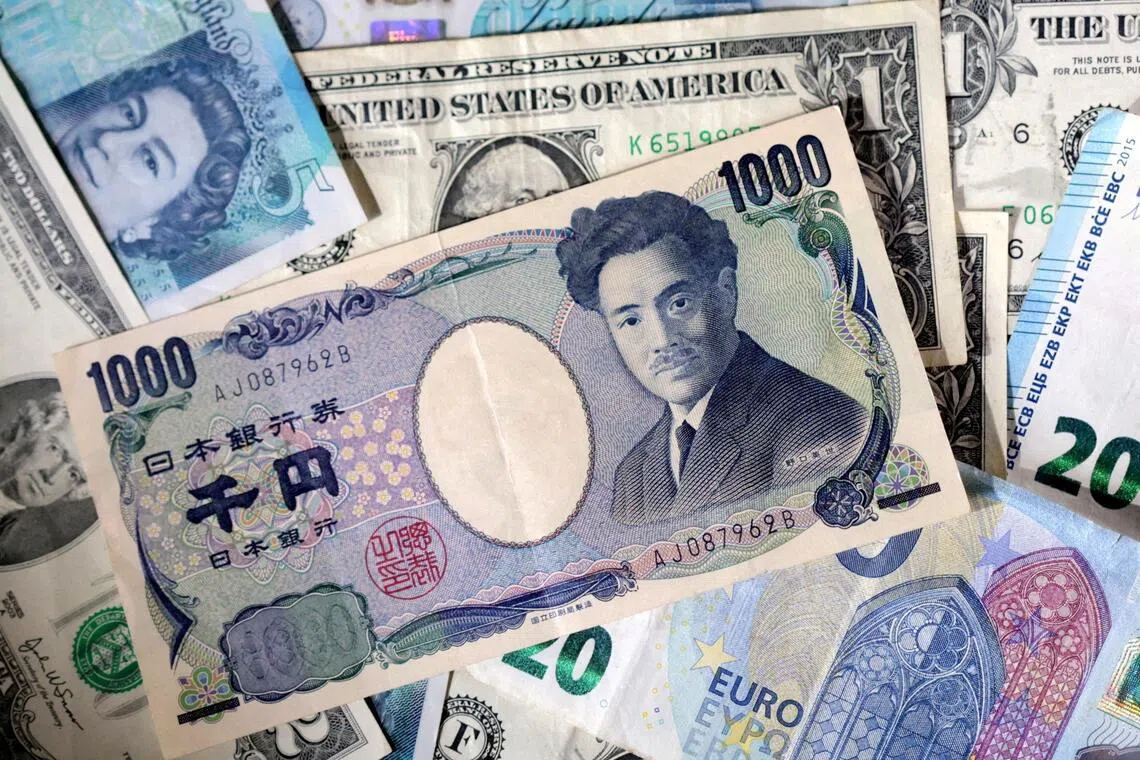 Credit : The Straits Times
The Weekend America Blinked on the Yen
There's a particular kind of admission that says more than a press conference ever could. On August 2nd, a reporter aboard Air Force One asked Donald Trump a simple question: why did the United States step in to support the Japanese yen? His answer was warm, almost sentimental — America and Japan have a great relationship, he said, Japan has always been generous to the US, this is what friends do. Then, half-joking, he added the caveat: "except for Pearl Harbor." It made for a good soundbite. It also wasn't really the answer.
Loading tweet preview…
What Actually Happened
Strip away the diplomatic pleasantries and the real story is this: at the end of July, the yen was in freefall, and Washington had run out of ways to pretend it wasn't America's problem too. On July 31, Reuters photographers caught something they weren't supposed to catch — a handwritten note visible in a photo of Treasury Secretary Scott Bessent's briefing materials during a Cabinet meeting at Camp David. It read, simply, "To Do: Buy Japanese Yen $5-10 bil." Whether that note was left in frame by accident or on purpose, markets read it as exactly what it looked like: a signal that Washington was about to step in. They were right. That same day, the US Treasury quietly told American banks to prepare for possible intervention in yen markets, and the New York Fed sold euros to buy yen on the Treasury's behalf — the first coordinated defense of the yen with Tokyo in more than a decade.
The Question Nobody Wanted to Answer Directly
Here's the thing Trump's answer conveniently avoided: America didn't intervene out of friendship alone. It intervened because letting Japan handle this on its own terms was a bigger risk to the US economy than most people realized. To understand why, you have to go back to late April, when Japan's Finance Minister Satsuki Katayama stood in front of reporters and delivered what amounted to a warning shot. She told journalists that the moment for "decisive action" had arrived, and — in a memorable, slightly ominous touch — advised reporters to keep their phones within reach at all times, including on holidays. The yen had just slid past 160 to the dollar, its weakest level since mid-2024, with speculators piling onto bets against the currency at the largest short position seen in nearly two years, according to CFTC data.
Why Spending Alone Didn't Fix It
Katayama wasn't bluffing. Within a month, Japan spent 11.7 trillion yen — about $73.7 billion — defending its currency, the largest sum it had ever spent in a single month doing so. It worked, briefly. The yen strengthened from 157 to the dollar to under 159 by the end of May. Then the defense ran out of steam, and the currency kept sliding anyway, eventually touching roughly 164 yen to the dollar on July 28, its weakest level in about 40 years. The uncomfortable truth is that Japan's intervention was fighting the wrong battle. The real pressure on the yen wasn't really about market panic — it was about interest rate math. Through the spring, Japan's benchmark rate sat around 0.75%, while the US Federal Reserve's rate hovered between 3.5% and 3.7%. That gap fuels the so-called carry trade: borrow cheaply in yen, convert to dollars, invest in higher-yielding US assets, pocket the difference. When millions of investors do this simultaneously, it floods the market with yen no matter how much money a government throws at defending it.
The Options Japan Never Wanted to Use
This is where Washington's real motive comes into focus. Japan had two tools available to genuinely stop the bleeding. One was sharply raising interest rates, which would kill the carry trade's appeal at the source, but risked triggering a disorderly unwind of a trade that has quietly become one of the hidden engines of liquidity propping up growth stocks and AI-related companies in the US market. The other was dumping a meaningful chunk of Japan's roughly $1.1 trillion in US Treasury holdings to fund yen purchases directly — a move that would push US bond yields higher just as the government sits on nearly $40 trillion in public debt and a wide fiscal deficit, worsened by the ongoing costs of the Iran war. Former Treasury Secretary Henry Paulson, who steered the US through the 2008 financial crisis, put it plainly in recent CNBC comments: supporting Japan now is in both countries' interest, because "we don't want them selling their Treasury holdings right now."
The Quiet Financial Plumbing Behind the Rescue
There's a clever piece of financial engineering behind how Japan managed to spend an estimated $52.8 billion defending the yen on July 30 alone without dumping its Treasury holdings outright. It used a Fed facility created during the pandemic panic of March 2020, called the FIMA Repo Facility — a mechanism that lets foreign central banks temporarily swap their Treasury holdings for dollars without selling them on the open market, then buy them back later once the immediate cash crunch passes. Bessent confirmed Japan tapped this facility, which allows the Bank of Japan to borrow up to $60 billion, and has since urged the Fed to expand its capacity further, calling it "an important backstop" that should be "upsized in the coming months."
A Root Cause Bessent Didn't Mention on X
Bessent's public statements framed the yen's collapse almost entirely as a problem of "disorderly movements" and speculative excess. Independent analysts have been blunter about the underlying cause. Mark Sobel, who spent four decades at the US Treasury and now chairs the US arm of the Official Monetary and Financial Institutions Forum, has pointed instead to Japan's own policy choices: an "overly accommodative" monetary stance that kept rates near zero for years, mounting concerns about Japan's public debt load, and, more recently, the fiscal policy direction of Prime Minister Sanae Takaichi's government. The yen, by this reading, hasn't been sliding for weeks or months — it's been sliding, with interruptions, since 2012. Framing this as a sudden bout of disorderly speculation, rather than the predictable result of over a decade of ultra-loose policy, makes for a tidier press statement, but it understates how structural the problem actually is.
Why Selling Euros Instead of Dollars Raised Eyebrows
The mechanics of the intervention itself have drawn almost as much scrutiny as the decision to intervene at all. Rather than the more conventional approach of selling dollars outright to buy yen, the New York Fed sold euros from the Treasury's Exchange Stabilization Fund and used the proceeds to purchase yen. Bessent explained the choice directly: Washington didn't want to weaken its own currency in the process, since a weaker dollar carries its own inflation and credibility risks. But some market strategists have called the workaround "weird" and potentially "unwise" precisely because it does the opposite job on a second currency — nudging the euro down to prop the yen up — without addressing the yen's underlying rate differential with the dollar at all. Bessent moved quickly to contain the diplomatic fallout, personally reassuring European officials that the euro sale wasn't an attack on their currency and insisting the euro was already trading near fair value; the actual distortion, he argued, was entirely on the yen's side of the ledger.
The 1997 Ghost in the Room
Bessent has leaned on a specific piece of history to justify moving so fast: the Asian Financial Crisis of 1997. In his telling, part of that crisis was triggered by a Japanese yen that fell too far, dragging neighboring Asian currencies down with it in a regional contagion that took years to unwind. He's pointed to South Korea's won, already showing signs of jitteriness in recent weeks, as an early warning that the same dynamic could be starting to repeat. Whether the comparison holds up is genuinely disputed among economists — 1997 unfolded against a very different backdrop of fixed exchange-rate pegs and thin foreign currency reserves across the region, conditions that don't map cleanly onto 2026. But the argument reveals something about Washington's actual calculus: this was never framed internally, whatever the public messaging said, as an isolated bilateral favor to Tokyo. It was framed as an attempt to keep a single weakening currency from cascading into a broader regional financial event that could eventually reach US shores anyway.
What Tokyo Gets Out of the Trade Relationship
It's also worth noting this didn't happen between two governments with no prior arrangement. In July 2025, the US and Japan signed a sweeping trade agreement that shifted their economic relationship away from its traditional free-trade orientation and toward the tariff-led framework Trump has pushed with most major trading partners. Bank of America FX strategist Shusuke Yamada noted after the intervention that its coordinated nature suggests "extensive currency diplomacy took place beforehand," meaning this wasn't a spontaneous rescue improvised over a single weekend so much as the activation of an understanding both governments had been quietly building for months. That context cuts against the pure-friendship narrative in one direction and against the pure-self-interest narrative in another: this looks less like an act of charity or a unilateral defensive maneuver, and more like two governments with genuinely intertwined economic exposure finally agreeing to formalize how they'd respond when exactly this kind of currency stress arrived.
Conclusion
The coordinated effort paid off, at least for now. By early August, the yen had climbed back toward the 155-157 range against the dollar, its strongest level in months. Whether that recovery holds is genuinely unclear. Nothing about the underlying interest rate gap, Japan's energy import bill, or America's own debt trajectory has fundamentally changed — the intervention bought time, not a resolution. If the yen resumes its slide, Washington's choices narrow considerably: it will likely have no option but to keep defending a currency it doesn't control, because the alternative, letting Tokyo fend for itself, was never really an option to begin with. Trump's answer aboard Air Force One made it sound like generosity. The far less flattering truth is that America helped Japan because it had no better way to help itself.
Share
8 min read
Topics Covered
Discussion
Join the conversation
What's your read on this? Share your take with the community below.
Today in History
On August 9, several notable moments in the history of japanese yen stand out. In 1107, Emperor Horikawa of Japan (born 1079) passed away. In 1428, Sources cite biggest caravan trade between Podvisoki and Republic of Ragusa. Vlachs committed to Ragusan lord Tomo Bunić, that they will with 600 horses deliver 1,500 modius of salt. Delivery was meant for Dobrašin Veseoković, and Vlachs price was half of delivered salt. In 1919, Joop den Uyl, Dutch journalist, economist, and politician, Prime Minister of the Netherlands (died 1987) was born. In 1933, Tetsuko Kuroyanagi, Japanese actress, talk show host, and author was born. In 1945, The Red Army invades Japanese-occupied Manchuria. In 1945, World War II: Nagasaki is devastated when an atomic bomb, Fat Man, is dropped by the United States B-29 Bockscar. Thirty-five thousand people are killed outright, including 23,200-28,200 Japanese war workers, 2,000 Korean forced workers, and 150 Japanese soldiers. In 1974, Kirill Reznik, American lawyer and politician was born. In 1989, Kento Ono, Japanese actor and model was born. In 1993, The Liberal Democratic Party of Japan loses a 38-year hold on national leadership. In 1999, Russian President Boris Yeltsin fires his Prime Minister, Sergei Stepashin, and for the fourth time fires his entire cabinet. Together, these milestones provide historical context for today's japanese yen news and ongoing narratives. More