
News
·
July 27, 2026
Deadly Ukrainian Attack on Iranian Vessel 'Cannot Go Unanswered,' Tehran Says
A Ukrainian strike on Iranian-linked shipping in the Caspian Sea killed a sailor and pulled Tehran deeper into a war it insists isn't its own.
RNN Originals
·
15
Share
4 min read
The Caspian Sea Just Became the Newest Front in a War That Refuses to Stay Contained
There's a particular kind of danger that comes from wars bleeding into each other. Ukraine's fight with Russia and Iran's fight with Israel and the United States have technically been separate conflicts, fought thousands of miles apart, with different combatants and different grievances. That fiction got harder to sustain over the weekend, when Ukrainian forces struck vessels in the Caspian Sea — a body of water that has nothing to do with the front lines in Donetsk or Kharkiv — and an Iranian sailor ended up dead.
What Actually Happened
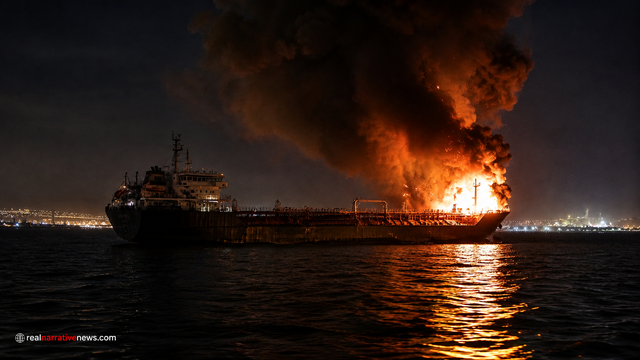
The basic facts are not seriously in dispute, even if their meaning is. Iran's Foreign Ministry says a Ukrainian strike hit an Iranian commercial vessel in the Caspian early Saturday, triggering an explosion that killed one crew member and wounded another. Tehran called it an act of aggression that risked further inflaming an already volatile region. Ukrainian President Volodymyr Zelenskyy did not deny it, saying on social media that Ukrainian forces had carried out long-range strikes in the Caspian against vessels involved in military cargo shipments tied to Iran, along with a warship. That's the shape of it: Kyiv reaching further than it usually does, into waters it doesn't normally touch, to hit a supply chain it says is arming its enemy.
A Disagreement Over Who Actually Owns the Ships
Here's where it gets messier, and where the editorializing on both sides starts to outrun the paperwork. Ukraine's military intelligence directorate has publicly named its targets — a general cargo vessel and another ship it links to a sanctioned Russian shipping operator, both of which it says made repeated calls at Iranian ports and showed patterns of tracking-signal gaps near those approaches. That's an awkward detail for Tehran's version of events. If the ships Kyiv struck are registered to Russian owners, Iran's framing of this as a straightforward attack on its own commercial fleet gets a lot less clean. It doesn't erase the fact that an Iranian sailor died on Iranian-flagged decking — but it does suggest the cargo, and the war it was allegedly supporting, may not have been quite as Iranian as Tehran's statements imply.
Why Tehran Is Reacting Like This Is Personal
Iran didn't just issue a diplomatic complaint and move on. Its Foreign Ministry summoned Ukraine's chargé d'affaires in Tehran to lodge a formal protest, calling the strike a hostile and criminal act, and framed it as a violation of the UN Charter's prohibition on the use of force. Foreign Minister Abbas Araghchi went further, pushing for a firm response from the UN Security Council, the EU, and the broader international community, and demanding accountability for those responsible. That's a lot of institutional weight to throw at what Ukraine is presenting as one strike among many in an active war. But it makes more sense once you place it against the backdrop Iran is actually operating in right now — absorbing strikes on its southern coast while its northern shipping lanes come under a different kind of pressure. Some Iranian officials have gone even further, alleging the Ukrainian strike was carried out at Israel's request, a claim that tells you how Tehran wants this incident understood: not as a Ukraine-Russia matter that spilled over, but as one more front in a campaign it believes is coordinated against it.
How Different Outlets Are Framing It
The Bigger, Uglier Pattern
Zoom out and the Caspian strike stops looking like an isolated incident and starts looking like a symptom. Iran's drones — the Shaheds that Russia has leaned on heavily in its war against Ukraine — are precisely why Kyiv has spent the past several years building expertise in countering them, expertise it has in turn started offering to countries on the receiving end of Iranian-linked strikes in the Middle East. The flow of weapons and influence between Moscow and Tehran was never a secret; it was a known feature of the war, mostly discussed in the abstract. What happened this weekend is that abstraction turning into a body. At the same time, Saudi forces are striking Houthi targets in Yemen following renewed attacks on Red Sea shipping. Russia's war, Iran's war, Yemen's war, the shipping lanes that connect all three — it's less a set of separate conflicts than one interlocking mess, and the Caspian Sea just became the latest place where that mess became visible.
Conclusion
Iran has said this "cannot go unanswered." Take that seriously, but don't assume it means an immediate military response. Iran is already fighting on more fronts than it would like, and opening hostilities with Ukraine directly would be an odd use of resources it appears to be rationing carefully elsewhere. More likely, at least in the near term, is exactly what Araghchi has already started doing: pushing the UN and the EU to treat this as an act of aggression worth condemning, while bolstering the broader narrative that Iran is a victim of coordinated pressure rather than a party whose own alliances put its ships in the blast radius to begin with. Whether that argument persuades anyone probably depends less on the facts of this one strike and more on how exhausted the rest of the world already is with adjudicating who provoked whom in a region where nearly everyone has a plausible claim to being provoked.
Share
4 min read
Topics Covered
Discussion
Join the conversation
What's your read on this? Share your take with the community below.
Today in History
On July 27, several notable moments in the history of ukraine stand out. In 1853, Vladimir Korolenko, Ukrainian journalist, author, and activist (died 1921) was born. In 1906, Jerzy Giedroyc, Polish author and activist (died 2000) was born. In 1942, World War II: Allied forces successfully halt the final Axis advance into Egypt. In 1980, Mohammad Reza Pahlavi, Iranian Shah (born 1919) passed away. In 1987, Marek Hamšík, Slovak footballer was born. In 1990, The Supreme Soviet of the Belarusian Soviet Republic declares independence of Belarus from the Soviet Union. Until 1996 the day is celebrated as the Independence Day of Belarus; after a referendum held that year the celebration of independence is moved to June 3. In 1996, In Atlanta, United States, a pipe bomb explodes at Centennial Olympic Park during the 1996 Summer Olympics. In 1997, About 50 people are killed in the Si Zerrouk massacre in Algeria. In 1999, Aleksandr Danilovich Aleksandrov, Russian mathematician, physicist, and mountaineer (born 1912) passed away. In 2002, Ukraine airshow disaster: A Sukhoi Su-27 fighter crashes during an air show at Lviv, Ukraine killing 77 and injuring more than 500 others, making it the deadliest air show disaster in history. Together, these milestones provide historical context for today's ukraine news and ongoing narratives. More