
News
·
July 4, 2026
Two Americas at 250: Mamdani and Trump Deliver Dueling Visions on Independence Day
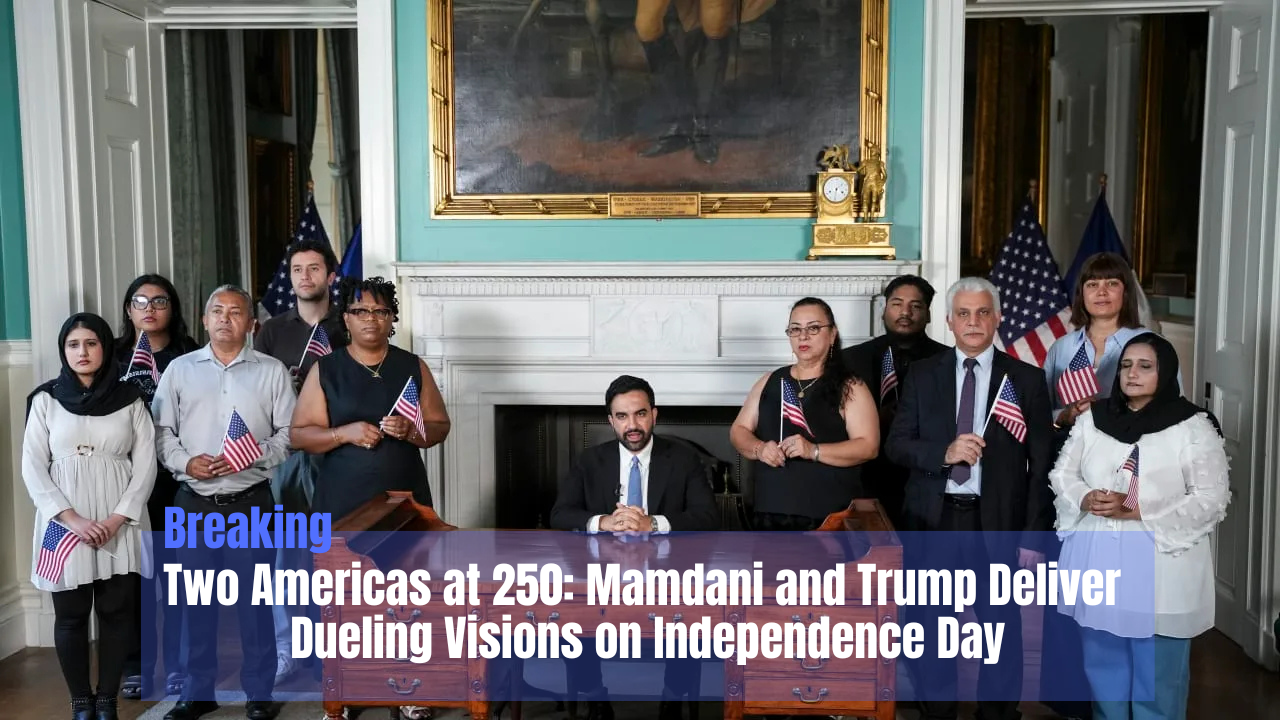
On the 250th anniversary of the United States, two political figures presented starkly opposing narratives of what America is and what it should become. New York City Mayor Zohran Mamdani used his July 4th address from George Washington's desk in Federal Hall to condemn oligarchy, immigration crackdowns, and foreign wars, while President Donald Trump, speaking at Mount Rushmore on Independence Eve, warned of a communist menace and promoted decades of Republican rule. The coverage of these dueling speeches has split the media landscape along familiar partisan lines, with left-leaning outlets framing Mamdani's speech as an inspirational reckoning with American ideals, and right-leaning outlets casting it as an anti-American socialist manifesto. As the country marks its semiquincentennial, the battle over who gets to define America has never been sharper.
Real Narrative News
·
18
 RNN
RNNTwo Speeches, Two Americas: Framing the 250th Anniversary
Pro-Mamdani outlets
Left-leaning and center outlets largely framed Mayor Mamdani's Independence Day speech as an inspirational and inclusive vision of America, emphasizing his celebration of immigrants, naturalized citizens, and democratic ideals. These outlets highlighted the historical setting at Federal Hall and presented his critique of inequality as continuous with America's founding promise of self-governance. Examples of this framing include: * Mayor Mamdani on 250 Years of a Grand Experiment in Self Governance (The Nation) * Zohran Mamdani on the Promise of America (Jacobin) * NYC Mayor Mamdani delivers Fourth of July speech condemning Trump and US immigration policies (Jerusalem Post) * Mayor Zohran Mamdani offers inspirational July 4th address surrounded by naturalized citizens (Irish Star)
Anti-Mamdani / Pro-Trump outlets
Right-leaning outlets framed Mamdani's speech as a socialist attack on America, an 'anti-American meltdown' fixated on oligarchs, ICE, and foreign wars. These outlets amplified Trump's Mount Rushmore rebuke that positioned Mamdani as 'the enemy of 1776,' while critics like billionaire Bill Ackman mocked the mayor's posture at Washington's desk. Coverage cast the speech as evidence of a dangerous ideological turn in American politics. Examples of this framing include: * Zohran Mamdani Delivers Socialist Manifesto to Celebrate America 250 (Townhall) * Mamdani's Anti-American Meltdown: Oligarchs, ICE, and 'Supremacy' on America 250 (RedState) * 'The Enemy of 1776': Trump Celebrates America 250 While Rebuking Mamdani (Hot Air) * Mamdani uses America 250 speech to attack capitalism and foreign wars (World Israel News) * For America 250, reject Mamdani's narrative of American oppression (Washington Examiner)
Federal Hall vs Mount Rushmore: The Symbolism of Two Stages
The staging of each speech was as much a message as the words spoken. Mamdani chose Federal Hall in Lower Manhattan, sitting at a replica of George Washington's desk and surrounded by naturalized citizens, deliberately anchoring his address in the founding city of the republic and framing immigration as America's oldest and most consequential story. He told the crowd that America 'belongs only to those with the right accent or the right shade of skin' according to his opponents, and rejected that vision as a betrayal of the country's ideals. Trump, by contrast, delivered his Independence Eve address from Mount Rushmore, using the granite likenesses of past presidents to project continuity with a specific reading of American greatness. According to reporting from Common Dreams, Trump 'spent his address to the United States the night before its 250th birthday fearmongering about the communist menace' and suggested the Republican Party 'should govern the nation for a century.' Right-leaning outlets like Hot Air framed the speech as a defense of 1776 against Mamdani's alleged threat to it. The visual and rhetorical contrast was not accidental. One stage invoked pluralism and the immigrant experience; the other invoked national monumentality and permanence. Coverage of the two events tended to mirror the imagery each politician selected, with sympathetic outlets amplifying the intended symbolism and hostile outlets stripping it away.
Sideshows and Second-Order Stories
The main speeches were not the only story. Billionaire and Trump supporter Bill Ackman criticized Mamdani for allegedly sitting on the wrong side of George Washington's desk, telling followers it was 'evident the NYC mayor has never held any job.' Ackman was later publicly corrected on the desk claim, but the exchange spread rapidly across right-leaning social media and outlets like Times of India and 2Paragraphs. Other secondary stories emerged in Mamdani's orbit. Twitchy amplified reports that actor Cynthia Nixon's wife had been appointed the highest-paid official in Mamdani's Department of Education, framing it as cronyism. Meanwhile, the Trump administration reportedly wiped Department of Energy thermostat suggestions from federal websites after GOP outrage over Mamdani's own energy proposals, according to the Irish Star. Even former President Bill Clinton weighed in with an America 250 statement that right-leaning outlets characterized as trying 'to keep up with' Mamdani's rhetoric. And Brad Lander, a likely NY-10 congressman and Mamdani ally, told Haaretz that 'Israelis will not be truly safe until Palestinians are free,' calling for a rethink of US aid to Israel, further tying the New York political moment to global foreign policy debates.
Conclusion: One Anniversary, Two Countries
America turned 250 with two of its most visible political figures describing it as if they lived in different countries. Mamdani's version is a republic still becoming itself, sustained by immigrants and self-governance, threatened by concentrated wealth and executive overreach. Trump's version is a nation under siege from within, defended by a single party and rooted in the imagery of its earliest leaders. The media coverage did not merely report these visions, it participated in them. Left-leaning outlets treated Mamdani's speech as a coherent invocation of American ideals; right-leaning outlets treated it as a hostile ideological project. The same phrases were read as inspirational in one column and anti-American in the next. As with any high-stakes political moment, readers benefit from reading across the divide. Watch the speeches, read multiple outlets, and notice which quotes each side chooses to elevate and which they omit. On the country's 250th birthday, the deepest disagreement was not about the past, but about who America is for now.
Topics Covered
Today in Mamdani History
On July 5, several notable moments in the history of Mamdani stand out. In 1916, Iva Toguri D'Aquino, American typist and broadcaster (died 2006) was born. In 1921, Nasser Sharifi, Iranian sports shooter was born. In 1928, Teofisto Guingona Jr., Filipino politician; 11th Vice President of the Philippines was born. In 1948, Monteiro Lobato, Brazilian journalist and author (born 1882) passed away. In 1951, Vladimir Tismăneanu, Romanian-American political scientist, sociologist, and academic was born. In 1963, Laureano Márquez, Spanish-Venezuelan political scientist and journalist was born. In 1993, Bona Arsenault, Canadian historian, genealogist, and politician (born 1903) passed away. In 2006, Space Shuttle program: Discovery launches STS-121 to the International Space Station. The event gained wide media attention as it was the only shuttle launch in the program's history to occur on the United States' Independence Day. In 2008, A bomb explodes at a concert in Minsk's Independence Square, injuring 50 people. In 2009, The first of four days of bombings begins on the southern Philippine island group of Mindanao. Together, these milestones provide historical context for today's mamdani news and ongoing narratives.