
News
·
August 10, 2026
Trump's Vaccine Order Lands Same Day as Fauci Text Leak
President Trump signed an order cutting recommended childhood vaccines from 18 to 11 and splitting the MMR shot, the same day Senate Republicans released Fauci texts on a theoretical miscarriage risk. Neither story is as simple as its headline.
Badis Jlassi
·
RNN Originals
·
1,800
Share
6 min read
 RNN
RNNTrump's Vaccine Order Lands Same Day as Fauci Text Leak
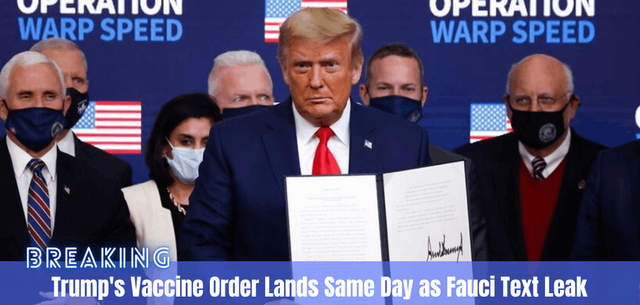
Two vaccine stories broke on the same Monday, and neither was small. In the Oval Office, President Trump signed an executive order that will reshape how American children get vaccinated for the first time in decades. Hours earlier, two Senate Republicans released a batch of Anthony Fauci's private text messages that critics say raise new questions about what health officials knew, and when, about a specific vaccine risk. Together, they made for the administration's most consequential day yet on a subject it has spent all year building toward.
Loading tweet preview…
What the Executive Order Actually Does
The order, titled "Delivering Gold Standard Childhood Vaccine Recommendations for Americans," trims the list of vaccines routinely recommended for all children from 18 diseases to 11, moving the remaining seven into a "shared clinical decision-making" category left up to parents and their doctors. It also calls for spacing out childhood immunizations across separate medical visits rather than combining them, and specifically recommends splitting the combined measles, mumps and rubella shot into three individual injections once standalone versions become available none currently are FDA-approved. Under the current combined MMR schedule, in place since 1971, children receive two shots; under the proposed split, they'd receive six. The order also directs the Justice Department to investigate whether states are unlawfully restricting religious, medical, or philosophical exemptions to vaccine mandates.
The "Peer Nations" Argument Behind It
The White House's case rests on a January 2026 HHS assessment that compared the US schedule against 20 developed countries and concluded America is a global outlier, recommending 84 vaccine doses across 57 shots for 18 diseases by 2024, up from 23 doses across 7 shots for 7 diseases in 1980. Deputy assistant to the president Heidi Overton framed Monday's order as "correcting" the fact that a similar overhaul HHS Secretary Robert F. Kennedy Jr. announced in January remains frozen by a federal court after medical groups successfully sued to block it. Whether more vaccines actually correlates with worse outcomes, or simply reflects that the US tracks and recommends protection against more diseases than some peer countries choose to, is a genuinely disputed reading of that same data the assessment doesn't establish that fewer recommended vaccines produce healthier children, only that the US recommends more of them.
Where Trump's Own Comments Broke From the Science
At the signing, Trump repeatedly suggested rising childhood vaccination rates were linked to increased autism diagnoses, calling the new approach part of getting the "best vaccine recommendations in the entire world." That claim isn't supported by the evidence: decades of large-scale scientific research, including studies involving millions of children across multiple countries, have found no causal link between vaccines and autism, a conclusion that remains the overwhelming consensus among pediatric and immunology researchers. News outlets covering the signing, including CNN and the AP, explicitly noted the autism claim as false in their own reporting rather than presenting it as a live scientific dispute.
Doctors' Actual Objection: More Visits, More Missed Shots
The medical pushback isn't primarily about the diseases themselves it's about logistics. Splitting the MMR shot into three separate injections triples the number of doctor visits required to get the same protection, and pediatricians have warned that every additional required visit is another opportunity for a working parent to miss an appointment, delay a dose, or quietly let the schedule lapse altogether. That warning lands at a genuinely bad moment: the US is in the middle of its worst year for measles cases in decades, driven in large part by declining vaccination rates since the pandemic. A policy explicitly designed to add friction to the vaccination process, whatever its intent, arrives while public health officials are already struggling to reverse exactly that trend.
Meanwhile: What the Fauci Texts Actually Show
The same day, Sens. Ron Johnson and Rand Paul released the first batch of texts recovered from Fauci's government-issued phone, part of a trove reportedly containing more than 34,000 messages and 522 voicemails obtained through a Senate subcommittee investigation. The specific exchange, from January 2021, shows Fauci, then-CDC Director Rochelle Walensky, and then-Surgeon General nominee Vivek Murthy discussing a theoretical concern: that fever following a second mRNA dose, tied to a cytokine response, could theoretically be associated with first-trimester miscarriage risk. Walensky called it "a good point," and Murthy said he'd been fielding similar public concerns. In the same exchange, Fauci also pushed back on a separate, unrelated myth then circulating, that mRNA could alter a person's genes, calling it a misperception. The following day, after Murthy flagged a since-outdated WHO recommendation against Moderna's vaccine in pregnancy, Fauci noted that more than 10,000 pregnant women had already been vaccinated with no reported issues, and that any risk had to be weighed against the documented dangers of COVID-19 itself during pregnancy, which was known even then to raise the risk of severe illness and poor birth outcomes.
A Theoretical Concern, Discussed Privately, Isn't the Same as a Confirmed Danger
It's worth separating two different questions here, because the texts themselves get conflated with a much larger claim in some of Monday's coverage. The texts confirm that health officials privately discussed a plausible, theoretical mechanism for concern, exactly the kind of internal deliberation scientific and medical teams are supposed to have before finalizing public guidance. They do not, on their own, confirm that mRNA vaccines actually increase miscarriage risk in practice. Subsequent large-scale data, including CDC's v-safe pregnancy registry tracking thousands of vaccinated participants, found miscarriage rates among vaccinated pregnant women consistent with the normal background rate, not elevated by the vaccine. Whether that later data resolves the theoretical concern raised in the texts, or whether critics are right that the concern should have been disclosed publicly in real time regardless of how it was later resolved, is the actual dispute here not, as some framing on Monday suggested, a settled finding that officials knowingly concealed a confirmed danger.
Both Stories Share the Same Undercurrent
CNN's own reporting on the vaccine order noted something the White House hasn't emphasized publicly: Trump's political advisers have reportedly harbored long-running reservations that pushing controversial vaccine policy is broadly unpopular and could cost the party support ahead of November's midterms. That tension a base energized by vaccine skepticism, set against a broader electorate that polling has consistently shown remains supportive of routine childhood immunization runs underneath both stories that broke Monday. One reshapes vaccine policy over the objections of most mainstream medical groups. The other resurfaces a years-old internal scientific debate and asks the public to judge, in hindsight and out of full context, decisions that were genuinely made under uncertainty at the time.
Conclusion
What's genuinely new here isn't that vaccine policy is contested that's been true for years. What's new is how directly this administration is now willing to act on that contest, both by rewriting federal recommendations over the objection of most major medical associations, and by using subpoenaed private communications to reframe how the public understands decisions made years ago under very different circumstances. Whichever side of this someone starts on, the honest read of Monday is that it produced one policy change with real, debatable tradeoffs, and one set of documents that raises fair questions about disclosure without actually proving the more sweeping claim being made about them. Conflating the two makes for a stronger headline. It doesn't make either story more true than it already was on its own.
Share
6 min read
Topics Covered
Discussion
Join the conversation
What's your read on this? Share your take with the community below.
Today in History
On August 10, several notable moments in the history of donald trump stand out. In 1920, Ádám Politzer, Hungarian-Austrian physician and academic (born 1835) passed away. In 1929, Aletta Jacobs, Dutch physician (born 1854) passed away. In 1937, Anatoly Sobchak, Russian scholar and politician, Mayor of Saint Petersburg (died 2000) was born. In 1958, Michael Dokes, American boxer (died 2012) was born. In 1971, Sal Fasano, American baseball player and coach was born. In 1980, Wade Barrett, English boxer, wrestler, and actor was born. In 1991, Nikos Korovesis, Greek footballer was born. In 1991, Marcus Foligno, American-Canadian ice hockey player was born. In 1999, Los Angeles Jewish Community Center shooting. In 2012, Ioan Dicezare, Romanian general and pilot (born 1916) passed away. Together, these milestones provide historical context for today's donald trump news and ongoing narratives. More