
News
·
August 21, 2026
Trump Vowed Full Oil Reserves. He Got a 43-Year Low.
Trump vowed to refill America's emergency oil stockpile 'right to the top.' Instead, his own war with Iran has driven it to its lowest level since 1983, while oil prices climb toward $91 a barrel.
Badis Jlassi
·
RNN Originals
·
10,033
Share
4 min read
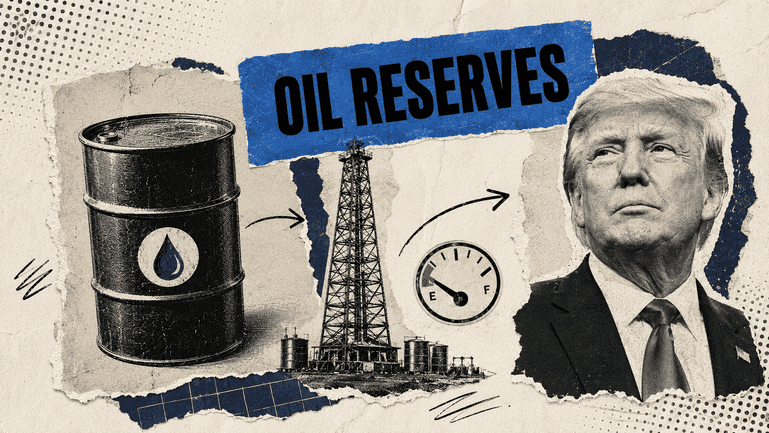 Trump promised to rebuild America’s strategic oil reserves.
Trump Vowed Full Oil Reserves. He Got a 43-Year Low.
On his first day back in office, Trump declared a "national energy emergency" and made a specific, quotable promise: fill America's emergency oil reserves "up again right to the top," and bring prices down while doing it. Nineteen months later, the reserve is at its lowest level since 1983, oil just logged its second straight weekly gain, and the president who made that promise is now threatening to bomb a US ally over a shipping dispute tied to the very war driving prices up. This isn't really a story about one broken promise. It's a story about how much a single geopolitical decision can override the best-laid plans of an energy policy.
Loading tweet preview…
The Promise, in Trump's Own Words
"We will bring prices down, fill our strategic reserves up again right to the top, and export American energy all over the world," Trump said during his January 2025 inaugural address, framing the Strategic Petroleum Reserve as a symbol of the previous administration's mismanagement. He wasn't wrong that there was ground to make up: President Biden had drawn the reserve down by nearly 300 million barrels between 2022 and 2023 to fight gasoline price spikes tied to Russia's invasion of Ukraine, leaving it at what was then a 40-year low. Trump called that drawdown politically motivated and vowed to reverse it. He didn't set a deadline for himself. In hindsight, that omission mattered.
Then the War Made the Promise Impossible
By March 2026, a little over a year into the pledge, the reserve sat at roughly 416 million barrels, about 58% of its 714-million-barrel capacity, according to the Department of Energy — nowhere close to "right to the top." Then the US and Israel went to war with Iran in late February, Iran shut the Strait of Hormuz in response, and the International Energy Agency called the resulting disruption the worst energy crisis in modern history. Rather than accelerating toward Trump's refill promise, the reserve started falling. According to figures tracked by Kobeissi Letter and ZeroHedge, the SPR logged 13 consecutive weekly declines, dropping to 326 million barrels by early July, its lowest level since May 1983, covering an estimated 16 days of US oil demand, down from a 2009 peak of roughly 36 days.
Why the Government Can't Just Buy It Back
Energy Secretary Chris Wright has pledged the administration will eventually put back more oil than it withdraws during the current drawdown, adding 1.2 barrels for every barrel released. That's a promise for later, not a fix for now. Refilling roughly 314 million barrels at current elevated prices would cost close to $20 billion, money Congress hasn't fully appropriated, and doing it quickly would itself push prices higher by creating exactly the kind of demand spike the reserve exists to prevent. The math boxes the administration in: buy oil now while prices are high and you're openly working against your own inflation-fighting message; wait for prices to fall and you're gambling that the war, and the strait closure driving the crisis, resolves on a timeline nobody controls.
The Numbers Behind This Week's Renewed Climb
Oil is back on the move again, and not in the direction the administration would prefer heading into an election year. Brent crude has pushed back above $91 a barrel, with prices set for a second consecutive weekly gain as the US-Iran war continues to disrupt supply. According to the EIA's most recent outlook, crude oil and petroleum liquids moving through Hormuz averaged just 4.9 million barrels per day in the second quarter of 2026, down from 21.6 million barrels per day before the conflict began — a roughly 77% collapse in throughput at the world's single most important oil chokepoint. Analysts at Armstrong Economics put the broader damage bluntly this week, noting that the headline price of oil is "only the beginning," with the real economic cost showing up in shipping rates, insurance premiums, refinery margins, diesel prices, electricity costs, and ultimately government borrowing.
Trump's Own Response Has Been to Escalate, Not Negotiate
Rather than pursuing a diplomatic resolution that might actually reopen the strait and ease the pressure on both prices and the depleted reserve, Trump has leaned toward pressure tactics. He told Axios the administration is "only semi-negotiating" with Iran, adding, "we are just watching Iran with its huge inflation and the fact they have no money." This week, with the 60-day US-Iran memorandum of understanding expiring and Iran instead reaching its own transit arrangement with Oman, Trump threatened to "bomb the s*** out of" Oman if it "gets in the way." That's a strategy built on the assumption that Iran's economy will buckle before America's own energy stockpile does. Given where the SPR already sits, it's a bet the US has considerably less room to lose than the administration's rhetoric suggests.
Conclusion
There's a version of this story where Trump simply hasn't gotten around to refilling the reserve yet, and there's a version where the war his own administration is waging has made that promise structurally impossible to keep on any near-term timeline. Both are true at once. What's not in dispute is the gap between the rhetoric and the reserve gauge: a president who built part of his political brand on criticizing his predecessor's empty stockpile is now presiding over an emptier one, driven by a conflict he has the power to end through negotiation but has instead chosen to escalate through threats. The Strategic Petroleum Reserve was built specifically to cushion moments exactly like this one. Right now, it's doing the opposite of what any of that planning assumed it would do.
Share
4 min read
Topics Covered
Discussion
Join the conversation
What's your read on this? Share your take with the community below.
Today in History
On August 21, several notable moments in the history of donald trump stand out. In 1914, World War I: The Battle of Charleroi, a successful German attack across the River Sambre that pre-empted a French offensive in the same area. In 1942, World War II: The Guadalcanal Campaign: American forces defeat an attack by Imperial Japanese Army soldiers in the Battle of the Tenaru. In 1944, World War II: Canadian and Polish units capture the strategically important town of Falaise, Calvados, France. In 1953, Ivan Stang, American author, publisher, and director was born. In 1963, Mohammed VI of Morocco, King of Morocco was born. In 1968, Cold War: Nicolae Ceaușescu, leader of the Socialist Republic of Romania, publicly condemns the Soviet-led Warsaw Pact invasion of Czechoslovakia, encouraging the Romanian population to arm itself against possible Soviet reprisals. In 1982, Lebanese Civil War: The first troops of a multinational force lands in Beirut to oversee the Palestine Liberation Organization's withdrawal from Lebanon. In 1983, Benigno Aquino Jr., Filipino journalist and politician (born 1932) passed away. In 1991, Coup attempt against Mikhail Gorbachev collapses. In 2013, Hundreds of people are reported killed by chemical attacks in the Ghouta region of Syria. Together, these milestones provide historical context for today's donald trump news and ongoing narratives. More