
News
·
August 27, 2026
Ten Weeks to the Midterms, and the Mail-Ballot Rules Are Still Up for Grabs Getting Blocked.
A federal judge has now lifted, and could soon re-impose, an injunction against Trump's executive order restricting mail-in ballots, leaving USPS rules for the November midterms in legal limbo weeks before voting begins.
Badis Jlassi
·
RNN Originals
·
1,009
Share
3 min read
 Donald Trump Midterms Voting
 Return to Sender: Trump's Mail-In Voting Order Keeps Getting Blocked, Unblocked, and Blocked Again
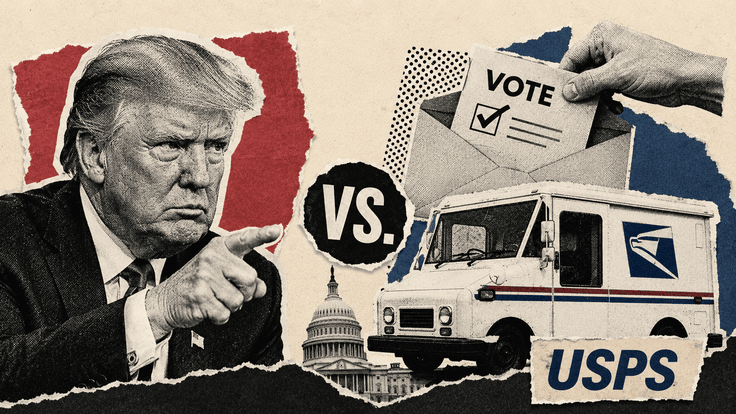
Ten weeks before the midterms, nobody, including the U.S. Postal Service, seems entirely sure what the rules for mailing a ballot will actually be. President Trump's executive order on mail voting has been blocked nationwide, partially revived by the Supreme Court, unwound by the same judge who first blocked it, and is now facing a fresh round of lawsuits from more than twenty states. Each side reads the docket as vindication.
Loading tweet preview…
What the Order Actually Does
Trump signed the order, titled "Ensuring Citizen Verification and Integrity in Federal Elections," back in March. It directs the Department of Homeland Security to compile lists of adult U.S. citizens and hand them to states, lets the Attorney General prioritize prosecuting state officials who issue ballots to people deemed ineligible, and instructs USPS to check mail-ballot recipients against those lists before delivery. The administration frames this as basic verification that only eligible voters receive ballots. Voting-rights groups counter that Congress never gave USPS, an independent agency, any authority to police who gets to vote, and that inserting a new eligibility gatekeeper weeks before an election risks disenfranchising legitimate voters, particularly military and overseas citizens, older Americans, recently naturalized citizens, and people with disabilities who rely on mail ballots.
The Legal Ping-Pong Match
U.S. District Judge Indira Talwani blocked the order's mail-voting provisions nationwide back in June, ruling that Congress never authorized USPS to regulate ballot eligibility and warning the order was sowing confusion this close to an election. Twelve Republican-led states appealed. On August 24, the Supreme Court sided with the administration 6-3, allowing DHS to build its citizenship list, letting the Attorney General pursue prosecutions, and permitting USPS to finalize rules on how state ballots must be designed and tracked. The Court pointedly did not touch the order's most disputed piece: USPS actually withholding ballots from people not on the list. Justices Sotomayor and Jackson dissented, with Jackson accusing the majority of adding to "electoral confusion on the eve of voting."
One Injunction Down, Three New Lawsuits Up
Two days after the Supreme Court's ruling, Talwani vacated her own nationwide injunction against a separate, related USPS rule governing ballot printing and tracking, concluding the high court's decision required her to reconsider it. USPS had said it would not apply that rule to the 2026 elections unless every injunction against it was lifted; with Talwani's order gone, that condition was met. Within hours, 23 states, Washington D.C., and Pennsylvania Governor Josh Shapiro filed a new suit challenging the finalized rule, while voting-rights groups amended an existing complaint to do the same. The Trump administration has argued that simply publishing the rule doesn't violate any outstanding court order, since the rule's own text says USPS won't act on it while litigation continues. The states can now ask Talwani for a fresh injunction, and few close observers expect this to be the last word before November.
Two Very Different Readings of the Same Docket
Administration allies point to the Supreme Court's 6-3 ruling as proof the order rests on firmer legal ground than critics claim, and argue that verifying citizenship before mailing a ballot is a modest safeguard against a form of fraud that, in their telling, existing state systems fail to catch. The 12 Republican-led states that intervened in the case have argued the executive order is itself entirely legal, a position neither the federal government nor those states had disputed at earlier stages of the litigation. Opponents, including the 23 states now suing and groups like the ACLU and League of Women Voters, argue the Constitution gives states, not the president or USPS, authority over the times, places, and manner of federal elections, and that Talwani's original injunction correctly found no fraud problem large enough to justify last-minute changes reaching military voters, seniors, and people with disabilities. Both sides agree on one thing: with mail and absentee voting already underway or about to begin in several states, the window to settle this before ballots go out is closing fast.
Conclusion
What's actually settled, ten weeks out, is surprisingly little: DHS can build its citizenship lists, the Attorney General can prioritize certain prosecutions, and USPS can finalize ballot-design rules, but the core question of whether the Postal Service can withhold a ballot from an eligible-looking voter remains tied up in courts that keep reversing themselves. Whether that gets resolved by Election Day, or simply generates enough confusion that both sides spend November arguing about the rules instead of the results, is still an open question.
Share
3 min read
Topics Covered
Discussion
Join the conversation
What's your read on this? Share your take with the community below.
Today in History
On August 27, several notable moments in the history of trump stand out. In 1590, Pope Sixtus V (born 1521) passed away. In 1782, John Laurens, American Revolutionary and abolitionist (born 1754) passed away. In 1822, William Hayden English, American politician, U.S. Representative from Indiana and Democratic vice-presidential nominee (died 1896) was born. In 1865, Thomas Chandler Haliburton, Canadian judge and politician (born 1796) passed away. In 1927, Five Canadian women file a petition to the Supreme Court of Canada, asking: "Does the word 'Persons' in Section 24 of the British North America Act, 1867, include female persons?". In 1985, Space Shuttle Discovery is launched on STS-51-I to deploy three communication satellites and repair a fourth malfunctioning one. In 2003, The first six-party talks, involving South and North Korea, the United States, China, Japan and Russia, convene to find a peaceful resolution to the security concerns of the North Korean nuclear weapons program. In 2009, Internal conflict in Myanmar: The Burmese military junta and ethnic armies begin three days of violent clashes in the Kokang Special Region. In 2024, Leonard Riggio, American businessman (born 1941) passed away. In 2024, Bob Carr, American politician (born 1943) passed away. Together, these milestones provide historical context for today's trump news and ongoing narratives. More