
News
·
July 6, 2026
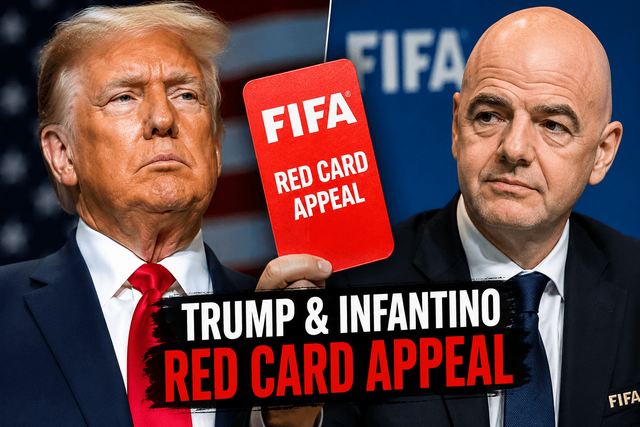
Trump's Phone Call to FIFA Rewrites World Cup History for the First Time
For the first time in the 96-year history of the FIFA World Cup, a sitting head of state has publicly intervened to overturn a disciplinary sanction against one of his own national team players, and won. When U.S. striker Folarin Balogun was shown a straight red card against Bosnia and Herzegovina in the Round of 32, his one-match ban for the Round of 16 clash with Belgium looked automatic. Then President Donald Trump called FIFA President Gianni Infantino. Within hours, FIFA invoked the rarely used Article 27 of its Disciplinary Code, suspended the ban 'on probation,' and cleared Balogun to face Belgium. The football world is now confronting an unprecedented question: what happens when the referee's whistle can be overruled by the Oval Office, and which established norms of the sport will change forever as a result?
Real Narrative News
 RNN
RNNOne Phone Call, Two Framings: A Sport Divided Over Trump's Intervention
Critical / Anti-intervention outlets
European and Latin American outlets across the political spectrum framed Trump's phone call to FIFA as an unprecedented breach of sporting independence, describing it variously as a 'scandal,' a 'coup against football,' and a 'demonstration of power' that undermines the credibility of the 2026 World Cup. These outlets emphasized that FIFA's own disciplinary bodies had already imposed the one-match ban, and that the reversal came only after presidential pressure. Examples of this framing include: * Causa Balogun: Infantino must not get away with this (Der Standard) * The FIFA decision to lift the red card ban for a US striker is a scandal (Süddeutsche Zeitung) * Donald Trump, the coup against football in the middle of the World Cup (Ouest France) * Trump plunges football world into collective stunned disbelief (n-tv) * Demonstration of power: how Trump changed the rules of the World Cup (Vechernyaya Moskva)
Sympathetic / Pro-intervention outlets
U.S. conservative outlets and pro-Trump commentators framed the phone call as a legitimate advocacy move by a sitting president on behalf of his national team, echoing Trump's own claim that the initial red card 'never warranted' a ban. These outlets amplified FIFA's public defense that Article 27 provides a formal review mechanism, and downplayed the timing and nature of the presidential intervention. Examples of this framing include: * Trump admits to asking FIFA president for review of controversial red card against Balogun (Washington Examiner) * Trump thanks FIFA - US star Balogun allowed to play after red card (Zeit, echoing Trump's Truth Social post) * Coupe du monde 2026: Donald Trump remercie la Fifa d'avoir annulé le carton rouge (Le Parisien) * Rantz: The world dragged the Seattle Times over its anti-Trump FIFA World Cup meltdown (KTTH Seattle)
Firsts in World Cup History: What Just Happened Has No Precedent
The Balogun affair is not simply another political controversy at a World Cup. According to Le Parisien's own historical review of past cases of political interference in football, no previous incident matches this one in kind or scale. Political meddling has happened before, at the level of federation elections, stadium boycotts, visa denials, or host-selection lobbying, but never has a sitting head of state successfully triggered the reversal of an in-tournament disciplinary sanction against one of his own players, mid-competition, hours before a knockout match. That is the first documented case in World Cup history. Several other firsts follow from it. It is the first time FIFA has invoked Article 27 of its Disciplinary Code, the 'probation' clause, to suspend a red-card ban for a host-nation player during a live World Cup. It is the first time a sitting U.S. president has publicly confirmed lobbying FIFA about a specific refereeing outcome, with Trump admitting on the record that he 'did not know a red card led to a match ban' before making the call, according to Icelandic outlet DV and Austrian outlet Kurier. And it is the first time in recent memory that a losing federation, Belgium, has publicly floated exploring 'all possible options,' widely read as a hint at possible CAS arbitration, in response to a FIFA disciplinary reversal. The consequences may extend far beyond Balogun's minutes on the pitch. Sports law analysts cited by Berlingske and Reuters warn that the precedent could destabilize the entire disciplinary architecture of major tournaments. If a phone call from a national leader can suspend a sanction under Article 27, why would any losing side accept future rulings without invoking political leverage of its own? For the first time, the neutrality of FIFA's own institutions is being questioned not by conspiracy theorists but by referees, ex-players, and national federations, all on the record, all during a live World Cup.
Possible Football Changes: Rules, Norms, and Governance After Balogun
The most immediate change may come to Article 27 itself. The clause was designed for exceptional humanitarian or evidentiary circumstances, not for presidential lobbying, and pressure is already building from European federations and readers, according to a Focus poll of German respondents who overwhelmingly demanded Infantino's removal and an investigation. Expect FIFA congresses in 2026 and 2027 to be asked to narrow Article 27's scope, require published written reasoning for every invocation, and prohibit its use within a set number of hours before a knockout match. That would be the first substantive rewrite of FIFA disciplinary procedure directly triggered by political interference. A second likely change involves the composition and transparency of FIFA's disciplinary and appeal committees. Kurier reported that an Austrian sits on the disciplinary committee that reviewed the Balogun case, and Infantino has publicly defended the 'independence' of FIFA's bodies. But independence that must be defended in press releases is independence already in doubt. Reforms could include mandatory disclosure of committee members deciding each case, cooling-off periods for members with ties to host federations, and independent observers from CAS or an outside body during World Cups. A third possible change concerns the VAR and red-card review process itself. If a straight red like Balogun's, involving contact with Bosnian defender Muharemović, can be effectively re-refereed off the pitch by a disciplinary panel under political pressure, federations will demand a formalized post-match VAR appeal that is public, evidence-based, and applied uniformly, not selectively. That, too, would be a first: a structural change to World Cup refereeing born not from a technology upgrade but from a governance crisis. Finally, expect a rethink of the host-nation privilege question. The 2026 World Cup is co-hosted by the U.S., Canada, and Mexico, but the political center of gravity, including the final at MetLife Stadium and the trophy presentation by President Trump himself, sits squarely in the United States. Academic work already flagged by Le Parisien and by scholars David Rowe and Catherine Ordway warns that FIFA and Trump are 'perfect bedfellows' whose alignment risks entrenching host-nation advantage. Future bidding cycles, including the 2030 tournament in Morocco, Portugal, and Spain, may be forced to include explicit anti-interference clauses in host agreements. That would be a first as well.
Voices from the Pitch: Nainggolan, Belgium, and the Referees Who 'Have Never Seen Anything Like This'
Reaction inside the sport has been unusually blunt. Former Belgium and Roma midfielder Radja Nainggolan told La Repubblica that 'the Balogun case shows this is no longer football,' though he pointedly absolved Trump himself, saying 'as a fan he does well to celebrate, the problem is with whoever made the decision.' The Belgian national team coach responded with public sarcasm, telling reporters his federation would consider 'all possible options,' according to Süddeutsche Zeitung, wording widely read as a signal of a possible formal complaint. Danish outlet Berlingske gathered football commentators who described the intervention in nearly identical terms: 'I have never seen anything like this in my entire life.' That phrase, from veterans who have covered decades of World Cups, is itself part of the story. So is the fact that Bosnia and Herzegovina, whose defender Muharemović was on the receiving end of Balogun's challenge, has said little publicly, illustrating the asymmetry Uruguayan outlet La Diaria highlighted in its piece asking 'Does Balogun, Trump or Infantino play?' Not all political weight, La Diaria argued, lands equally inside football. For referees, the message is chilling. If a straight red issued on the pitch can be neutralized by a phone call before the next kickoff, what discretion do match officials still hold? Referee associations in UEFA and CONMEBOL are likely to raise the question formally in the coming months, and FIFA may find itself needing to reassure its own officials that their calls will be respected regardless of which head of state is watching.
Conclusion: The World Cup Rulebook Will Not Look the Same After 2026
Whether Balogun scores against Belgium or not, the phone call that put him on the pitch has already scored a goal against something more valuable than any single match: the assumption that FIFA's rules apply the same way to everyone. For the first time in the tournament's history, a red card was overturned in the middle of a World Cup after direct presidential lobbying. For the first time, Article 27 has been used in this way. For the first time, referees, federations, and former players are openly asking, on the record, whether the sport is still refereed on the pitch or in the Oval Office. The media response has split along the familiar lines, European outlets and the global left calling it a scandal and a coup, American conservative outlets calling it common-sense advocacy, and centrist wire services documenting the storm without fully naming its scale. But underneath the framing wars, a rare consensus is forming among those who care about football's governance: something has changed that will require new rules to contain. Expect, in the months to come, proposals to narrow Article 27, to publish disciplinary reasoning, to shield referees from post-match political review, and to hard-code anti-interference clauses into future host agreements. Expect debate over whether Infantino can credibly finish his term. And expect the 2026 World Cup, whoever lifts the trophy on July 19 at MetLife Stadium, to be remembered as the tournament where a phone call became the most consequential set-piece of them all.
Topics Covered
Today in Trump History
On July 7, several notable moments in the history of Trump stand out. In 1939, Gérard Bourgoin, French sports executive, president of AJ Auxerre (2011-2013) and (Ligue de Football Professionnel) (died 2025) was born. In 1940, Nursultan Nazarbayev, Kazakh politician, 1st President of Kazakhstan was born. In 1947, Adolfo Müller-Ury, Swiss-American painter (born 1862) passed away. In 1947, Roy Señeres, Filipino diplomat and politician (died 2016) was born. In 1957, Phil Mallow, American politician was born. In 1964, Thierry Warmoes, politician was born. In 1981, Roman Shirokov, Russian footballer was born. In 1982, While attempting to return to Sheremetyevo International Airport, Aeroflot Flight 411, an Ilyushin Il-62, crashes near Mendeleyevo, Moscow Oblast, killing all 90 people on board. In 2022, Arnaldo Pambianco, Italian former professional road racing cyclist (born 1935) passed away. In 2024, Khyree Jackson, American football player (born 1999) passed away. Together, these milestones provide historical context for today's trump news and ongoing narratives.