
News
·
July 30, 2026
One Night, Four Cities: Inside Russia's Deadliest Strike on Ukraine in Weeks
Ballistic and cruise missiles hit Kyiv, Kryvyi Rih, Lviv, and Poltava within hours of each other, killing at least eight people and sending a Russian missile into Polish airspace.
Badis Jlassi
·
RNN Originals
Share
3 min read
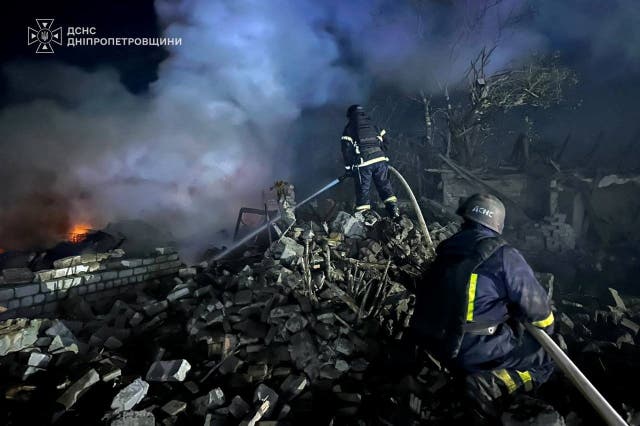 Emergency personnel at work following Russian missile strikes in Ukraine on Thursday (Reuters)
One Night, Four Cities: Inside Russia's Deadliest Strike on Ukraine in Weeks
Zelenskyy had warned this was coming. A day earlier, fresh off a trip to Washington, he told Ukrainians their safety this week would depend on how quickly allies moved on air defenses. Within 24 hours, Russia answered with one of its heaviest nights of long-range strikes in weeks, hitting Kyiv, Kryvyi Rih, Lviv, and Poltava almost simultaneously, and sending a cruise missile far enough west that Poland scrambled fighter jets to defend its own airspace.
Loading tweet preview…
A Family Home in Kryvyi Rih
The worst of it landed in Zelenskyy's hometown. In the Kryvyi Rih area, a ballistic missile struck an ordinary house, killing both parents along with three of their children, ages 6, 11 and 17. Two more children were pulled out alive from the wreckage. Regional official Oleksandr Vilkul described it on Telegram as a direct strike, launched from Russia's Voronezh region, and warned the toll could still climb as crews kept clearing rubble through the night.
Kyiv and Lviv Weren't Spared Either
In the capital, ballistic missiles killed a 31-year-old man and wounded two others, damaging residential buildings, a market, a garage cooperative, and storage facilities, according to Ukraine's National Police. Far to the west in Lviv, near the Polish border, a cruise missile strike wounded 34 people, including children ages 6, 13 and 15, regional official Maksym Kozytskyi said. Emergency crews were still combing through rubble there hours after the impact. Altogether, officials confirmed at least eight dead across the country, with dozens more wounded.
Then a Missile Crossed Into Poland
Sometime overnight, a Russian Kh-101 cruise missile crossed into Polish airspace, according to Ukrainian Foreign Minister Andrii Sybiha. Poland's military said an unidentified object was tracked flying westward, prompting an F-16 to scramble and attempt to intercept it before it vanished from radar. A helicopter later located what officials described as a probable impact site near the village of Tarnawa-Kolonia. It's a scenario NATO members have now faced more than once this year, and each time it happens, it sharpens the same question: how much longer can a strike land this close to alliance territory before it becomes something more than a near miss.
Why This Night Matters
None of the individual pieces here are new. Russia has struck Ukrainian cities before, families have died in their homes before, and stray missiles have tested Polish airspace before. What made this particular night stand out was the sheer breadth of it — four regions hit within hours of each other, immediately after Zelenskyy's own warning that this kind of night was coming. The European Union responded within hours by disbursing roughly 3.47 billion euros to Ukraine as part of its broader support package, with EU Commission President Ursula von der Leyen framing it as a direct answer to the attack.
Conclusion
Strip away the diplomatic language and what's left is a single night that managed to touch nearly every part of this war at once: a family killed in their own home, a capital city rattled awake, a border city sharing rubble and warnings with its NATO neighbor, and a Polish jet scrambling into the dark to chase a missile that wasn't supposed to be there. Zelenskyy said it plainly — Ukraine's safety now depends less on its own resolve, which hasn't wavered, and more on how quickly its allies decide to match it.
Share
3 min read
Topics Covered
Discussion
Join the conversation
What's your read on this? Share your take with the community below.
Today in History
On July 30, several notable moments in the history of ukraine stand out. In 1419, First Defenestration of Prague: A crowd of radical Hussites kill seven members of the Prague city council. In 1627, An earthquake kills about 5,000 people in Gargano, Italy. In 1656, The Battle of Warsaw ends with a Swedish-Brandenburger victory over a larger Polish-Lithuanian force. In 1864, American Civil War: Battle of the Crater: Union forces attempt to break Confederate lines at Petersburg, Virginia by exploding a large bomb under their trenches. In 1968, Robert Korzeniowski, Polish race walker and coach was born. In 1971, An All Nippon Airways Boeing 727 and a Japanese Air Force F-86 collide over Morioka, Iwate, Japan killing 162. In 1974, Radostin Kishishev, Bulgarian footballer and manager was born. In 1981, As many as 50,000 demonstrators, mostly women and children, took to the streets in Łódź to protest food ration shortages in Communist Poland. In 2006, An Israeli airstrike kills 28 Lebanese civilians, including 16 children. In 2013, Antoni Ramallets, Spanish footballer and manager (born 1924) passed away. Together, these milestones provide historical context for today's ukraine news and ongoing narratives. More