
News
·
August 25, 2026
Six Months, One Blockade, Zero Resolution: Inside the Iran Oil Standoff
Six months into an unprecedented war, the Trump administration launched what Treasury called an 'economic D-Day' against Iran on Monday. Oil prices fell anyway, the Strait of Hormuz is still crippled, and nobody agrees on how this ends.
Badis Jlassi
·
RNN Originals
·
770
Share
5 min read
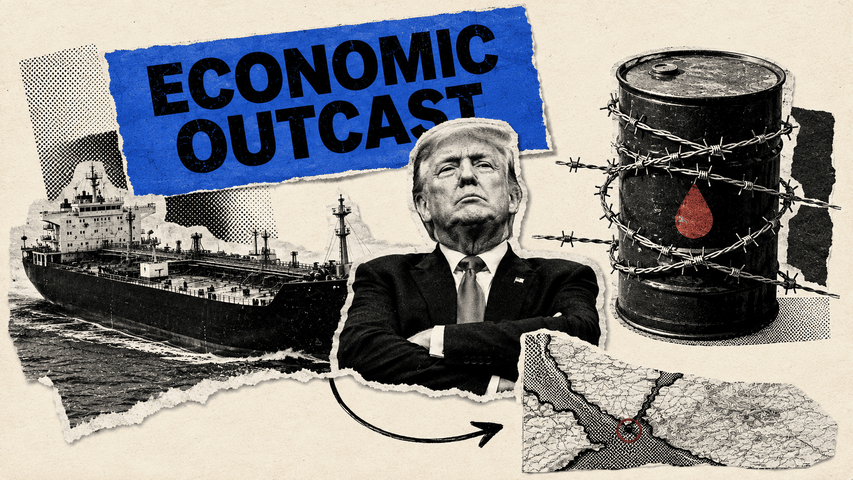 Inside 'Operation Economic Outcast': The Sanctions Blitz Aimed at Ending the Iran War
Inside 'Operation Economic Outcast': The Sanctions Blitz Aimed at Ending the Iran War
Treasury Secretary Scott Bessent stood behind a podium on Monday and reached for the biggest historical comparison he could find. "In the Second World War, D-Day marked the historic beginning of a campaign with our allies to target and drive the enemy from its positions," he said, unveiling a sweeping new sanctions program called Operation Economic Outcast. The message was blunt: nearly 60 people, companies, and vessels tied to Iran were sanctioned in a single day, and any country still doing business with Tehran had a choice to make. Oil traders had a different reaction. Instead of climbing on the news of Washington's toughest-ever push to isolate Iran, crude fell. West Texas Intermediate dropped about 2.5% to $84.89 a barrel. Brent slid the same amount to $92.06. Six months into a war between the US, Israel, and Iran that has already rewritten how the world thinks about oil supply, the market's message was almost as loud as Bessent's: it doesn't believe more sanctions, on their own, change what happens next in the Persian Gulf.
Six Months Into a War That Won't End
The conflict itself has been running since late February, when Trump ordered strikes intended to dismantle Iran's nuclear program and, in his words, cripple its broader military capability. What started as an air campaign has settled into something messier and harder to end: a slow-motion economic siege layered over intermittent violence in and around the Strait of Hormuz, the narrow waterway that used to carry roughly a fifth of the world's oil. Before the war, about 130 vessels a day passed through it. By early August, ship-tracking data showed as few as eight. Iran has attacked tankers along Oman's coast, the US has responded with airstrikes and a naval blockade, and a June memorandum meant to reopen the strait to commercial traffic collapsed within weeks over disputes about which routes ships could actually use. The result is the kind of disruption energy analysts don't have a clean historical comparison for. One longtime oil market analyst put the ongoing loss at roughly 8 million barrels a day, even with the strait technically open. That's not a rounding error. That's a meaningful slice of global supply that simply isn't moving.
Bessent's 'Economic D-Day'
Operation Economic Outcast is the administration's attempt to make the economic side of that siege do more of the work the military side hasn't finished. The plan expands secondary sanctions to cover digital assets, gold, aviation, technology, and shipping, and threatens to cut off any bank caught laundering money for Tehran from the US dollar system entirely. Bessent framed the choice for other countries in stark terms, describing a fork between "complete global isolation and a subsistence economy" or a path back to normalcy. The White House was even more direct in its own statement, promising to sever every remaining economic lifeline sustaining what it called a withering regime. Not everyone is convinced it will work. One Atlantic Council analyst noted that the sanctions' real-world impact depends entirely on whether Washington is willing to punish the foreign counterparties actually keeping Iranian trade alive, since raising the cost of doing business with Tehran is a very different achievement than actually cutting off its ability to finance a war. A Washington-based sanctions expert was blunter still, telling reporters this wasn't really an economic D-Day at all.
The China Problem
That question points straight at China, which buys the overwhelming majority of what's left of Iran's oil exports and which Bessent pointedly declined to exempt from the new sanctions regime, even while insisting the administration prefers quiet diplomacy over public confrontation. The diplomatic math here is awkward. Trump is scheduled to host Chinese President Xi Jinping for a state visit on September 24, where both sides want to advance a broader trade deal, the kind of high-stakes summit that doesn't usually pair well with threatening a country's banks over a third party's oil. The administration has already sanctioned Chinese entities involved in processing Iranian crude. Whether it's willing to go further, against China's actual government and financial system a month before a state dinner, is the real test of how serious Operation Economic Outcast is meant to be.
What Iran Is Actually Saying
Iran, for its part, has been sending two different messages depending on who's talking. President Masoud Pezeshkian told state media it would be better to end the war now, while Iran was still, in his framing, negotiating from a position of strength rather than after further losses. That's the sound of a government looking for an offramp. But Foreign Ministry spokesman Esmail Baghaei struck a very different tone days later, insisting the Strait of Hormuz stays closed to normal shipping until the US lifts its naval blockade entirely, a precondition Washington has shown no sign of accepting. Iran and Oman are negotiating a narrower, bilateral shipping arrangement in the meantime, but that's a workaround, not a resolution. Two governments, months into an economically brutal war, both insisting they want it over, and neither willing to be the one who moves first.
The Number Nobody Wants to Say Out Loud
It's worth pausing on what this actually costs, beyond the barrel prices that scroll across cable news. US Strategic Petroleum Reserve stocks have fallen below 300 million barrels, the lowest level since January 1983, drained by a year of using the reserve as a shock absorber for a war with no clean end in sight. Brent has swung wildly through the year, dipping below $70 in hopeful stretches and spiking past $109 when Trump threatened to hit Iran extremely hard. Every one of those swings shows up somewhere ordinary: a gas station price board, a shipping surcharge, a heating bill this winter. Sanctions campaigns and blockades read as abstractions in a briefing room. They land, eventually, as a number on a pump.
What's clear after six months is that neither the war nor the economic offensive layered on top of it has produced the clean resolution either side keeps gesturing toward. The US has escalated financially in part because escalating militarily further carries its own risks; Iran keeps talking about wanting peace while refusing the one concession Washington has demanded. Somewhere in that standoff sits a global oil market that has adjusted, however painfully, to less supply, a permanent risk premium, and headlines that swing between "deal imminent" and "onslaught launched" every few weeks. Bessent called Monday an economic D-Day. Whether it actually forces Tehran's hand, or just becomes the latest escalation in a war that keeps finding new ways not to end, is the question nobody in Washington or Tehran is answering yet.
Share
5 min read
Topics Covered
Discussion
Join the conversation
What's your read on this? Share your take with the community below.
Today in History
On August 25, several notable moments in the history of iran stand out. In 1914, World War I: Japan declares war on Austria-Hungary. In 1930, György Enyedi, Hungarian economist and geographer (died 2012) was born. In 1941, World War II: Anglo-Soviet invasion of Iran: The United Kingdom and the Soviet Union jointly stage an invasion of the Imperial State of Iran. In 1942, Ivan Koloff, Canadian wrestler (died 2017) was born. In 1944, World War II: Paris is liberated by the Allies. In 1955, Gerd Müller, German businessman and politician was born. In 1973, Dezső Pattantyús-Ábrahám, Hungarian lawyer and politician, Prime Minister of Hungary (born 1875) passed away. In 1997, Egon Krenz, the former East German leader, is convicted of a shoot-to-kill policy at the Berlin Wall. In 2005, Hurricane Katrina makes landfall in Florida. In 2024, Salim Al-Huss, Lebanese statesman, 34th Prime Minister of Lebanon (born 1929) passed away. Together, these milestones provide historical context for today's iran news and ongoing narratives. More