
Analysis
·
September 2, 2026
Trump & OpenAI Under Fire: Lawsuits and Copyright Fights Pile Up
The Trump administration throws its weight behind OpenAI in the New York Times copyright dispute, even as the company faces 30 fresh lawsuits over the Tumbler Ridge school shooting and Sam Altman takes the stage at the G20. The result: a company simultaneously winning in court and losing in the headlines.
Badis JLassi
·
RNN Originals
·
511
Share
4 min read
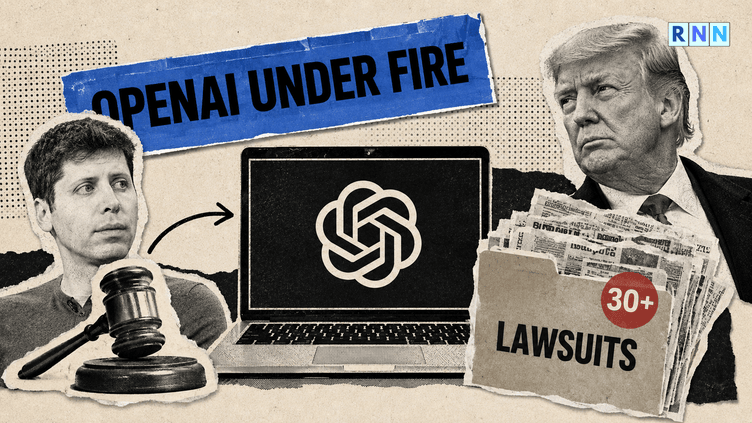 Lawsuits and Copyright Fights Pile Up
Trump's DoJ backs OpenAI in legal face off with New York Times
Loading tweet preview…
The past 48 hours have been a whiplash for OpenAI. On one side, the Justice Department walked into court with a 20-page brief arguing that training large language models on copyrighted material is fair use effectively taking OpenAI's side against The New York Times. Government lawyers framed the case as bigger than one publisher versus one AI lab, telling the court that limiting training data would hurt U.S. competitiveness against China and weaken national security. That is the kind of political cover companies usually only dream about. On the other side, the company is being buried under a wave of civil claims tied to the Tumbler Ridge school shooting. Thirty separate lawsuits have now been filed by survivors, teachers, and grieving families, and the filings allege something explosive that OpenAI executives overruled their own internal safety team's warnings months before the incident. Neither story cancels the other out. Together, they show a company that Washington has decided is too important to lose, and a public that is no longer willing to give it the benefit of the doubt.
A Company Winning in Court and Losing in the Headlines
The DoJ brief did not come out of nowhere. For months, White House officials have been signaling that they view a strong domestic AI sector as a strategic asset something closer to the semiconductor industry than to a search engine. The filing leans into that framing, arguing the Times' position would give foreign rivals an opening to pull ahead. That is a very specific message aimed at judges, lawmakers, and other publishers who might be considering their own suits. But the political tailwind ends the moment you leave the courtroom. The Tumbler Ridge filings are ugly in a way that press releases cannot smooth over. Plaintiffs describe internal Slack threads, dismissed risk assessments, and a culture where speed apparently mattered more than caution. Whether or not those claims survive discovery, they are now part of the public record. And that is exactly the kind of story that keeps regulators in Ottawa, Brussels, and Washington asking harder questions about what these systems can do when they leave the lab.
How Different Newsrooms Are Telling the OpenAI Story
Left-Leaning Framing: Accountability, Victims, and Corporate Overreach
Left-leaning outlets are pulling the lens back and asking a harder question: what does it mean when the government intervenes on behalf of one of the most valuable private companies in the world? Quartz's coverage does not celebrate the DoJ brief it labels it. The headline flatly reports that "the Trump administration sided with OpenAI," and the piece walks readers through what the fair use argument would mean for smaller publishers, freelancers, and rights-holders who cannot afford to fight back. Gizmodo takes an even sharper tone, tying the news to the Tumbler Ridge lawsuits and framing this as "the worst possible time" for OpenAI to be dabbling with more autonomous agents. iPhone in Canada, meanwhile, keeps the focus tightly on the 30 plaintiffs and the alleged overruling of internal safety staff. Across this cluster, the story is not about American competitiveness. It is about a company that keeps being handed second chances by people who benefit from its success.
Centrist Framing: Process, Precedent, and the Business of AI
Centrist newsrooms are treating this as a legal and industrial story rather than a moral one. Reuters and TechCrunch both stay close to the filings themselves quoting the brief, breaking down the fair use doctrine, and pointing out that a favorable ruling would set a precedent every AI company in the country would rely on. There is no cheering, but no scolding either. The tone is procedural. TechCrunch's headline, "US government sides with OpenAI on issue of training LLMs on copyrighted material," is almost clinical. Reuters' live coverage of Sam Altman at the G20 fits the same pattern: here is what he said, here is who he met with, here is what industry ministers are asking for. In this framing, the story is really about whether the U.S. legal system can keep up with a technology that is being deployed faster than it can be regulated.
Right-Leaning Framing: National Security and Standing Up to Legacy Media
Right-leaning outlets are running with a very different angle. For them, this is a story about the Trump administration finally treating AI the way it should have been treated all along as a matter of national strength. The Hollywood Reporter's coverage leans into the government's argument that limiting AI training would "undermine national security" and put the U.S. behind China. Fox Business elevates the White House framing, presenting AI dominance as a strategic priority, not a corporate favor. The New York Post takes it further, framing the DoJ brief as a rebuke of the Times itself a legacy publisher trying to use the courts to slow down an industry it does not control. In this cluster, the Tumbler Ridge lawsuits get significantly less airtime, and when they do come up, they are usually paired with a reminder that OpenAI has not yet responded and that plaintiffs' attorneys have their own incentives.
Conclusion
OpenAI is entering a new phase, and it is not the one Sam Altman was probably hoping for. The company has clearly won something important: the U.S. government is now on record defending its business model in one of the highest-profile copyright cases in the country. That is a shield most tech firms never get to hold. But shields do not silence victims, and they do not answer questions about internal decision-making. The Tumbler Ridge lawsuits, whatever their eventual outcome, have already forced a conversation that OpenAI's PR team cannot control one about who inside the company gets to say no, and what happens when they are ignored. Meanwhile, Altman is on a stage in Seoul talking about innovation policy while lawyers on two continents build cases against his company. That is the split-screen of AI in 2026. In Washington, it is a national asset. In the courtroom, it is a defendant. In the press, it is whatever a given newsroom needs it to be. The one thing that is not up for debate is that the era of OpenAI being treated as a scrappy startup is over. From here on out, every headline is a policy document and every lawsuit is a stress test.
Share
4 min read
Topics Covered
Discussion
Join the conversation
What's your read on this? Share your take with the community below.
Today in History
On September 2, several notable moments in the history of openai stand out. In 1915, Benjamin Aaron, American lawyer and scholar (died 2007) was born. In 1927, Milo Hamilton, American sportscaster (died 2015) was born. In 1936, Andrew Grove, Hungarian-American businessman, engineer, and author (died 2016) was born. In 1941, Jyrki Otila, Finnish economist and politician (died 2003) was born. In 1946, Walt Simonson, American author and illustrator was born. In 1954, Franz Leopold Neumann, German lawyer and political scientist (born 1900) passed away. In 1962, William Wilkerson, American publisher and businessman (born 1890) passed away. In 1973, J. R. R. Tolkien, English novelist, short story writer, poet, and philologist (born 1892) passed away. In 2013, Frederik Pohl, American author and publisher (born 1919) passed away. In 2014, Goolam Essaji Vahanvati, Indian lawyer and politician, 13th Attorney General of India (born 1949) passed away. Together, these milestones provide historical context for today's openai news and ongoing narratives. More