
News
·
August 2, 2026
The Woman at the Door: What We Still Don't Know About the Moscow Restaurant Bombing
A security guard's refusal to let one woman inside a Moscow restaurant may have prevented a mass-casualty attack. Russian officials still haven't said who she was, or who the bomb was really meant for.
Badis Jlassi
·
RNN Originals
·
1,216
Share
3 min read
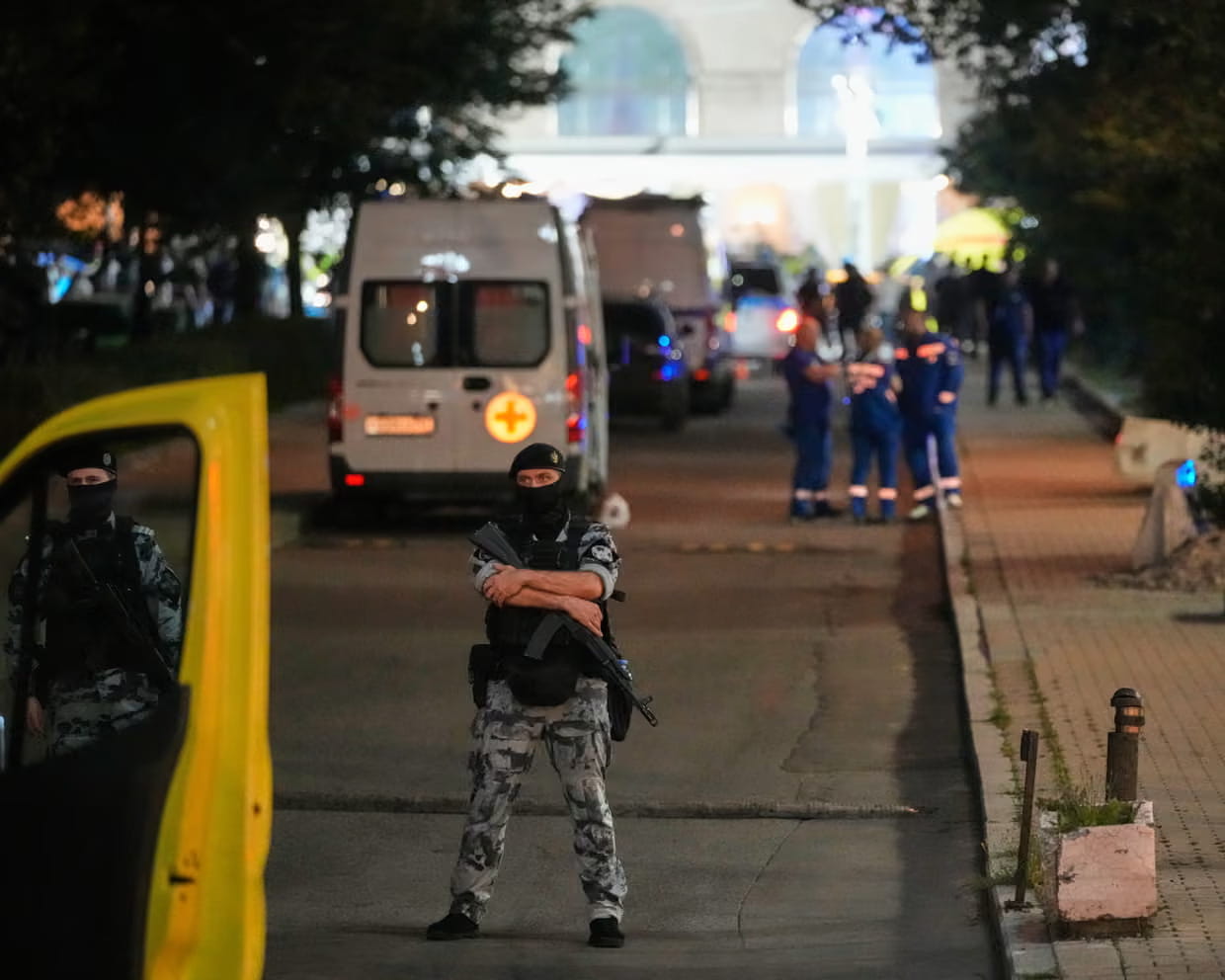 Image Credit : Reuters
The Woman at the Door: What We Still Don't Know About the Moscow Restaurant Bombing
A security guard did his job on Saturday night, and it probably saved dozens of lives. He also died for it. What's left behind is a blast site in one of Moscow's most recognizable buildings, three bodies, 21 wounded, and a story Russian officials are telling in careful, incomplete pieces the kind of account that raises almost as many questions as it answers.
The Basic Timeline
Around 8:10 p.m. local time on Saturday, an unidentified woman approached the entrance of Balzi Rossi, an Italian restaurant tucked into the base of one of Moscow's seven Stalin-era skyscrapers on Kudrinskaya Square. According to Russia's National Anti-Terrorism Committee, a security guard stopped her before she could get inside. The device she was carrying detonated where she stood, killing her, the guard, and one customer, and wounding 21 others. The restaurant had been closed to the public that night for a private event.
A Bomb Built to Maximize Casualties
The device carried the explosive force of roughly one kilogram of TNT and was packed with metal ball bearings, according to reporting on the investigation a construction pattern investigators typically read as evidence of intent to injure as many people as possible, not just to destroy a doorway. That detail alone complicates the official narrative. If the goal was mass casualties, a security guard's refusal to let one woman inside may have been the only thing standing between this being a story about three deaths and a story about dozens.
The Detail Nobody Has Explained Yet
Here's where the official account gets thin. Reuters, citing people familiar with the investigation, reported that the bomb may have been detonated remotely, meaning the woman carrying it might not have known what she had in her hands when it went off. If true, that reframes the entire incident not a willing attacker stopped at the door, but someone used, knowingly or not, as a delivery mechanism for someone else's plan. Russian authorities haven't confirmed or denied this. They also haven't named her, said what her connection to the restaurant or the event was, or offered a motive of any kind.
The Unverified Detail That's Spreading Anyway
A Telegram channel called ASTRA, which tracks unofficial reporting inside Russia, cited witnesses claiming a birthday celebration for a Russian general was underway near the blast site. Neither Russian authorities nor independent outlets have been able to confirm that claim, and it's exactly the kind of detail that spreads fastest precisely because it can't yet be checked. If accurate, it would suggest the private event wasn't incidental to the target it may have been the target. If false, it's a reminder of how quickly rumor fills the space state media leaves empty.
Why the Silence Matters
More than four years into the war with Ukraine, Russia's FSB has publicly acknowledged stepping up protection this year for senior military officers, a detail that only sharpens the question of who this restaurant, on this night, was actually meant for. Officials have called the case under investigation, which is true of nearly every unresolved bombing at this early stage, but it's also a phrase that buys time without answering anything. Until Moscow names the woman, confirms or denies the remote-detonation theory, and addresses the general's-birthday-party claim directly, this remains a story defined less by what happened than by what authorities have chosen not to say.
Conclusion
What's confirmed is grim enough on its own: a bomb built to hurt as many people as possible, a guard who paid with his life to keep it out, and a death toll that could have been dramatically higher. What's unconfirmed is where the real story likely lives who built the device, who the woman was, whether she knew what she was carrying, and who, if anyone, was actually meant to be inside when it went off. Until Russian investigators answer those questions on the record, every theory filling the gap deserves to be read as exactly that: a theory, not a fact.
Share
3 min read
Topics Covered
Discussion
Join the conversation
What's your read on this? Share your take with the community below.
Today in History
On August 3, several notable moments in the history of moscow stand out. In 1601, Long War: Austria captures Transylvania in the Battle of Goroszló. In 1903, Macedonian rebels in Kruševo proclaim the Kruševo Republic, which exists for only ten days before Ottoman Turks lay waste to the town. In 1935, Georgy Shonin, Ukrainian-Russian general, pilot, and cosmonaut (died 1997) was born. In 1936, A fire wipes out Kursha-2 in the Meshchera Lowlands, Ryazan Oblast, Russia, killing 1,200 and leaving only 20 survivors. In 1968, Konstantin Rokossovsky, Marshal of the Soviet Union during World War II (born 1896) passed away. In 1998, Alfred Schnittke, Russian composer and journalist (born 1934) passed away. In 2008, Aleksandr Solzhenitsyn, Russian novelist, dramatist and historian, Nobel Prize laureate (born 1918) passed away. In 2010, Widespread rioting erupts in Karachi, Pakistan, after the assassination of a local politician, leaving at least 85 dead and at least 17 billion Pakistani rupees (US$200 million) in damage. In 2019, Six hundred protesters, including opposition leader Lyubov Sobol, are arrested in an election protest in Moscow, Russia. In 2023, Worst floods hit major parts of Slovenia. Together, these milestones provide historical context for today's moscow news and ongoing narratives. More