
News
·
August 22, 2026
Leavitt Sold the Canada Deal. It Collapsed 60 Hours Later.
Trump announced a tentative deal with Canada on Tuesday night. By Friday, talks had collapsed entirely, 50% tariffs took effect at midnight, and Carney pulled his negotiators out of Washington.
Badis Jlassi
·
RNN Originals
·
535
Share
3 min read
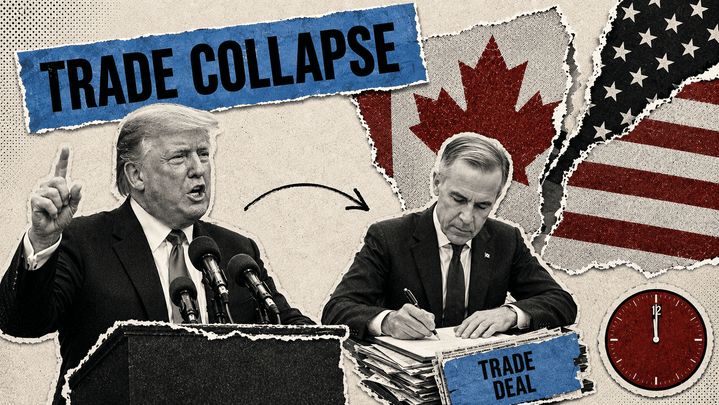 Trade Deal Collapse
Leavitt Sold the Canada Deal. It Collapsed 60 Hours Later.
For about two and a half days, it looked like the tariff fight between the US and its second-largest trading partner was actually over. By Friday night, it wasn't just back on — it was worse than before. Fresh 50% tariffs on $20 billion worth of Canadian goods took effect at the stroke of midnight, Prime Minister Mark Carney pulled his negotiators out of Washington entirely, and both governments spent the weekend publicly blaming each other for the fastest, ugliest breakdown in the relationship since Trump returned to office.
Loading tweet preview…
A Pattern That Started With Karoline Leavitt, Nineteen Months Ago
This exact rhythm, confident declaration followed by a messier reality, has defined how the administration has talked about Canada since day one. Press Secretary Karoline Leavitt made her formal briefing room debut in January 2025 defending the first round of Canadian tariffs, framing them as a response to "illegal fentanyl" crossing the northern border. When NBC's Gabe Gutierrez pointed out that only 43 pounds of fentanyl had actually been seized at the Canadian border that year, versus 21,100 pounds at the Mexican border, Leavitt didn't engage with the comparison. "You're asking me for what the president's justification is for these tariffs. It's not up to you. You're not the president, Gabe!" she said. The specific numbers behind the administration's Canada rationale have been contested by reporters ever since, even as the tariffs themselves kept escalating anyway.
The Near-Deal That Made Headlines on Tuesday
By this week, the story looked like it was heading toward resolution. With a fresh round of 50% tariffs on Canadian wine, hockey sticks, cement, and dairy-adjacent goods set to hit at Wednesday's deadline, Trump announced late Tuesday night on Truth Social that he'd paused the tariffs for three days, citing a pending deal "subject to the finalization of documents." The emerging terms sounded significant: Trump suggested reviving the long-dead Keystone XL pipeline, floated changes to US tariffs on Canadian autos, and hinted at lowering duties on Canadian steel and aluminum. US Trade Representative Jamieson Greer said the two sides had "eliminated some of the irritants" built up over the past year. Carney, for his part, was notably more measured, saying "substantial progress has been made, although there is important work still to be done."
Then, Late Friday, It Fell Apart Entirely
Carney's caution turned out to be the more accurate read. Late Friday night, hours before the new three-day pause was set to expire, Canada's Prime Minister announced he was suspending negotiations altogether and recalling his negotiators to Ottawa. "That progress has not been enough to meet our objectives for Canadians," Carney said in a statement, adding, "As a result, this evening, I have decided to suspend trade negotiations with the U.S." He confirmed Canada would retaliate "dollar for dollar," matching the roughly $20 to $28 billion in new US levies with its own countermeasures on American goods and services.
Each Side Blames the Other for What Went Wrong
Washington's account puts the blame squarely on Ottawa. US Trade Representative Jamieson Greer said Canadian negotiators made "last-minute demands" that upended a draft deal worked out over days of talks, calling the collapse "a missed opportunity for Canada to partner with the United States." Canada's version points the finger back: Carney said it was the US that introduced late changes to the terms. Reporting from NBC and the Irish Times points to a specific sticking point, provincial bans on American alcohol sales that several Canadian premiers, including Ontario's Doug Ford, were reluctant to lift as part of any deal, even as Carney personally pushed them to. Quebec's premier said she was still "analyzing" the request as talks entered their final hours.
What's Actually Taking Effect Now
The tariffs cover roughly $20 billion worth of Canadian exports, about 5% of what Canada sells the US, hitting plywood, liquor, electrical equipment, hockey gear, cement, and various clothing categories. Notably, the administration carved out key sectors from the new duties, including energy, potash, and critical minerals, meaning the pain is concentrated in manufacturing and consumer goods rather than Canada's largest overall export categories. Trump invoked Section 338 of the 1930 Tariff Act to authorize the tariffs, a provision no president has used to impose duties since it became law nearly a century ago. Total US-Canada trade in the first half of 2026 ran close to $376 billion, meaning this dispute, however large the percentages sound, is playing out against one of the largest bilateral trading relationships on earth.
Share
3 min read
Topics Covered
Discussion
Join the conversation
What's your read on this? Share your take with the community below.
Today in History
On August 22, several notable moments in the history of donald trump stand out. In 1895, Paul Comtois, Canadian lawyer and politician, 21st Lieutenant Governor of Quebec (died 1966) was born. In 1950, Kirk Bryan, American geologist and academic (born 1888) passed away. In 1951, Jack Bickell, Canadian businessman and philanthropist (born 1884) passed away. In 1974, Cory Gardner, American politician was born. In 1977, Keren Cytter, Israeli visual artist and writer was born. In 1986, Celâl Bayar, Turkish lawyer and politician, 3rd President of Turkey (born 1883) passed away. In 1991, Brayden Schenn, Canadian ice hockey player was born. In 2004, Daniel Petrie, Canadian director and producer (born 1920) passed away. In 2011, Jack Layton, Canadian academic and politician (born 1950) passed away. In 2011, Casey Ribicoff, American philanthropist (born 1922) passed away. Together, these milestones provide historical context for today's donald trump news and ongoing narratives. More