
Analysis
·
August 31, 2026
Google Quietly Renamed Lake Ontario. What's Really Behind It?
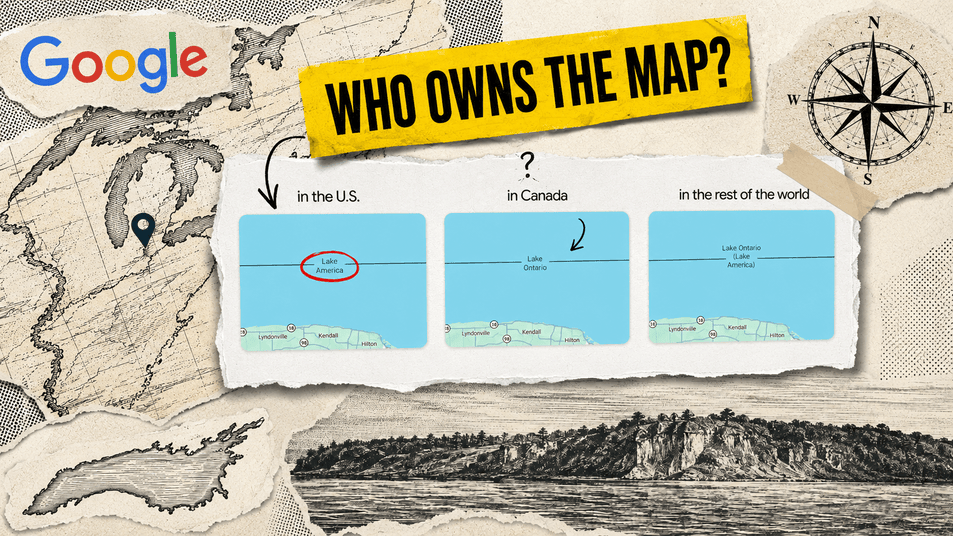
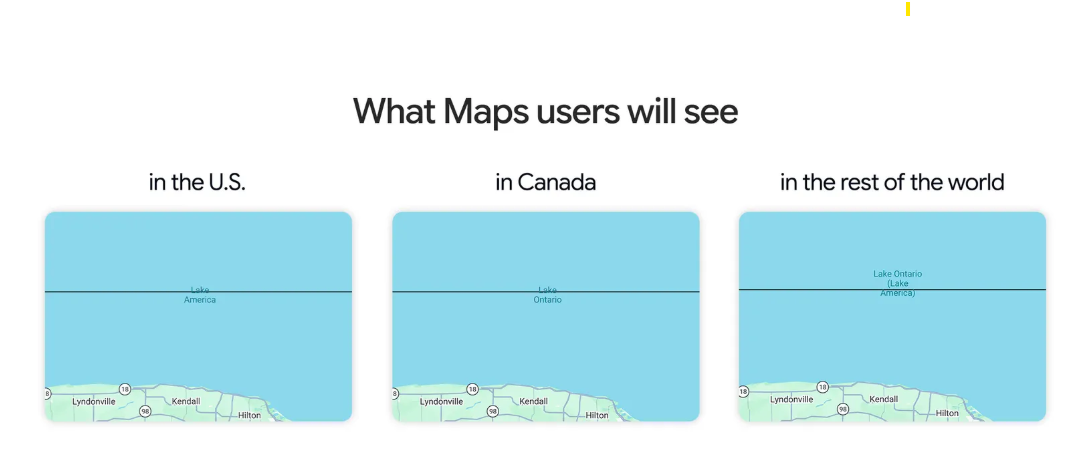
For a brief moment this week, some users searching Google Maps noticed something strange. Lake Ontario, the smallest of the five Great Lakes and one of the most heavily trafficked bodies of freshwater on the continent, was showing up under a different name. No press release, no announcement, no explanation. Just a quiet edit inside the world's most powerful mapping tool. And now people want to know why.
Collins Oboth
·
RNN Staff Writer
·
3,246
Share
5 min read
 Lake Ontario, one of the five Great Lakes shared by Canada and the United States
A name change nobody asked for
Lake Ontario has been called Lake Ontario for a very long time. The name is stitched into treaties, shipping charts, school textbooks and the songs of two countries. So when users started spotting a different label on Google Maps, the reaction was less about geography and more about disbelief. Some flagged it as a glitch. Others took screenshots. A few pointed out that Google has quietly done this before with other places, and each time the company gave a similar reply: our maps reflect local naming conventions and official sources. That answer is technically fine. It also does not fully explain how a lake shared by Canada and the United States, with a name unchanged for centuries, ends up edited overnight. The deeper issue is not the label itself. It is who gets to change it, and how.
Loading tweet preview…
Google Maps launches
Google Maps goes live and quickly becomes the default way most of the world navigates. Place names on the platform start to carry an authority they never had before.
The border disputes begin
From the Persian Gulf to Crimea, Google gets pulled into naming fights between governments. The company begins showing different labels in different countries depending on local law.
Gulf of Mexico controversy
Google renames the Gulf of Mexico to the Gulf of America for U.S. users after a federal order, drawing sharp criticism from Mexico and reopening the debate about political influence on maps.
Lake Ontario appears altered
Users report seeing Lake Ontario listed under a different name on Google Maps. The company has not publicly explained the change or how long it was live.
The credibility test
Canadian officials, cartographers and researchers are asking whether this was a routine data update, a rendering error, or something more deliberate. The answer will shape how much trust Google keeps in one of its most sensitive products.
Google's credibility problem is bigger than a lake
Maps used to be printed on paper and updated once a year. If a name was wrong, you noticed the next time you bought an atlas. Today most people never see a paper map. They see Google Maps, and whatever it says is treated as fact. That's where the trouble starts. When one company controls the default view of the planet, every small edit is a policy decision, even if it was never meant to be one. A quiet change to Lake Ontario, whether it lasted five minutes or five days, still tells users something about how the world is labeled today. And if that label can shift without warning, so can everything else on the map. Google has spent years telling regulators and the public that its mapping decisions are neutral. The Lake Ontario incident makes that harder to argue. It doesn't take a conspiracy to be a problem. It just takes a lack of transparency, repeated often enough.
The Gulf of Mexico moment set the tone
You can't talk about Lake Ontario without talking about what happened earlier with the Gulf of Mexico. When the U.S. government moved to rename it the Gulf of America, Google followed suit for American users. Mexican officials pushed back. Canadian commentators watched closely. And a lot of people outside North America saw the whole episode as a warning: if a president can rename a gulf overnight and have it show up on Google, then place names are not really neutral anymore. They are political assets. That's the backdrop against which the Lake Ontario change is being read. Whether or not there is any political motive here, the trust has already been damaged. Users are now trained to ask why. And once that question is on the table, a company's silence starts to sound like an answer.
Lake Ontario borders Ontario, New York and a shared shipping corridor that moves roughly 160 million tons of cargo through the Great Lakes system each year. A name is not just a name when it sits on top of that much shared infrastructure.
Why this matters for U.S.–Canada relations
The U.S. and Canada share the longest peaceful border in the world, and the Great Lakes are the clearest example of what that partnership actually looks like on the ground. Water quality agreements, fisheries treaties, coast guard operations, invasive species monitoring, all of it depends on the two countries agreeing on what these lakes are and what they are called. Any suggestion, even by accident, that a shared lake now has a different name in the world's most-used mapping app is going to make Ottawa uncomfortable. It doesn't take much. Canadians have already spent the last year watching the political mood in Washington shift, hearing loose talk about tariffs, annexation jokes, and disputes over water rights out west. A quiet renaming of Lake Ontario, even for a moment, lands in that context. It doesn't stay a tech story. It becomes a diplomatic one. That is the part Google seems to underestimate every time this happens. The company treats these edits like data updates. Governments treat them like statements.
What could happen next
A few things are likely to follow from here. First, Google will probably issue a short statement blaming a data provider, a testing environment, or an automated pipeline. That has been the pattern in almost every previous incident. Whether people accept the explanation is another matter. Second, expect Canadian federal officials to say something, even if only to reaffirm that Lake Ontario is Lake Ontario. Politicians rarely miss the chance to defend a national landmark, especially when the fix costs them nothing. Third, and this is the more interesting one, expect renewed pressure on Google to publish a clearer policy on how place names get edited, who signs off, and how the public is notified. That pressure has been building for years. Each of these little incidents pushes it a step closer to actual regulation, particularly in the EU and now increasingly in Canada. Fourth, watch other platforms. Apple Maps, Bing and OpenStreetMap will now be under a microscope to see whether they show the same label or a different one. Divergence between platforms is itself becoming a form of political map.
The bigger question hiding under the surface
The Lake Ontario story is small on its own. A label changed, a label got changed back, everyone moves on. But it points to something we still haven't figured out as a society. We have handed over the job of describing the world to a handful of private companies, and we haven't really decided what the rules are. Who gets to name a mountain? Who decides which border to draw and which one to leave off? Who is allowed to look at a shared lake and quietly assign it a different word? Right now, the answer is whoever has the biggest platform. That is not a stable answer, and events like this one keep reminding us why. The question is not really what Google did to Lake Ontario this week. The question is what it, or the next company, or the next government, decides to do the week after. And whether anyone will notice in time.
The story isn't the lake. The story is who now owns the map.
Share
5 min read
Topics Covered
Discussion
Join the conversation
What's your read on this? Share your take with the community below.
Today in History
On August 31, several notable moments in the history of google stand out. In 1420, The 8.8-9.4 Caldera earthquake shakes Chile's Atacama Region causing tsunami in Chile, Hawaii, and Japan. In 1772, William Borlase, English geologist and historian (born 1695) passed away. In 1864, During the American Civil War, Union forces led by General William T. Sherman launch an assault on Atlanta. In 1884, George Sarton, Belgian-American historian of science (died 1956) was born. In 1907, Russia and the United Kingdom sign the Anglo-Russian Convention, by which the UK recognizes Russian preeminence in northern Persia, while Russia recognizes British preeminence in southeastern Persia and Afghanistan. Both powers pledge not to interfere in Tibet. In 1931, Jean Béliveau, Canadian ice hockey player (died 2014) was born. In 1982, G. Willow Wilson, American journalist and author was born. In 1993, Russia completes removing its troops from Lithuania. In 2002, George Porter, English chemist and academic, Nobel Prize laureate (born 1920) passed away. In 2007, Jean Jacques Paradis, Canadian general (born 1928) passed away. Together, these milestones provide historical context for today's google news and ongoing narratives. More