
News
·
August 3, 2026
Who Opened the Gate? The Question Behind Ceuta's Deadliest Migrant Surge
As many as 60,000 people crossed into Spain's Ceuta enclave in 48 hours, and more than 70 died. Behind the official explanation of smugglers exploiting a court ruling lies a harder question: did Morocco let it happen?
Badis Jlassi
·
RNN Originals
·
515
Share
3 min read
 RNN
RNNWho Opened the Gate? The Question Behind Ceuta's Deadliest Migrant Surge
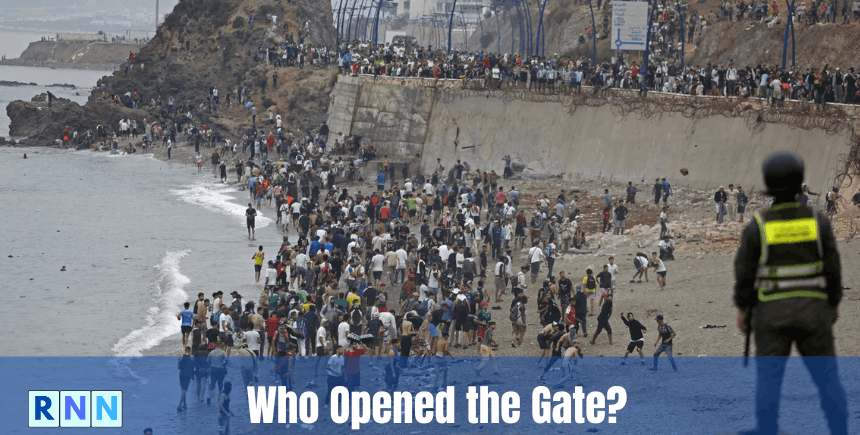
For a border that's been fortified for decades, it fell astonishingly fast. In roughly 48 hours, somewhere between 50,000 and 60,000 people swam, waded, and walked across the maritime line separating Morocco from Spain's tiny North African enclave of Ceuta. More than 70 of them died trying. And now, days later, the most contested question isn't how many crossed — it's whether Morocco quietly let them.
Loading tweet preview…
The Official Story: A Ruling, Misread on Purpose
Spain's version starts with a court decision. On June 29, Spain's Supreme Court ruled that migrants intercepted at sea trying to reach Ceuta or Melilla couldn't be handed straight back to Morocco under the fast-track "hot return" procedure used for land crossings — they'd need the standard immigration process instead. Prime Minister Pedro Sánchez has blamed human-smuggling networks for twisting that narrow legal distinction into a rumor that spread, in his words, like wildfire: cross by water, and Spain can't send you back quickly. Spain's Interior Ministry says the same thing more bluntly, describing traffickers exploiting the ruling to push a surge of mostly young migrants toward the border.
Ceuta crisis: Spain and Morocco's 30 years of strategic rapprochement and underlying tensions
Thousands of migrants remain stranded in Spain's Ceuta after mass border crossing
Moroccans gather at Ceuta border, desperate for news of loved ones
The Migrants Tell a Different Story
Talk to the people who actually crossed, and the story shifts. Several migrants interviewed by reporters said Moroccan border guards simply weren't there to stop them, and that word of an unguarded crossing spread through social media within hours, pulling in people from across the country and beyond. One 24-year-old told a reporter he didn't know why authorities let them through, speculating it might have been political. Spanish officials have stopped short of formally accusing Rabat of deliberately facilitating the surge — but the fact that so many migrants independently describe the same thing, an open door rather than a breached one, is hard to wave away as coincidence.
What The Telegraph Says Western Intelligence Suspects
This is where the story gets harder to dismiss. The Telegraph has reported that Western intelligence services suspect Rabat deliberately allowed the crossing, reading it as retaliation tied to Spain's gas negotiations with Algeria, Morocco's regional rival, layered on top of long-standing friction over the disputed Western Sahara territory. Spanish security officials have also claimed, both during this crisis and during a similar 2021 surge, that Moroccan intelligence agents were spotted among the migrants, allegedly using the chaos to survey Ceuta's border defenses up close. None of this amounts to proof. Morocco's government has publicly said the situation was "not wanted by the Kingdom," and a Moroccan commentary outlet has argued the theory is implausible, pointing to Rabat's fast cooperation on returns as evidence it was blindsided, not orchestrating anything.
Europe Splits Down the Middle
Whatever caused it, the fallout has been immediate and politically messy. More than 20 EU heads of state signed a joint letter demanding an emergency meeting of interior ministers, with member states saying they're ready to reinstate internal border checks. German Chancellor Friedrich Merz publicly demanded Morocco "take back illegal migrants immediately" and pushed for the EU's Return Regulation to be enforced without delay. Italian Foreign Minister Antonio Tajani went further, tying the crisis directly to Spain's own decision to regularize hundreds of thousands of undocumented migrants earlier this year, calling it a pull factor that "encourages human trafficking." On the other side, Spanish and European left-wing officials have accused critics of exploiting a humanitarian tragedy for political points, with one MEP calling out what she described as "demagoguery" dressed up as border security concern.
Conclusion
Strip away the finger-pointing and two things are true at once, however uncomfortable that is. Spain's court ruling really did create a legal gap that smugglers could exploit, and that gap really was marketed online as a guaranteed path to stay. But an unguarded border, matched with intelligence reporting and firsthand accounts pointing toward Moroccan involvement, isn't something a rumor alone explains. Until Rabat and Madrid answer the same question with the same story — did someone open this gate on purpose, or did it just collapse under weight nobody expected — every version of this crisis being told across Europe right now is still, at best, half the picture.
Share
3 min read
Topics Covered
Discussion
Join the conversation
What's your read on this? Share your take with the community below.
Today in History
On August 4, several notable moments in the history of ceuta stand out. In 1342, The Siege of Algeciras commences during the Spanish Reconquista. In 1492, Christopher Columbus sets sail from Palos de la Frontera, Spain. In 1604, Bernardino de Mendoza, Spanish commander and diplomat (born 1540) passed away. In 1903, Habib Bourguiba, Tunisian journalist and politician, 1st President of the Republic of Tunisia (died 2000) was born. In 1959, Portugal's state police force PIDE fires upon striking workers in Bissau, Portuguese Guinea, killing over 50 people. In 1960, Niger gains independence from France. In 1975, A privately chartered Boeing 707 strikes a mountain peak and crashes near Agadir, Morocco, killing 188. In 1997, Oued El-Had and Mezouara massacre in Algeria: A total of 116 villagers killed, 40 in Oued El-Had and 76 in Mezouara. In 1999, Brahim Díaz, Spanish-Moroccan footballer was born. In 2023, Worst floods hit major parts of Slovenia. Together, these milestones provide historical context for today's ceuta news and ongoing narratives. More