
News
·
September 1, 2026
A Drone on a German Runway, and the Quiet War Europe Keeps Pretending Isn't Happening
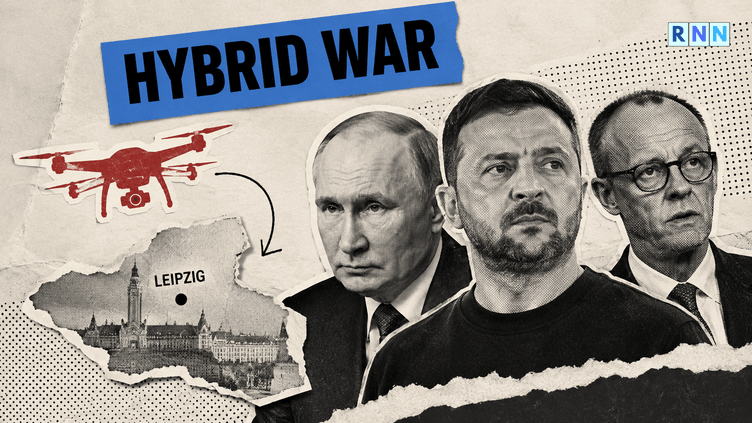
For most of August, Germany treated the strange object found near a Ukrainian cargo plane at Leipzig/Halle Airport as a police matter. On Tuesday, Berlin stopped pretending. The government named Russia as the actor behind the attempted drone attack, shut down a Russian consulate, and framed the incident as one more entry in a long ledger of hybrid operations pressing against Europe's soft edges.
Collins Oboth
·
RNN Staff Writer
·
3,519
Share
8 min read
 Leipzig/Halle Airport in Schkeuditz, Germany, on August 5, 2026, after an explosive-laden drone was found near a Ukrainian cargo aircraft.
The night the tarmac stopped being ordinary
Leipzig/Halle isn't the kind of airport most people can find on a map. It sits in Saxony, about an hour's drive south of Berlin, and outside logistics circles it doesn't get talked about much. Inside those circles, it is one of the most important pieces of infrastructure in Europe. DHL runs its European cargo super-hub out of it. Ukrainian Antonov jets, some of the biggest cargo planes still flying, park on its aprons. Military transport moves through it. If you want to squeeze the belt that keeps Western supplies flowing east, this is one of the buckles. Which is why what happened in the early hours of August 5 wasn't just strange. It was pointed. An airport worker found a small drone in the cargo zone, close to a Ukrainian aircraft, carrying what turned out to be an explosive charge. Around the same time, a DHL Boeing 757-200 clipped an unidentified object on the ground. Nineteen flights were diverted. The site was closed for hours while a police robot picked apart the device. Then it happened again. Three weeks later, on August 25, investigators found a third drone and what German media described as suspected military explosives on land near the airport perimeter. It was not looking like an accident anymore.
Germany is expected to identify Russia as responsible for the drone attack in Leipzig | DW News
Germany's Merz says Berlin is preparing response to Leipzig drone incident
Germany plans to blame Russia for Leipzig attack as tensions with Putin escalate

Germany accuses Russia of drone attack on Leipzig airport
Measures to be announced next week: Germany believes Russia was behind Leipzig drone incident: media reports
Germany: Leipzig airport drone attack was Russian
Germany blames Russia for attempted drone attack at Leipzig airport
Germany blames Russia for explosives-laden drone at Leipzig airport
Germany Blames Russia for Explosive Drones Sent to Leipzig Airport
EU condemns Russia’s ‘attempted drone attack’ at Germany’s Leipzig Airport
Germany to blame Russia for attempted drone attack on Ukrainian cargo plane at Leipzig/Halle airport
Russia responsible for hybrid attack on Leipzig airport, Germany insists
First drone discovered
In the pre-dawn hours, an airport employee finds a small drone carrying explosives in the secure cargo zone near the south runway, close to a Ukrainian Antonov aircraft. A DHL Boeing 757-200 strikes an unidentified object during the same window. Leipzig/Halle closes; 19 flights are diverted.
Investigation widens
Saxony state authorities and the federal police open a joint probe. German outlets begin reporting that officials suspect a coordinated hybrid attack potentially involving foreign actors targeting logistics infrastructure and Ukraine-bound cargo.
Third drone and military-grade explosives
Investigators locate a third drone and what German media describe as suspected military explosives near the airport perimeter. The find sharpens the theory that the incident was not a lone actor but a planned operation.
Berlin names Russia
Interior Minister Alexander Dobrindt and Foreign Minister Johann Wadephul say the police work, offence patterns and intelligence findings, taken together, establish Russian responsibility for the attempted attack. Germany orders the closure of Russia's Bonn consulate general and terminates the Russian House cultural centre agreement in Berlin.
Moscow pushes back
The Russian embassy in Berlin calls the accusations absurd, baseless, and an unprecedented escalation. Spokeswoman Maria Zakharova says Moscow will respond. The Kremlin frames the move as another wave of what it describes as anti-Russian hysteria in Germany.
EU response takes shape
European Commission President Ursula von der Leyen prepares to meet NATO Secretary General Mark Rutte. EU foreign ministers gather at Gymnich in Ireland. Berlin pushes for more sanctions listings, travel bans and pressure on Russia's shadow fleet, while allies signal solidarity.
Loading tweet preview…
How Berlin got from suspicion to a name
Leipzig/Halle is a major European logistics hub, with DHL's European cargo hub, Ukrainian Antonov aircraft, and military transport operating there. On August 5, an airport worker found a drone carrying an explosive device near a Ukrainian aircraft. Around the same time, a DHL Boeing 757 struck an unidentified object, causing 19 flights to be diverted and the airport to close for several hours. On August 25, investigators found another drone and suspected military explosives near the airport perimeter. The repeated incidents suggested the attacks were deliberate.
Leipzig/Halle is DHL's main European air cargo hub and one of NATO's most reliable logistics corridors for material heading east. Hitting the runway there, even symbolically, is not the same as hitting any airport. It is aimed at the supply chain that keeps Ukraine fighting.
Moscow's answer, and why it matters
Russia's rejection came quickly and in familiar tones. The Russian embassy in Berlin described the accusations as absurd, baseless and contrary to common sense. Foreign Ministry spokeswoman Maria Zakharova said Moscow would respond to what she called Berlin's anti-Russian action, without spelling out how. The embassy framed the German measures as an unprecedented escalation and warned that consequences would follow, laying the blame in advance on the German government. Moscow's line has a consistent shape. Deny the specific act. Suggest the accusation benefits others, in this case Ukraine, European defence firms, and what the embassy called the militaristic wing of Europe's elite. Warn of consequences. It is a script that has been used almost verbatim after every attribution decision in the last three years, from the Nord Stream investigations to the Czech ammunition depot case to the sabotage attempts in the Baltics. The fact that the script is familiar is not, on its own, evidence that Berlin's conclusion is right. But it is a reminder that Moscow's public denials have become part of the choreography of these incidents, not a serious rebuttal of them. Countries watching from the sidelines are calibrating their responses accordingly.
How the story looks from three different rooms
One of the more useful exercises in a story like this is to walk it through different political rooms in Europe and see how it lands. On the left, the reading tends to focus on escalation and civilian risk. A drone with explosives near a busy commercial airport is a reminder that hybrid war spills over into ordinary aviation. The concern is less about punishing Moscow than about hardening infrastructure, protecting workers on the tarmac, and keeping the door open for de-escalation. Groups on this side of the debate will use Leipzig to argue for stronger anti-drone regulation, more transparency on incidents, and caution against language that pushes NATO and Russia closer to open conflict. On the right, especially in Germany's own political landscape, the reading is closer to a national security wake-up call. Critical infrastructure was targeted on German soil. Russian operatives, in Berlin's telling, walked assets right up to a NATO logistics artery. The response, the argument goes, should not stop at shutting a consulate. It should include harder counter-intelligence, stricter visa screening for Russian nationals, mandatory drone defence at every major airport, and a public accounting of how deep the infiltration goes. Some voices further right also raise questions about whether Germany's continued energy and trade links with Russian-adjacent economies have made this kind of operation easier to run. In the centre, where most European governments still try to live, the mood is more measured but also more worried. This is the crowd that has been quietly tracking sabotage incidents across the continent since 2022 and watching them accelerate. For them, Leipzig is not a shock, it is a data point. What Berlin did on Tuesday, in this reading, is finally say out loud what many chancelleries have been saying in private. The centre wants coordinated European action rather than a dozen national responses, and it wants it before the next incident, not after.
The pieces that don't fit neatly yet
It is worth being honest about what is still unclear. Berlin has not, at least publicly, laid out the specific intelligence that ties the drone to Russian state agencies. That is normal. Sources and methods get protected. But it means the public, and the Russian government, are being asked to take a lot on the credibility of German services. Those services have generally earned that credibility over the past two years, but healthy scepticism is not the same as sympathy for Moscow. A few operational questions also remain open. Who physically launched the drone. Whether the operators were Russian nationals, third-country recruits, or local sympathisers. How the explosives crossed into Germany, and whether the same supply chain has been used elsewhere. Whether the target was symbolic, timed to a specific cargo flight, or aimed at causing an actual mass-casualty event. Different answers to those questions would change how frightening this really is. There is also the question of deterrence. If the goal of Russian hybrid operations is to test how far Europe will let them go before it responds, closing a consulate and shutting a cultural centre is a specific answer. Whether it is enough of one is what allies will be arguing about in Brussels this week.
Why an airport was chosen
There is an old rule in sabotage: hit the nodes, not the lines. You do not need to bomb every kilometre of rail track if you can knock out one switching yard. You do not need to interdict every arms shipment if you can make one hub feel unsafe. Airports, and especially cargo airports, are nodes. Insurance premiums rise. Airlines reroute. Cargo carriers renegotiate risk. Governments spend money on defensive kit they had been putting off. Every one of those effects costs the target country far more than the attack itself. Leipzig also sits at the intersection of the two things Moscow most wants to disrupt: Western commercial logistics and Western military logistics. Antonov aircraft flying in and out of the airport have been a visible symbol of Ukraine's continued operational lifeline. DHL's presence links the site to global e-commerce and industrial supply chains. A drone in that space is a message written in equal parts to Kyiv, Berlin, and every insurance underwriter in London. That is what makes calling this attack important. If it is treated as a one-off incident, the underlying logic keeps working. If it is treated as an act of state, the calculus starts to shift.
What likely happens next
A few developments are already visible on the horizon. First, Brussels will do more than issue statements. European Commission President Ursula von der Leyen has scheduled talks with NATO Secretary General Mark Rutte. EU foreign ministers are meeting at Gymnich in Ireland this week. Poland's foreign minister has already declared full solidarity with Germany. British Prime Minister Andy Burnham has said any Russian attempts to undermine support for Ukraine are doomed to fail. Expect a joint response package, probably combining new sanctions listings, travel restrictions on named Russian nationals, and further squeezing of the so-called Russian shadow fleet that helps evade oil price caps. Second, expect a wave of quiet spending. Airports across Europe with a defence or Ukraine-support footprint will accelerate anti-drone procurement. Radar systems, RF jammers, physical netting near sensitive aprons, additional armed patrols. Some of it will be public. Most of it will not. Third, watch what Moscow does. The Russian foreign ministry has promised a response. That could be symmetrical, closing a German diplomatic property in Russia, or asymmetrical, an information campaign, cyber activity, or a fresh incident somewhere else in Europe designed to stretch attention. History suggests the answer usually arrives inside two to three weeks. Fourth, watch how German politics absorbs this. Berlin's coalition has been under domestic pressure over defence spending and Ukraine policy. A clean, high-visibility attribution gives the government a rare moment of consensus. Whether that consensus survives the next budget fight is a different question.
Hybrid war works precisely because it never quite forces you to admit you are in one. Leipzig is the moment Germany admitted it.
The larger picture nobody wants to say plainly
The awkward truth sitting under this story is that Europe has been at low-intensity war with Russia for years, and has spent that entire time pretending it is only doing sanctions. Fires at defence factories in Poland. Cables cut in the Baltic. Rail signals hacked in the Czech Republic. Arson at logistics warehouses in the UK. A pipeline blown up somewhere no one wants to publicly investigate all the way. Now a drone with explosives near a Ukrainian plane on a German runway. Each of these on its own is a footnote. Together they are a policy. Someone, somewhere, has decided that the risk of doing this is lower than the reward, and that reward is measured in European hesitation, delayed shipments, political friction, and the slow erosion of the idea that the war stops at Ukraine's border. Germany's decision to name Russia this week does not end that campaign. It probably does not even slow it much in the short term. But it does something else. It puts the country's most cautious major government on record saying the quiet part out loud. Once Berlin has said it, it becomes harder for Rome, Vienna, Budapest, or any capital that has preferred ambiguity to keep pretending they don't see what is happening. That is the real story of the drone at Leipzig. Not the device itself, and not even the diplomatic fallout. The story is a European government finally treating a series of coincidences as what they have been for some time. A pattern. And once you call something a pattern, you have to decide what to do about it.
The drone didn't detonate. The point still landed.
Share
8 min read
Topics Covered
Discussion
Join the conversation
What's your read on this? Share your take with the community below.
Today in History
On September 1, several notable moments in the history of leipzig airport stand out. In 1870, Franco-Prussian War: The Battle of Sedan is fought, resulting in a decisive Prussian victory. In 1878, Princess Alexandra of Saxe-Coburg and Gotha (died 1942) was born. In 1919, Hilda Hänchen, German physicist and academic (died 2013) was born. In 1939, World War II: Germany and Slovakia invade Poland, beginning the European phase of World War II. In 1944, World War II: Launch of Operation Ratweek, complicating German retreat. In 1961, TWA Flight 529 crashed shortly after takeoff from Midway Airport in Chicago, killing all 78 people on board. At the time, it was the deadliest single plane disaster in U.S. history. In 1981, Albert Speer, German architect and author (born 1905) passed away. In 1983, Cold War: Korean Air Lines Flight 007 is shot down by a Soviet jet fighter after the commercial aircraft strayed into Soviet airspace, killing all 269 on board, including Congressman Lawrence McDonald. In 1990, Edwin O. Reischauer, American scholar and diplomat (born 1910) passed away. In 2008, Iraq War: The United States Armed Forces transfers control of Anbar Province to the Iraqi Armed Forces. Together, these milestones provide historical context for today's leipzig airport news and ongoing narratives. More