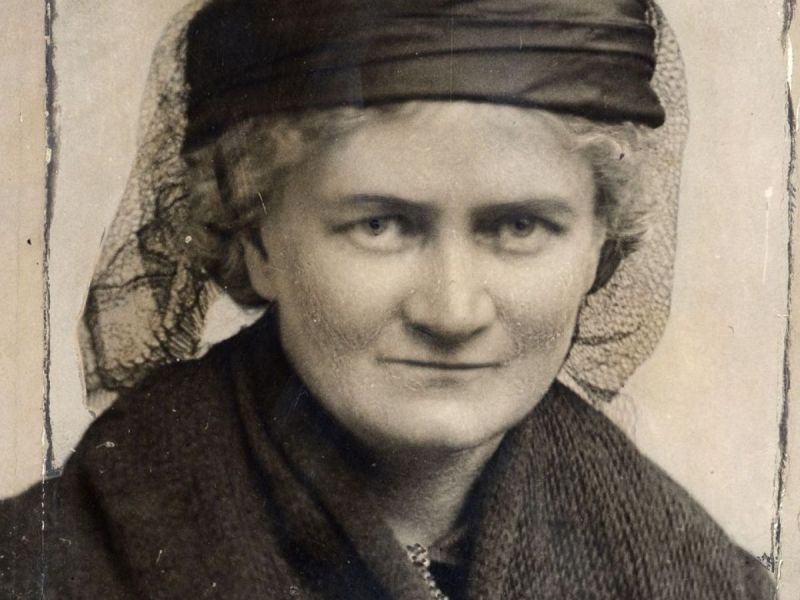
Violet Gibson: The Irish woman who shot Mussolini
April 7, 2026
Wanted in Rome
On this day 100 years ago, Violet Gibson tried to change the course of history. On 7 April 1926, Italian fascist dictator Benito Mussolini was walking through cheering crowds in the centre of Rome when a woman in a black veil attempted to assassinate him. Mussolini survived the attempt on his life, after a bullet grazed his nose, in an episode largely forgotten by history.
The person who pulled the trigger was Anglo-Irish woman Violet Gibson who mingled among the crowd with a Model 1892 revolver hidden under her shawl. Gibson shot at Mussolini as he walked through Piazza del Campidoglio, seat of Rome's city hall, after he had addressed the International Congress of Surgeons. Imprisonment and deportation She fired one shot, with the bullet grazing Mussolini's nose, before the gun jammed and she was almost lynched by the crowd. She was only saved after the police intervened to arrest her. As for Mussolini, he suffered only minor injuries which he dismissed as a mere trifle, and once his nose was bandaged he continued his parade around the Capitoline Hill. Gibson was imprisoned in Rome but later released without charge, on the orders of Mussolini, before being deported to Britain. There she spent the rest of her life in a mental asylum, despite repeated pleas for her release. She died in 1956 and is buried in Northampton. Dublin remembers Gibson In 2022, Gibson was honoured with a plaque outside her childhood home in Merrion Square in Ireland's capital Dublin. The memorial to Gibson, described on the plaque as an Anti-Fascist, was erected with the unanimous support of Dublin City Council and Gibson's family. Plaque dedicated to Violet Gibson in Merrion Square, Dublin. Photo RTE. The motion to install the plaque was first proposed by independent councillor Mannix Flynn who said it was time to bring Violet Gibson into the public eyes and give her a rightful place in the history of Irish women and in the history of the Irish nation and its people, hailing her as a committed anti-fascist. Speaking in 2022, Flynn noted that it suited both the British authorities and her family to have her seen as 'insane' rather than as political, adding that for some odd reason Gibson had been totally ignored by the Irish establishment, and indeed the British establishment. Who was Violet Gibson? Born in Dublin in 1876, Gibson came from a privileged background. Her father was the politician and lawyer Lord Ashbourne, a friend of British prime minister Benjamin Disraeli. Gibson suffered ill health throughout her life. In 1922 she had a nervous breakdown and was declared insane. She was committed to a mental institution for two years.At the time of her attack on Mussolini in Rome she was aged 50. She was never released from St Andrew's Hospital in Northampton where she died aged 79. In recent years it came to light that she had written several letters appealing for her release to powerful society figures, including Princess Elizabeth - the future Queen - and Winston Churchill. The letters never reached their intended recipients. Over the years Gibson has been the subject of books, plays and songs. She was also portrayed by Olwen Fouéré in The Irish Woman Who Shot Mussolini, broadcast on Irish television in 2021.
Wanted in Rome
Coverage and analysis from Italy. All insights are generated by our AI narrative analysis engine.