
0
Trump and Netanyahu Have Royally Screwed Each Other Over
April 21, 2026
AI Analysis: Name Calling
Posted 3 hours ago by
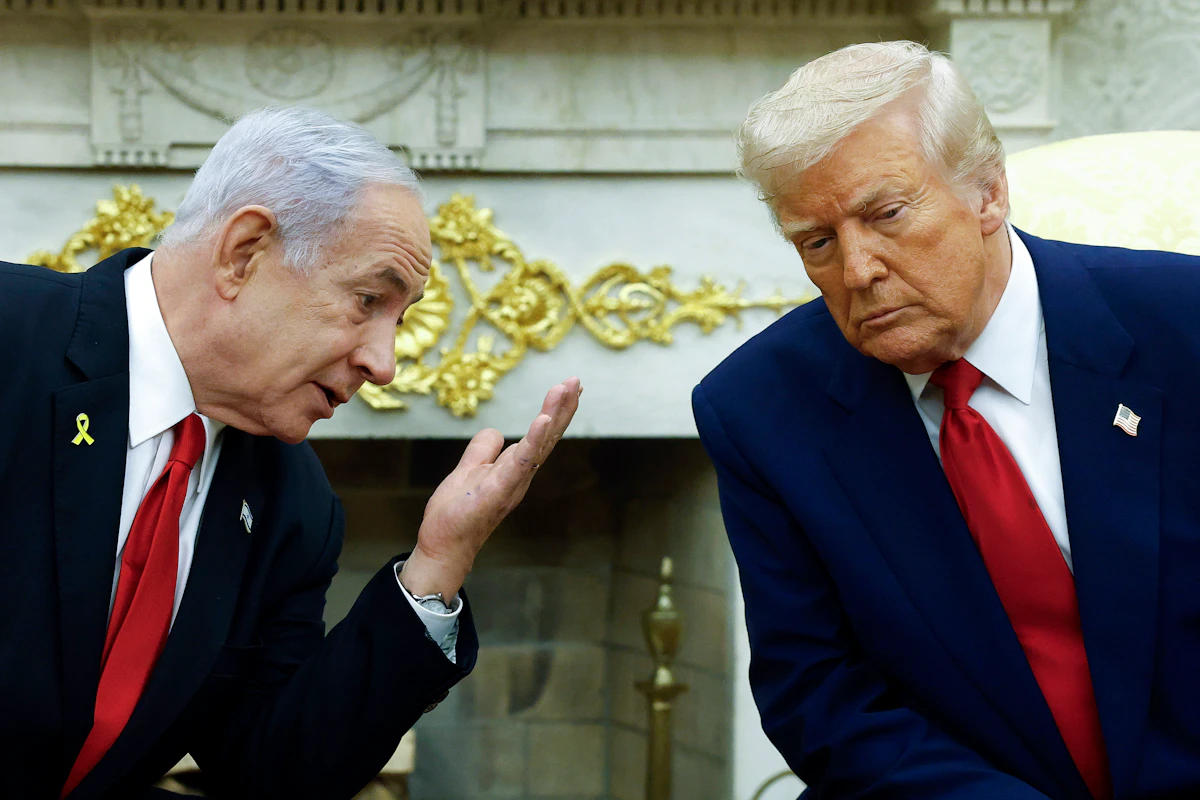
Donald Trump and Benjamin Netanyahu share a lot of traits. They are both solipsistic, mendacious, narcissistic, and paranoid megalomaniacs who perceive themselves as victims of a cabal of elites. Now they share something else: They have lost a war together. Driven by vanity and hubris, the U.S. president and Israeli prime minister miscalculated Iran’s mettle, and now their mutually inflicted failure is causing them considerable political harm at home.
What started as a Smith Wesson partnership has degenerated into a Thelma Louise ending.In the U.S., there has been no rally-around-the-president effect from this war. Every day, another poll shows Trump’s approval rating hitting a new low and support for the war below 40 percent. As The Wall Street Journal reported over the weekend, his public “bravado” is a mere mask for his private fears about the damage the war is doing to him as he stares down the November midterm elections that appear certain to cost him unified control of Washington. Meanwhile, in Israel, Netanyahu is getting clobbered on all sides. The New York Times reported Friday that “the prime minister’s critics, and even some of his allies on the right, have seized on ... his inability to resist Mr. Trump’s pressure” to end the war. Netanyahu’s coalition, like Trump’s, is also lagging in polls in an election year. “A core element of Mr. Netanyahu’s appeal to voters—the argument that his close bond and strategic mind meld with Mr. Trump make him uniquely equipped to ensure Israel’s security—now appears far less convincing,” the Times noted. As reporting from the aforementioned outlets has shown, Netanyahu prodded and, some might say, dragged Trump into a war America had no interest in. In that sense, Netanyahu is responsible for Trump’s political damage. But with all due respect to Netanyahu’s swindling qualities, you can’t really “drag” the president of the United States into a war he does not want to participate in. A willing, even enthusiastic Trump joined Netanyahu in what he thought was a cool video game in which the other side would surrender quickly. Because the war failed to achieve anything close to Netanyahu’s fantasy scenarios of Iranian capitulation and regime change, Trump in fact inflicted major political damage on Netanyahu. Trump entered this war without clear and attainable objectives, without public support, without coherently defined deliverables, and with no overriding American interests at stake. A war that he justified as “preventing Iran from becoming nuclear” is now mainly an effort to reopen a shipping corridor that was wide open before he launched the war. History will judge him harshly on this adventure, but Trump may not be defined solely by the failed Iran war. However ill-conceived and impulsive it was, it’s one among many of his destructive, incomprehensible, self-inflicted political debacles. Netanyahu is an entirely different opera. For him, the Iran war is an epic calamity. This was his once-in-a-lifetime opportunity, and it has amounted to very little. Iran was the defining issue of his career. It was his political raison d’etre, the epitome and culmination of how he interprets history and his self-ordained image as the protector of Israel. For him, every year is 1938 all over again, Tehran is Berlin, and he is Winston Churchill. In this respect, this war was his Normandy D-Day, and the invasion failed. Here was a near-perfect strategic alignment and confluence of elements: a jittery, impressionable American president willing to collude; overwhelming American-Israeli military and technological superiority; a weakened Iran under severe economic strain and diminished geopolitical stature. But, and not for the first time in his strategic assessments, Netanyahu got it wrong. His assumptions about how the war would transpire were fundamentally flawed. His rosy scenarios of regime collapse have not come to fruition, and he wrongly dismissed the possibility of Iran upending the military asymmetry and shutting the Strait of Hormuz. And it is unlikely Netanyahu will ever get another opportunity like this. But who is most to blame? A peculiar phenomenon has emerged among both Trump’s and Netanyahu’s supporters: It’s the other guy’s fault.MAGA voters need to reconcile how Trump, who promised to never engage in “forever wars,” decided to attack Iran—so they conclude he was duped by an external actor. Meanwhile, Netanyahu’s hardcore supporters accuse Trump of not going the distance and eventually dumping Israel. In the one of the few countries in the world where Trump is popular, he is now a disappointment.In the last 15 months, Netanyahu has developed total dependency and reliance on Trump, lubricated by deep fealty. Some of it was politically motivated: from his ardent neoconservative tendencies, his affinity to anti-Clinton Republicans (Newt Gingrich and the Evangelicals), his anti-Obama association with the Tea Party movement, his speech to Congress in 2015 against the Iran nuclear deal, and his intrinsic and cultural disdain for anything “liberal.” Some of it comes from the grievances and sense of victimhood he shared with Trump: persecuted by a left-wing cabal, hated by the media, resented by the judiciary, and detested by elites. But a lot of it was genuinely about Iran. Netanyahu accurately identified Trump’s megalomania as a vulnerability he could exploit. Trump is amenable to extreme sycophancy and all you need to do is massage his ego, fan his anger at his predecessors, and promise him a huge win.How many times has Netanyahu tried to dupe Trump? For most of 2017 and into 2018, Netanyahu prodded Trump to withdraw from the Joint Comprehensive Plan of Action, the Iran nuclear deal that Barack Obama struck in 2015. He believed that if Trump ripped it up and imposed crippling sanctions, Iran would come crawling and beg for a better deal. In May 2018, Trump unilaterally withdrew. Over the next seven years, Iran increased its uranium enrichment centrifuges from 200 to 19,000 and accumulated approximately 1,000 pounds of uranium enriched to 60 percent purity. In March 2025, Israel violated the ceasefire in Gaza and Netanyahu reassured Trump that it was a temporary resumption of war to destroy Hamas. In June 2025, Netanyahu convinced Trump to attack Iran’s military nuclear facilities. “We obliterated their nuclear capabilities,” Trump ceremoniously announced, with Netanyahu declaring that we “set them back decades.” The stage was set for the biggest manipulation of them all: the all-out war against Iran that began in February.As a general rule of political and international relations writing, wars cannot and should not be determined to have been a “success” or a “failure” while they’re ongoing or in their very immediate aftermath. But there are immediate takeaways from the Iran war when comparing the stated goals and the actual results. The Middle East is less safe, and the global economy is less stable. Iran has discovered something—its power to control the Strait of Hormuz—that’s much more effective than nuclear capability or a network of terror proxies. It has also exhausted the U.S. military’s resources and bruised its ego; shattered the business model of the Arab Gulf States; and merely by surviving the onslaught of bombs, caused Israel to become even more of a pariah state.Trump and Netanyahu, in their infinite delusions of grandeur, expected this to be a quick win that would buoy their respective political fortunes. They probably envisioned being showered with praise by their countrymen and the media, and relished the thought of rubbing the victory in their opponents’ faces. The exact opposite has happened instead, and they have no one to blame but themselves—and each other.
Reliability Insights
P
Technique: Name Calling
Our AI detected use of specific narrative techniques in this piece.The New Republic
Coverage and analysis from United States of America. All insights are generated by our AI narrative analysis engine.