
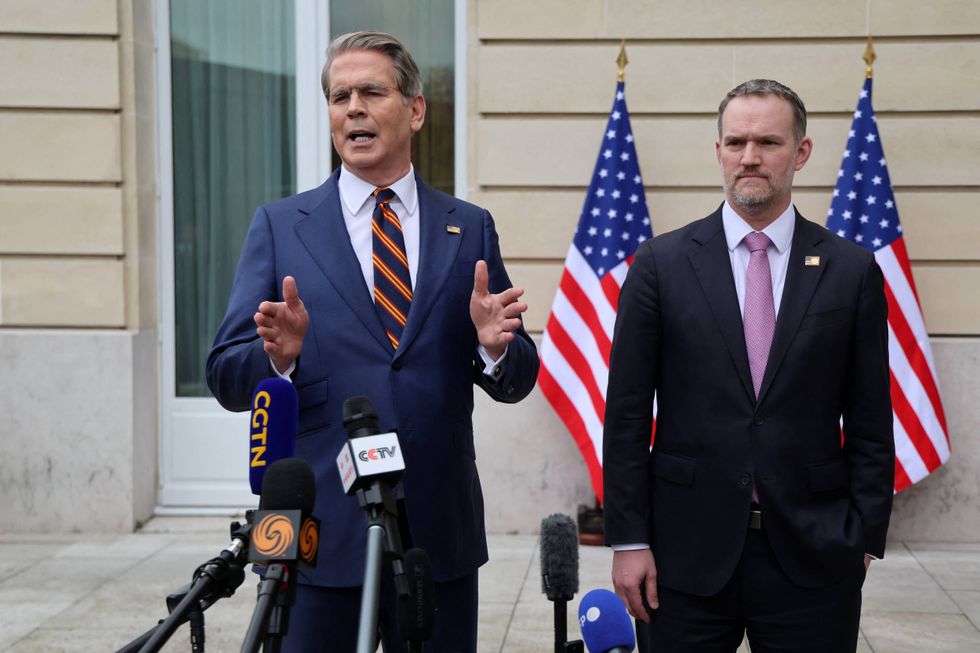
Treasury Adviser Admits Agency Didn’t Prepare for Economic Fallout of Trump’s Iran War
April 10, 2026
Common Dreams
The top Democrat on the Senate Finance Committee revealed Thursday that an adviser to the US Treasury Department admitted he was unaware of the agency doing any work to prepare for the economic fallout of President Donald Trump's war on Iran, which has plunged the global economy into chaos and cost American drivers billions at the pump.Sriprakash Kothari, a top adviser to Treasury Secretary Scott Bessent and Trump's nominee to serve as Assistant Secretary of the Treasury for Economic Policy, told US Sen.
Ron Wyden's (D-Ore.) staff behind closed doors that not only did he not perform any work related to energy markets leading up to the war, but that he wasn’t aware of anyone at Treasury who did, Wyden wrote in a letter to Bessent.Wyden quotes Kothari as saying he did no work to prepare for economic impacts of the war leading up to the conflict, just subsequent to its start on February 28.When later asked to clarify this response, he reiterated that he had not performed any analysis or work related to energy markets, or any other economic facet, in the lead-up to military action in Iran, Wyden added. He further told staff that the work he performed subsequently occurred after learning about the February 2026 strikes in the news. Mr. Kothari was then asked whether he was aware of anyone at Treasury performing analysis or work related to energy markets in the lead-up to potential military action in Iran, he responded that he was not aware of anyone performing any such work.Wyden wrote that given the rapidly growing affordability crisis in the US—a crisis intensified by Trump's war on Iran—it is unacceptable that Treasury may not have performed the most basic planning before it was launched.Every problem resulting from the conflict which we are seeing now, wrote Wyden, was not only foreseeable but was predicted by the intelligence agencies, which reported as recently as last March that Iran was 'capable of inflicting severe damage to an attacker' and of 'disrupting shipping, particularly energy supplies, through the Strait of Hormuz.'In just six weeks, Trump's Iran war has cost American taxpayers over 30 billion and counting, and US drivers collectively spent over 8 billion more on gas during the first month of the illegal assault, which sent oil prices surging.CNN reported last month that the Trump administration significantly underestimated Iran’s willingness to close the Strait of Hormuz in response to US military strikes while planning the ongoing operation.While key officials from the Departments of Energy and Treasury were present for some of the official planning meetings about the operation before it started, CNN reported, citing unnamed sources familiar with the discussions, the agency analysis and forecasts that would be integral elements of the decision-making process in past administrations were secondary considerations.
Common Dreams
Coverage and analysis from United States of America. All insights are generated by our AI narrative analysis engine.