
SpaceX’s first employee just raised $500 million for the company that moves satellites once rockets put them in the wrong orbit
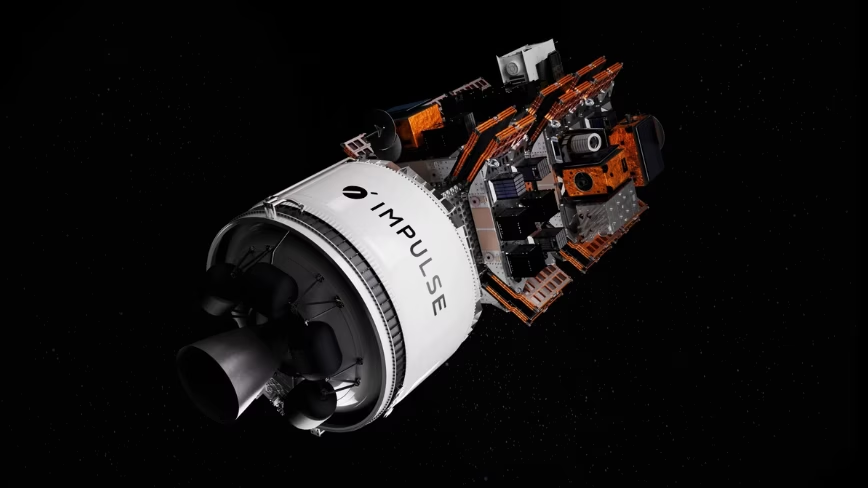
Impulse Space, the orbital transfer vehicle startup founded by Tom Mueller, has raised 500 million in a Series D round that values the company at 4.26 billion. The round was co-led by 137 Ventures and Banner VC, with participation from existing investors including Peter Thiel’s Founders Fund and Linse Capital. The company has now raised [] This story continues at The Next Web
Narrative Intelligence Brief
This article was published by The Next Web, a source frequently categorized with a lean left bias based in Netherlands. Our narrative intelligence engine continuously monitors coverage from this outlet to track framing, bias, and rhetorical patterns. Our initial algorithmic scan of this specific piece did not flag high-confidence rhetorical techniques, suggesting a generally straightforward reporting style or neutral framing. By understanding the editorial perspective of The Next Web, readers can better contextualize the information presented and compare it across our broader media matrix to find the real narrative.
Explore related topics: Stay informed with Real Narrative News as we track unfolding stories. Dive deeper into our coverage of pivotal topics including marco rubio, white house, earnings transcript, donald trump, nba finals, real madrid, conference transcript, toy story, trump signs, and حزب الله. Our intelligence streams continuously monitor these keywords to bring you unbiased analysis and real-time updates on topics like "SpaceX’s first employee just raised $500 million for the company that moves satellites once rockets put them in the wrong orbit".
More from The Next Web
June 2, 2026
Palo Alto Networks shareholders have rejected executive pay seven times, and the CEO still earns nearly $100 million
June 2, 2026
The world’s mathematicians just issued a formal declaration telling AI companies to stop using their work without permission
June 2, 2026
SpaceX’s first employee just raised $500 million for the company that moves satellites once rockets put them in the wrong orbit
June 2, 2026
Amazon’s Ring is sued over its Familiar Faces facial-recognition feature
June 2, 2026
Taiwan shows off robot patrol dogs that could guard its South China Sea islands
Analysis Methodology
This narrative analysis was generated using the CoDataLab Global Intelligence Engine. Our proprietary AI scans thousands of cross-border sources to identify sentiment patterns, framing techniques, and potential media bias. While AI provides the data-driven foundation, our objective is to empower readers with additional context beyond the standard headline.The content displayed above is a structured summary designed for rapid information processing. For the full original report, please visit the source outlet.More Coverage
Discussion