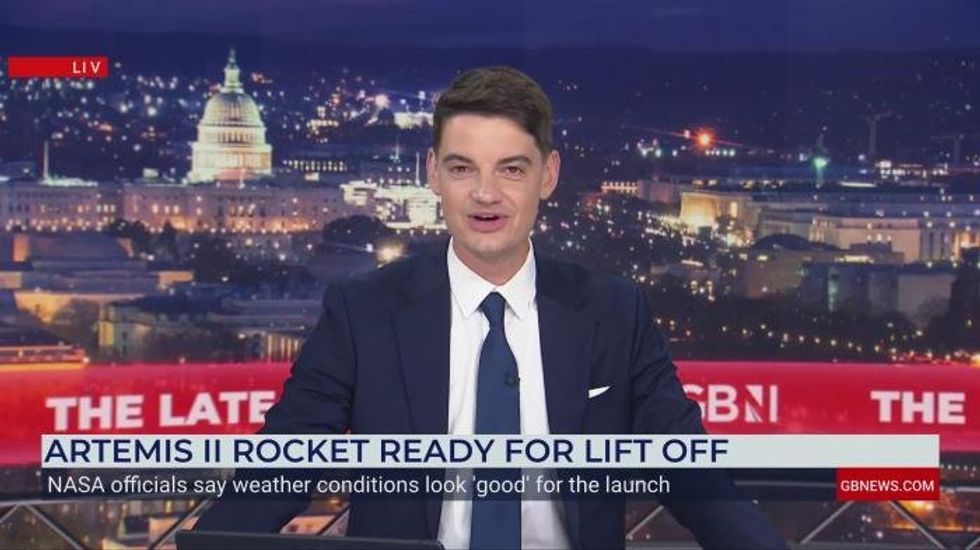
Massive solar flare could leave Nasa Moon mission in peril as astronauts thrust into firing line
April 1, 2026
GB News
A massive solar flare could leave Nasa's Moon mission in peril after a solar incident triggered radio blackouts this week.The solar eruption came from a group of sunspots that are now moving further into Earth's view.Solar flares release intense electromagnetic radiation and high-energy radioactive particles which can damage electronic equipment and satellites, disrupt radio communications, and endanger astronauts.Nasa is hoping to launch four brave voyagers towards the Moon at 6.24pm or 11.24pm UK time on Wednesday to kick off a 10-day mission, becoming the first crewed lunar journey since 1972.
TRENDING Stories Videos Your Say But at a briefing on Tuesday afternoon, Nasa warned there was a 55 per cent chance of a low-level flare in the next 48 hours, and a 10 per cent chance of an even more dangerous X-class flare.An X-class solar flare can cause large scale radio blackouts and long-lasting radiation storms that endanger satellites.Mark Burger is the launch weather officer at the 45th Weather Squadron of Cape Canavaeral's Space Force Station.He said predicting solar activity makes Earth-bound weather forecasting look easy, adding the Sun is an entity that almost has a mind of its own.Mr Burger added: The Sun has become a little bit more active here over the last day and we had a solar flare erupt, but there was minimal impact for us, as most of the energy was not Earthward facing.But he said Nasa was monitoring for additional solar flares, which may interfere with the Artemis II mission - which will feature the first woman to exit low Earth orbit, Christina Koch, and the first black man to exit low Earth orbit, Victor Glover.Mr Burger added: Right now, where that sunspot group is, it’s still kind of out on the limb. If we were to get another flare from that group, as it rotates towards the center of the solar disk, that would be something that would predispose us to getting a little bit more of that energy.But as far as whether or not that’s actually enough to trigger a constraint (reason to not launch) that’s still a pretty high bar.LATEST ON ARTEMIS II:Countdown underway for first manned Moon mission in more than 50 years as crew 'ready to go'Nasa astronaut says cause of medical emergency unknown as Artemis II Moon mission nearsBritish engineers to help Nasa track Artemis II as astronauts prepare to blast off on Moon missionDamaging particles from solar storms can arrive quickly, with the initial surge in X-rays hitting Earth eight minutes after an eruption.More damaging protons from the Sun begin to arrive some minutes or hours after.Solar storms can remain harmful for astronauts, even after a successful launch.The Artemis II crew, which also features Reid Wiseman and Canadian astronaut Jeremy Hansen, have been warned to evacuate the central storage bays to lower radiation exposure in the case of solar eruption.Emily Nelson, chief flight director, said: One of our test objectives is actually to set up the radiation shelter, so we’ll be doing that anyway, even without a radiation event.Basically, we’ve got a section of the spacecraft that we would set up for the crew to stay in that area until we gave them the all clear that the radiation event had passed.Currently, the weather is looking promising for a launch on Wednesday, with only a 20 per cent chance of inclement weather which would prevent liftoff.Mr Burger said that if the launch is delayed, the odds of bad weather increase.He added: But it looks pretty good for Wednesday. Even if we have showers around, we have a two hour launch window.We should be able to shoot the gap between those showers, and none of these look particularly vigorous. Our Standards: The GB News Editorial Charter
GB News
Coverage and analysis from United States of America. All insights are generated by our AI narrative analysis engine.