
0
Keir Starmer faces fresh crisis as report lays bare how his new finance adviser torpedoed Britain's economy
May 20, 2026
Posted 2 hours ago by
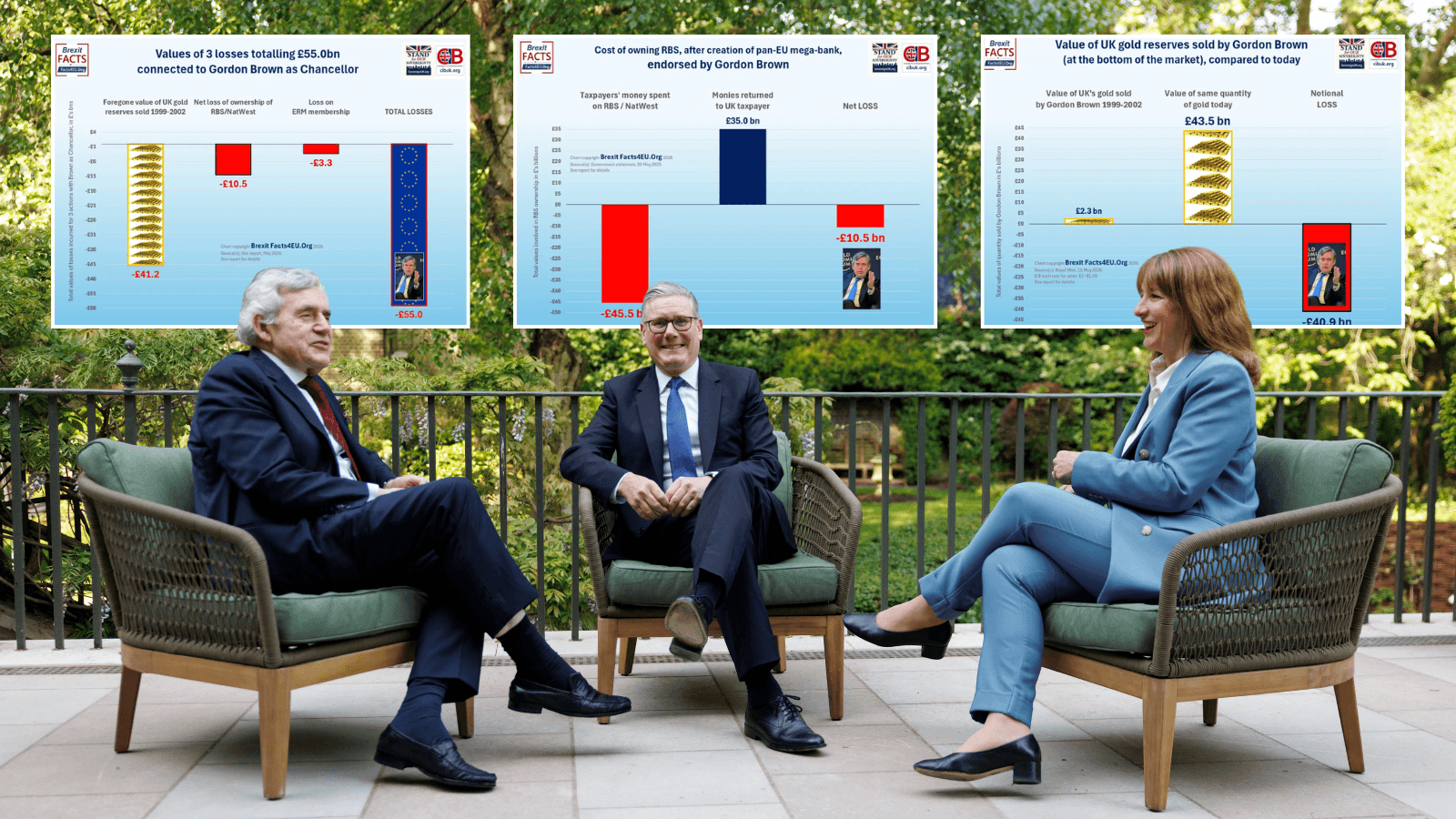
Sir Keir Starmer is set for a fresh crisis as a new report reveals how much damage his new special envoy on global finance has done to Britain’s economy.The shocking report has been revealed to GB News following research produced by FACTS4EU in collaboration with Stand for our Sovereignty and The Campaign for an Independent Britain. Sir Keir announced Gordon Brown as his Special Reviewer on Global Finance and Cooperation, earlier this month, and the sense among MPs was one of bafflement.Former Conservative minister, Lord Redwood, told GB News: “Gordon will be a very useful investment adviser as long as Keir remembers to do the opposite.
Analysis Methodology
This narrative analysis was generated using the CoDataLab Global Intelligence Engine. Our proprietary AI scans thousands of cross-border sources to identify sentiment patterns, framing techniques, and potential media bias. While AI provides the data-driven foundation, our objective is to empower readers with additional context beyond the standard headline.The content displayed above is a structured summary designed for rapid information processing. For the full original report, please visit the source outlet.Infallibly wrong.” TRENDING Stories Videos Your Say An anonymous Labour MP told the BBC: “It's a joke. There is no question to which bringing these two back is the answer.”The new report details how, in May 1999, the price of gold was 282.40 per oz, the lowest it had been in 20 years. At the request of Mr Brown, the Treasury announced its intentions to sell part of the UK’s gold reserves at the bottom of the market.FACTS4EU worked out on May 15, this year, the same amount of gold would have been sold for £43.5billion.The report also finds Mr Brown played a substantial role in a crisis that cost the taxpayer £45.5billion. After becoming a banker, the former Prime Minister had been a backer of the massive expansion of the Royal Bank of Scotland.RBS had made a huge EU acquisition of ABN Amro, which greatly overstretched its management and balance sheet, leading to its collapse.Mr Brown had supported the takeover, which saw a mega-bank with its headquarters in Scotland.Upon its collapse, the taxpayer, via the UK Government and HM Treasury, became the majority shareholder of RBS in November 2008, taking a 58 per cent stake. LATEST DEVELOPMENTS:Moment Rachel Reeves is interrupted by heckler shouting Labour is ‘running country into the ground’HMRC warning as savers forced to overpay thousands in tax after system errorsEnergy chiefs urge Labour to 'prioritise North Sea oil' following emergency talksBy December 2009, the country’s total ownership of RBS rose to 84.4 per cent, costing the taxpayer £45.5billion.Lord Redwood continued: “Gordon Brown cost this country dear. Selling gold too cheaply to buy Euros and dollars to help the young European currency lost us billions of future gains.“Backing RBS in a disastrous EU takeover which helped crash the bank saw him pay too much for shares to prop it up.“Predictable large losses followed when later governments sold the shares.”Mr Brown’s third most expensive period on the UK taxpayer was an advocate for the EU’s Exchange Rate Mechanism.Created in 1979, the UK would join in 1990 but obtained an opt-out from joining EMU in return for agreeing to the next major Treaty amendment, the Maastricht Treaty, in 1991.While not Chancellor at the time the UK joined, Mr Brown acted as a cheerleader for joining, setting the scene for “Black Wednesday”.This is confirmed on the Government website, which reads: “After a flood of selling the pound on foreign stock exchanges, Britain was forced to leave the ERM in 1992, less than two years after joining. “This day became known as ‘Black Wednesday', costing the UK Treasury £3.3billion.”Lord Redwood concluded: “Far from saving the world, Gordon Brown backed policies which allowed and even encouraged banks to over-reach and then helped crash them with measures to curb the inflation caused.“He was a strong proponent of the UK joining the ruinous European Exchange Rate mechanism, which brought us inflation, big losses and recession.“Whilst he was right to delay the UK's entry into the Euro, he did not rule out membership.“His backing for buying Euros, expanding RBS more in Europe, and especially for the European Exchange Rate Mechanism disaster, imposed many EU losses on the UK.”Our Standards: The GB News Editorial Charter
Analysis Methodology
This narrative analysis was generated using the CoDataLab Global Intelligence Engine. Our proprietary AI scans thousands of cross-border sources to identify sentiment patterns, framing techniques, and potential media bias. While AI provides the data-driven foundation, our objective is to empower readers with additional context beyond the standard headline.The content displayed above is a structured summary designed for rapid information processing. For the full original report, please visit the source outlet.Narrative Intelligence Report
Our AI engine has processed this content to identify structural patterns, rhetorical techniques, and underlying sentiment.
Source Credibility
This article aligns with typical narrative patterns from its source. Our engine suggests evaluating this piece with awareness of its detected rhetorical framing.
GB News
Coverage and analysis from United States of America. All insights are generated by our AI narrative analysis engine.