
0
Dreaming in black and white: The rise of Emirati artist Abdulla Al Lutfi
May 7, 2026
Posted 3 hours ago by
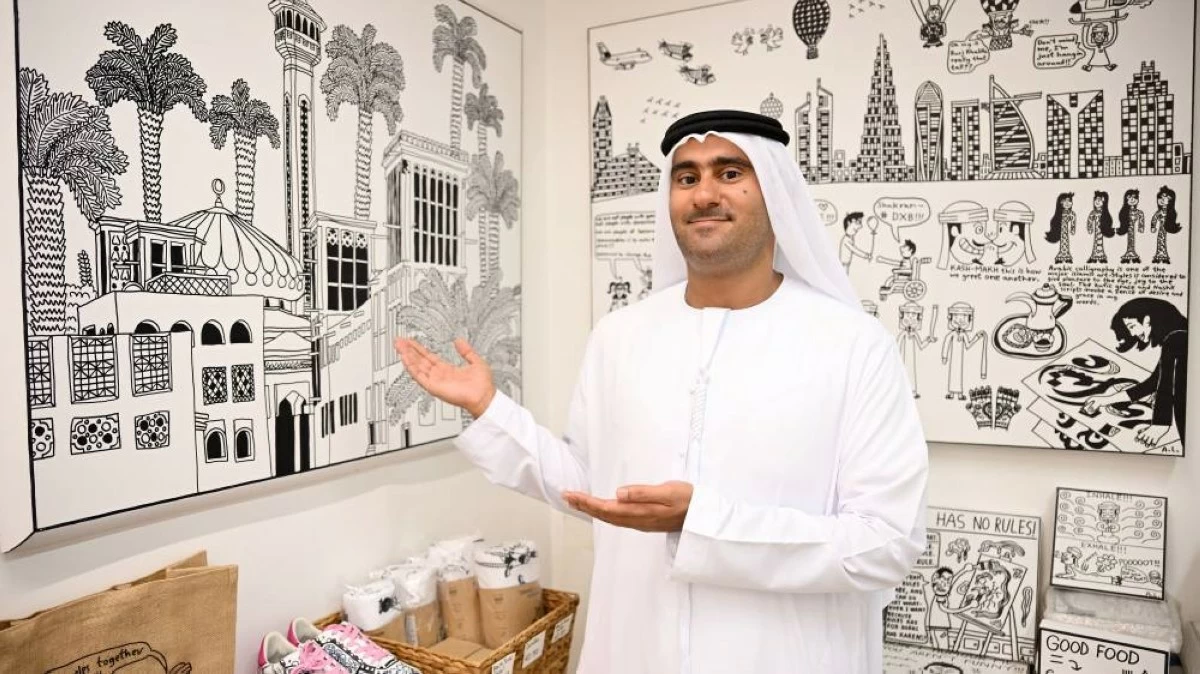
Burj Khalifa. Zayed National Museum. Emirates and Etihad Airways aeroplanes. Etihad Rail.Most artists limit their work to canvases, hung up in silent rooms. But not Emirati artist Abdulla Al Lutfi – his dream is to see his work up in lights, on the façades of UAE’s iconic monuments, and zipping across the sky and land, as moving works of art.This 33-year-old savant – as he often introduces himself – is no ordinary artist, after all.
Abdulla only draws in black and white, in his signature bold and playful style. It’s a technique he is most comfortable with, as an artist on the autism spectrum. Known for his precision and attention to detail, Abdulla’s art often captures landmarks around Dubai. Photo credit: Najeeb Mohammed, Emirates 24|7 His work isn’t limited to landscapes. He loves drawing people, and often includes witty jokes and one-liners that invite viewers to look closer. Photo credit: Najeeb Mohammed, Emirates 24|7He told Emirates 24|7: “I just like drawing cities and buildings, and people. I used to do colours, but I find it a bit stressful, so I prefer doing just black and white art.”The only exception he makes is when he draws the UAE flag. Then, all the colours – black, white, red, and green – are honoured. Abdulla only draws in black and white, in his signature bold and playful style. Photo credit: Najeeb Mohammed, Emirates 24|7Abdulla first became interested in art when reading manga comics in high school. The line drawings in Japanese graphic novels were precise and told visually striking stories. When he then discovered the Diary of a Wimpy Kid book series, which told simple, playful stories in black and white, he was inspired.Abdulla applied what he observed to his own style, and successfully created unique monochromatic renderings that tell everyday stories of the UAE. At his art studio, Next Chapter, in Al Fahidi historical neighbourhood, Dubai, you might spot people in traditional attire, palm trees, and famous landmarks, but you might also find miniature storylines playing out, and plenty of witty one-liners and jokes that invite viewers to look closer. Abdulla’s book, Autism Completes Me!!! A Book That Explores the Mind of A.L., promotes autism awareness and acceptance. Photo credit: Najeeb Mohammed, Emirates 24|7A world in monochromeHe draws daily inspiration from Dubai: “I look around when I go out in the city, and get ideas and then do my outlines in black and white.”His precise, multilayered artworks have propelled him to local and international fame. Abdulla is frequently invited around the UAE to teach students his technique, showcase and auction his work, make custom pieces for corporations, and collaborate with brands. He said: “I look around when I go out in the city, and get ideas and then do my outlines in black and white.” Photo credit: Najeeb Mohammed, Emirates 24|7He has also illustrated a children’s colouring book, commissioned by the Embassy of the UAE in Washington D.C., USA. In the coming months, he is heading to Hungary, where his work will be auctioned, and to Switzerland, where he will be drawing for a live audience.A difficult beginningLife is good for Abdulla, who calls himself the “black and white ambassador of the UAE”. But behind his success lies a far more difficult beginning – one that took a lot of courage and determination to overcome.Growing up, he faced difficult social situations, and spent years struggling to understand how he was different. It wasn’t until the age of 18 that he found direction. His parents brought him to Mawaheb Art Studio in Dubai, a creative learning space for people of determination, and that's where he met his mentor, Gulshan Kavarana, an Indian educator who teaches life skills through art. Abdulla calls himself the “black and white ambassador of the UAE”. Photo credit: Najeeb Mohammed, Emirates 24|7She told Emirates 24|7: “It was very difficult with [Abdulla] initially. He didn’t know he had autism when he came to me. He was stimming and didn’t know why he was doing it. He kept trying to stop, but I could see how stressful it was for him.”Stimming is a self-stimulatory behaviour common in individuals with autism – it involves repetitive physical movements, like flapping hands or rocking, or sounds like humming or repeating phrases – to regulate emotions and sensory input.Kavarana explained that women tend to mask autistic traits, like stimming, because of societal pressures, while men usually openly stim in public. In Abdulla's case, he had learned to mask as well, because of social norms.Kavarana said: “I told him: ‘You don’t need to control it in my art studio – just be yourself’. When he realised he could be free to do as he wanted, his whole personality changed.”Finding confidence and purpose Abdulla with his art mentor Gulshan Kavarana, who has helped and guided him since he was 18 years old. (Supplied picture)With the help of his mentor, Abdulla learned more than art – he discovered how to navigate the world. Kavarana taught him important life skills, social cues and protocols. The list of topics they covered was exhaustive. She said he learned “to hold the door open for others, greet people, wait till everyone finishes eating before getting up from the table that ‘no’ means no”.Abdulla was an A student – always asking questions and embracing new concepts. As his confidence grew, so did his artistic voice.Professionally, he found his groove. Naturally witty, he brought his humour into his art as a way to creatively express himself. Once he realised colours weren’t working for him, he switched to just black and white. He developed a custom style, created his very own artist signature ‘A.L.’, and began making a living out of his passion. With his parents’ help, he established an art studio in Dubai, and booked commissions from all around the UAE.Even in his personal life, Abdulla didn’t stop pushing himself. Since he is adventurous and loves off-roading, he decided to learn how to drive. After just two attempts, he passed his driving test and got his driving licence at age 19.More recently, he prioritised his health and lost 53kg, going down from 148kg to 95kg – he completely changed his eating habits, went off sodas, which were once a favourite, and walked everywhere, often clocking 20,000 steps a day.Staying true to himselfThat kind of determination and focus is just part of who he is, according to Kavarana: “He’s not just a man with autism – he’s so much more. He’s very caring, and always thinks of others.”Sometimes, parents with children who are on the autism spectrum, approach Abdulla's art studio, looking for a way to engage their kids. He never hesitates to help.Kavarana said: “He doesn’t bring up how much the class will cost, or say he’s busy – he always sits with the kids, works with them, and takes his time with them, teaching them his art process.”Abdulla knows what he wants – it’s one of his best qualities and biggest quirks, according to Kavarana. She said: “You can’t force him to do something he doesn’t want to do. He was invited to visit a corporation, to do an art show, and they were offering him Dh20,000 per day for four days. But he refused, because he doesn’t work on Fridays or Saturdays – that’s his rule. No one can change his mind about his days off.”A future full of possibilityFor the artist, his quirks are just part of his life – and he is having a great time.In January this year, he began a new chapter by marrying Mariam, a Filipina-Egyptian expat who is also on the autism spectrum. Kavarana first introduced them over a decade ago, when they were both art students at Mawaheb. Although they lost touch in the intervening years, the pair reconnected in 2025, thanks to his mentor. Abdulla said: “Mariam loves anime and video games, like me. We’re having the time of our lives.” He is very happy – he saved her number on his phone under the name ‘My Lovely Wife’.So, what’s next for the savant? Time will tell, but so far, the future looks promising.For now, Abdulla has a message for parents with children on the autism spectrum: “I want to say to parents, just love them, care for them and treat them with respect. Give them hope. If they have a dream, let them follow it. Maybe they will become artists, just like me!”
Emirates 24/7
Coverage and analysis from United Arab Emirates. All insights are generated by our AI narrative analysis engine.